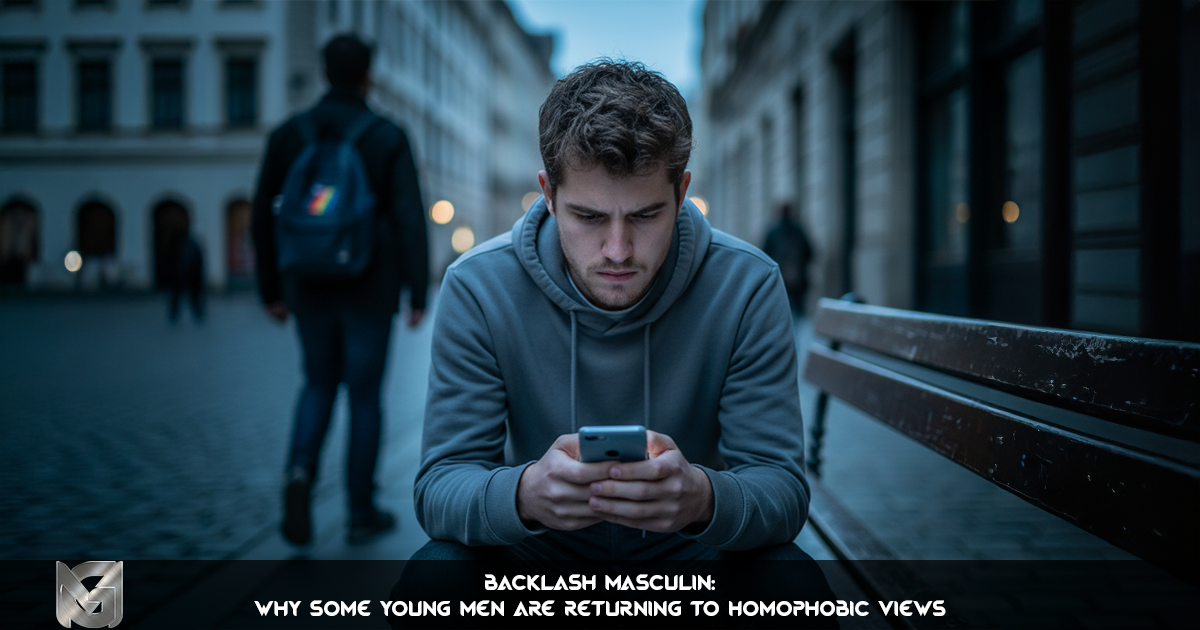
Backlash masculin. The term is showing up more and more in media coverage and online debates, like a warning light. While acceptance of LGBTQ+ people has increased in many countries, recent surveys suggest that a share of young men (especially under 24) are once again expressing more conservative, sometimes openly hostile opinions on issues such as same-sex marriage or the social acceptance of homosexuality.
This does not mean that “an entire generation” is turning back. It points instead to a fracture: a widening gap between young women and young men, and a polarization fueled by political, religious, media, and digital narratives. For Gay Mag, the stakes are clear: understand what’s happening, name homophobia when it appears, and most importantly identify practical levers to respond. This is exactly why the concept of Backlash masculin matters right now.
What the data says: a signal, not a destiny
Several recent analyses share a common finding: among young adults, men are less supportive of LGBTQ+ rights than women of the same age. In the Backlash masculin conversation, this gender gap is one of the key warning signs.
A widening gender gap
Figures cited in a synthesis relayed by PinkNews, drawing on research and polling data (including results associated with the Pew Research Center), suggest that:
- Young men born in the 2000s may be less supportive than those born in the 1990s of certain advances, such as same-sex marriage.
- On the question of whether homosexuality “should be accepted by society,” the gap between young men and young women appears particularly striking.
The American Institute for Boys and Men (AIBM) also highlights, based on large survey datasets, that on items like “homosexuality should be accepted by society,” the male/female differential is very large among the youngest cohorts. This pattern is often cited as evidence of Backlash masculin.
Beware shortcuts: methodological caution
Before drawing definitive conclusions, rigor matters:
- Surveys evolve (methods, samples, margins of error).
- Attitudes vary by country, education level, religion, media exposure, and more.
- A “drop” of a few points isn’t necessarily a historic reversal; it can be a symptom of polarization.
So the journalistic value isn’t in declaring catastrophe. It’s in asking the right question: what is producing this hardening among some young men, and how does it connect to Backlash masculin?
Why this return to homophobic opinions can happen
There isn’t one single cause. Think of it as a cocktail of factors that, together, make certain young men more receptive to conservative or hostile narratives. Understanding Backlash masculin means looking at these drivers without panic, but without denial either.
1) “Culture war” as a media product
In many countries, LGBTQ+ topics have become political “markers”:
- Same-sex marriage, relationship and sex education, trans visibility, drag shows, etc.
- Each topic gets turned into controversy, often with anxiety-driven headlines.
The result: some young men don’t “meet” LGBTQ+ people in real life; they meet them through conflict narratives. Homophobia then feeds on caricatures, invented threats, and moral panic. This is one of the classic mechanisms behind Backlash masculin.
2) Social media: soft radicalization through repetition
Platforms don’t “create” homophobia, but they can amplify it:
- Polarizing content generates more engagement.
- Algorithms reward repetition and escalation.
- Micro-influencers can normalize slurs, stereotypes, and homophobic “jokes.”
What used to be shameful can become “cool,” “ironic,” or “edgy.” And irony often works as a shield: homophobia is tested as a meme, then normalized. In the Backlash masculin dynamic, this “banalization pipeline” is central.
3) Identity crisis, masculinity, and a sense of decline
Some young men are growing up in a context of:
- Economic pressure (housing, jobs, precarity).
- Contradictory expectations around masculinity.
- A feeling that “everything is changing too fast.”
On anxious ground like this, certain narratives offer a simple answer: “if you’re suffering, it’s because minorities have been given too much.” It’s false, but psychologically effective. Homophobia becomes a tool of identity reassurance: “I’m a real man because I reject that.” This is another driver frequently associated with Backlash masculin.
4) The return of religion as political language
Researchers and commentators (including AIBM’s analysis) point to the possible influence of messaging from conservative religious groups on “social issues.”
Important: this is not about blaming “religion” as a whole. It’s about observing that some politicized religious actors use LGBTQ+ topics as a mobilization lever, framing homosexuality as a moral threat. In some contexts, this contributes directly to Backlash masculin.
5) Disinformation: invented numbers, manufactured fears
Modern homophobia often comes wrapped in fake “facts”:
- Deliberate confusion between sexual orientation and criminality.
- Conspiracy theories about schools.
- Narratives about “propaganda” and “recruitment.”
These stories are powerful because they create an illusion of rationality: “I’m not homophobic, I’m concerned.” Except the concern is built on lies. Disinformation is one of the accelerants of Backlash masculin.
What it changes for LGBTQ+ people and for society
When a segment of young men hardens its views, the impact isn’t abstract.
Everyday homophobia: the return of slurs and fear
In schools, locker rooms, public transport, and public spaces, homophobia shows up as:
- Slurs (“f*g,” “queer” used as insult), humiliation.
- Online harassment.
- Physical violence.
Even when the law protects, the social climate can deteriorate. And that climate weighs on mental health: anxiety, isolation, self-censorship. This is the lived consequence of Backlash masculin.
A “back in the closet” effect: less visibility, less safety
When the environment becomes hostile, LGBTQ+ people adapt:
- Avoid holding hands.
- Change how they speak or present themselves.
- Hide their love life at work or school.
This isn’t a “personal choice.” It’s a survival strategy in the face of homophobia.
Political polarization: rights become negotiable
The danger is that LGBTQ+ rights start being treated as an electoral bargaining chip. When homophobia becomes a campaign tool, it gets normalized.
How to respond: 7 practical levers without moralizing
The goal isn’t to “win a debate.” It’s to reduce homophobia and strengthen safety, dignity, and social cohesion.
1) Return to real life: tell stories, not slogans
Young men rarely change their minds through scolding. But embodied stories work:
- Testimonials (athletes, soldiers, artists, workers, fathers).
- Stories of couples, families, life paths.
Homophobia declines when homosexuality stops being an abstraction.
2) Debunk “fake threats” with clear pedagogy
Create short, shareable formats:
- “True/False” on rumors.
- Explanations of what schools actually teach.
- Clarification of terms (sexual orientation, gender identity).
3) Address masculinity without attacking it
Instead of “men are the problem,” propose:
- Models of non-violent masculinity.
- Male ally figures.
- A framing of respect as strength.
4) Equip bystanders: the silent majority must act
Homophobia grows when witnesses stay silent. Train and encourage:
- Simple responses (“Stop. That’s not funny.”)
- Reporting mechanisms.
- Support for victims.
5) Relationship and sex education: better, not less
Effective programs don’t “sexualize” children. They teach consent, respect, prevention, and anti-bullying skills.
6) Hold platforms and media accountable
- Consistent moderation.
- De-indexing hateful content.
- Transparency about algorithms.
7) Don’t forget culture: series, sport, music, influence
Pop culture can reduce homophobia faster than political speeches. Diverse, realistic, non-caricatured representation changes norms.
And in Europe and France: why this matters here too
Even if the most cited figures are often American, the dynamic is transnational:
- Narratives circulate in French on TikTok, YouTube, and X.
- “Culture wars” get copied from one country to another.
- Homophobic slurs at school remain a reality across Europe.
For Gay Mag, the editorial opportunity is strong: produce an article that explains, equips, and refuses panic, while still naming homophobia clearly. That’s also how you treat Backlash masculin seriously, without sensationalism.
Conclusion: understanding backlash masculin to defuse it
Backlash masculin is not a generational inevitability. It’s a social phenomenon fueled by narratives, fears, algorithms, and political strategies. The good news is that what is constructed can be deconstructed.
The most effective response is neither contempt nor fear: it’s a combination of human stories, education, fact-based counter-narratives, and active solidarity. Because in the end, homophobia doesn’t only harm LGBTQ+ people. It damages society as a whole, and it gives Backlash masculin room to spread.
For comments or projects, please contact me.