Gay Friendly Masters of the Universe
The question comes back every time a new He-Man project is announced. And it’s not random. Since the 1980s, the Masters of the Universe franchise has carried a stubborn reputation: a “camp” universe, a hyper-masculine aesthetic that, over time, became fertile ground for queer readings, sometimes even a gay fantasy embraced by pop culture.
But there’s a real gap between fan readings, subtext, icons, and on-screen, explicit representation. As the next film approaches, what can we reasonably say today? Will it be genuinely inclusive, or simply “queer-friendly” by aesthetic inheritance? To answer that, it helps to place He-Man in a broader lineage of fictional characters who shaped gay pop culture and the way queer audiences read cinema.
Before we decide: what does “gay-friendly” even mean in cinema?
People often mix up three different levels, even though they don’t tell the same story. In this article, Gay Friendly Masters of the Universe is used as a practical label, but the reality is more nuanced.
Gay-friendly through aesthetics (subtext)
A film can feel welcoming to LGBTQ+ audiences because it leaves room for interpretation. Think visual codes, ambiguity, symbolism, camp tone, stylized sensuality. That’s one reason Gay Friendly Masters of the Universe discussions often start with visuals.
Gay-friendly through representation (text)
A film becomes truly inclusive when it features clearly identified LGBTQ+ characters, written with dignity, without caricature, and with real narrative weight, not just a wink. If the new movie wants to earn the Gay Friendly Masters of the Universe label, this level matters.
Gay-friendly through posture (marketing and messaging)
A studio can communicate “inclusion” without translating it on screen. That’s where audiences get wary: rainbow-washing is real, and it can feel like exploitation. In other words, Gay Friendly Masters of the Universe cannot be just a marketing mood.
Why He-Man became a queer icon (without necessarily meaning to)
A hyper-stylized male body aesthetic
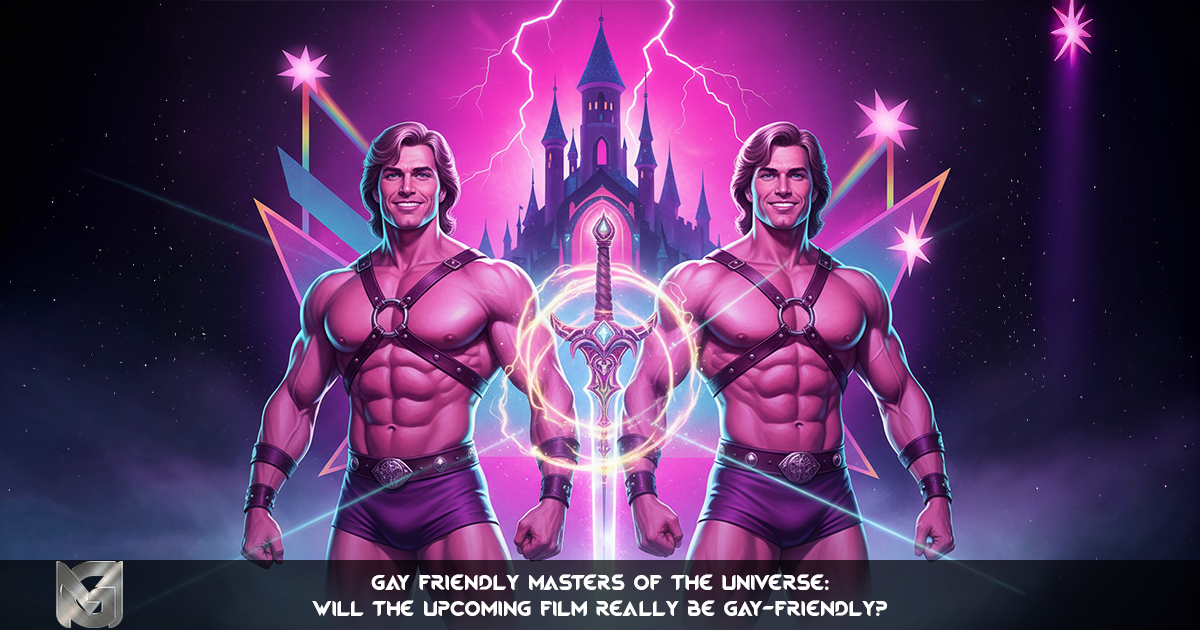
From the original animated series (He-Man and the Masters of the Universe, 1983), the tone is set: sculpted muscles, harnesses, boots, heroic poses, and intense male camaraderie. Back then, the goal was straightforward: sell action figures. But the cultural impact went well beyond marketing.
That idealized, displayed, stylized male body has been read by many LGBTQ+ viewers as a form of homoerotic fantasy. Cultural commentary has often pointed out that the franchise has long been surrounded by queer subtext, sometimes unintentional, sometimes amplified by reception. This is the aesthetic foundation behind Gay Friendly Masters of the Universe as a recurring pop-culture question.
Prince Adam / He-Man: a possible closet metaphor
At the heart of the myth is transformation: Adam “becomes” He-Man. Secret identity, fear of being found out, a double life. For many queer fans, it’s hard not to see an echo of the closet experience.
This isn’t proof of authorial intent, it’s a reading. But that’s exactly how icons are born: when a work, even unintentionally, offers symbolic handles to an audience that recognizes itself in its codes. That’s also why Gay Friendly Masters of the Universe remains a live topic.
He-Man in a wider gay pop-culture lineage: fictional characters that shaped queer readings
He-Man’s gay-icon status makes even more sense when you put him next to other fictional characters that have marked gay cinema history, sometimes through explicit representation, sometimes through coding, camp, or pure fandom adoption. In that lineage, Gay Friendly Masters of the Universe becomes a shorthand for a broader cultural phenomenon.
The coded icon: characters read as queer before they could be openly queer
Long before mainstream cinema embraced explicit LGBTQ+ characters, queer audiences learned to read between the lines.
Sebastian Venable (Suddenly, Last Summer, 1959): an off-screen presence, but central to a story long discussed for its coded queerness.
Brick Pollitt (Cat on a Hot Tin Roof, 1958): repression, masculinity, and the unsaid, a classic case of subtext.
Tom Ripley (The Talented Mr. Ripley, 1999): desire, obsession, and identity performance.
The camp villain / theatrical figure: when excess becomes queer pleasure
Camp is a major gateway for queer attachment. These characters aren’t necessarily “gay” in the text, but they became gay-culture staples.
Frank-N-Furter (The Rocky Horror Picture Show, 1975): a foundational figure for queer midnight-movie culture.
The Joker (multiple films): theatricality, style, and a fandom-driven queering of the character.
Ursula (The Little Mermaid, 1989): a drag-coded icon adopted by generations of queer fans.
The hypermasculine fantasy: bodies, power, and the gay gaze
This is where He-Man sits most comfortably: the heroic male body as spectacle. It’s a key reason the Gay Friendly Masters of the Universe conversation keeps resurfacing.
Achilles (Troy, 2004): a mainstream epic that still sparked queer readings and debates.
Spartacus (Spartacus, 1960; and later TV adaptations): masculinity, brotherhood, and the politics of desire.
Superman (various films): the “perfect” male body and the tension between secrecy and identity.
The explicit gay character: when representation becomes text, not just subtext
Modern cinema has offered characters that are openly gay and culturally significant.
Ennis Del Mar & Jack Twist (Brokeback Mountain, 2005): a turning point in mainstream visibility.
Chiron (Moonlight, 2016): a landmark character for tenderness, masculinity, and Black queer identity.
Simon Spier (Love, Simon, 2018): the teen coming-out story as mainstream rom-com.
Camp and gay culture: when seriousness becomes delicious
A grand mythology that sometimes borders on kitsch
Masters of the Universe has always flirted with excess. Grandiose dialogue, theatrical villains, baroque sets, simplified morals. It can feel naive, but it checks many boxes of what Susan Sontag described as “camp”: an aesthetic where exaggeration becomes pleasure.
In gay culture, camp isn’t just “kitsch.” It’s a way to flip seriousness, reinterpret it, and sometimes survive through it. And He-Man, with its codes, became perfect material. This is another layer of Gay Friendly Masters of the Universe, even before we talk about explicit representation.
Skeletor: the theatrical villain as an accidental star
Skeletor is all about flamboyance, punchlines, posture. In memes and internet culture, he’s become almost performative. Again: not necessarily LGBTQ+ in the text, but highly “appropriable.” That’s why Gay Friendly Masters of the Universe often includes villains and side characters in the discussion.
The franchise over time: cartoons, series, and film
The 1980s: an era of social censorship
The 1980s were marked by strong normative pressure in mainstream media. In that context, explicit LGBTQ+ representation in a children’s cartoon was unthinkable.
So if queerness existed, it lived in interpretation, aesthetics, and what remained unsaid. That historical context matters when judging Gay Friendly Masters of the Universe today.
1987: the live-action film and its frequently discussed subtext
The 1987 Masters of the Universe film has often been reread, in hindsight, as carrying a more visible gay subtext than people assume. Not because it states anything, but because it stages codes, costumes, poses, heightened drama, that resonate with queer imaginaries. It’s a key reference point in Gay Friendly Masters of the Universe debates.
Recent reboots: a more modern awareness of reception
More recent productions, notably around Netflix, arrive in a world where studios know a few things for sure.
fandoms are diverse
queer readings exist
the demand for representation is real
Some pop-culture commentary notes that creative teams have sometimes addressed the question of subtext and LGBTQ+ audiences more directly, even if explicit representation varies across projects. In other words, Gay Friendly Masters of the Universe is now part of the franchise’s public conversation.
Actors and the “fantasy effect”: when casting becomes a signal
The hero as a gay fantasy: a pop-culture classic
He-Man isn’t alone. Many hyper-muscular heroes, superheroes, warriors, athletes, have been eroticized through a gay gaze. The difference is that Masters of the Universe pushes the aesthetic so far it becomes a signature. That’s why Gay Friendly Masters of the Universe isn’t a niche question.
Dolph Lundgren: cold virility, an accidental icon
In the 1987 film, Dolph Lundgren plays a very “Greek statue” He-Man. For part of the audience, that distance, silent power, controlled intensity, feeds the fantasy.
Nicholas Galitzine: casting that changes the conversation
The choice of Nicholas Galitzine to play He-Man in the upcoming film has been widely discussed in LGBTQ+ media because of his recent visibility with queer audiences.
Casting doesn’t guarantee representation. But it can shape reception, draw a broader LGBTQ+ audience, and push interviews and promotion to address the topic. It’s one more reason Gay Friendly Masters of the Universe is trending ahead of release.
The upcoming film: what to watch for to know if it’s truly inclusive
Without post-release reviews, we can’t conclude. But we can define a clear checklist. If you care about Gay Friendly Masters of the Universe in a concrete sense, these are the signals.
Signal 1: the place of queer characters
A modernized franchise doesn’t just add a token character. It works on the overall balance: diversity of roles, agency, complexity.
If the film introduces, or confirms, LGBTQ+ characters, the questions will be:
are they integrated naturally?
do they have real arcs?
are they treated with the same dignity as everyone else?
Signal 2: how bodies are filmed
He-Man is a hero who is “looked at.” The film can embrace that dimension, aesthetic and sensuality, or neutralize it.
A film can be queer-friendly without sexualizing, of course. But with Masters of the Universe, the way the male body is filmed is a strong cultural marker. The studio can embrace the iconic heritage, or smooth it out to avoid debate. This is central to Gay Friendly Masters of the Universe as an audience expectation.
Signal 3: promotional messaging (and its limits)
Interviews and marketing often provide clues. But marketing can promise more than the film delivers.
A good indicator is coherence.
if promotion talks inclusion, the film should show it
if promotion avoids the topic, the film may still be inclusive, but the studio may fear backlash
Signal 4: media and community reception
When reviews land, we should look at two angles.
mainstream film criticism (craft, writing, direction)
LGBTQ+ pop-culture criticism (representation, subtext, reception)
Both matter, and they won’t always say the same thing.
The “Gay Mag” test: 7 simple criteria to judge without being played
Does the film include explicit LGBTQ+ characters?
Do they have real narrative purpose?
Does it avoid humiliating cliches and stereotypes?
Are relationships (romantic or not) treated with respect?
Does it feel like a story that welcomes queer audiences rather than simply using them?
Is marketing consistent with the content (anti rainbow-washing)?
Do LGBTQ+ audiences feel considered, not exploited?
If the answer is mostly “yes,” we’ll be able to call it genuinely gay-friendly, not just camp inheritance. That’s the real standard behind Gay Friendly Masters of the Universe.
Conclusion: a franchise that’s already queer-friendly, and a legacy that keeps growing
Gay Friendly Masters of the Universe: if we’re talking cultural heritage, the franchise already is, through its aesthetic, its camp, and its hyper-masculine heroism reread by generations of LGBTQ+ fans.
The upcoming film will be judged on whether it can translate that legacy into modern storytelling. Not just winks and vibes, but characters, arcs, and choices that feel genuinely welcoming. If it does, Gay Friendly Masters of the Universe will stop being a question and become a conclusion.
For comments or projects, please contact me.