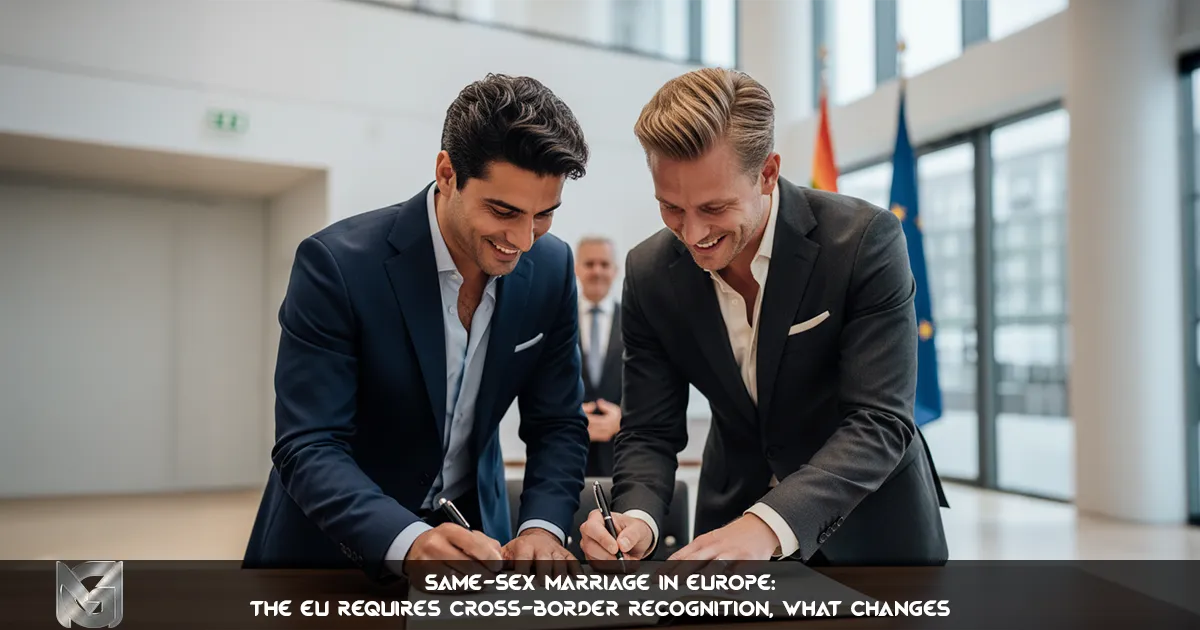
same-sex marriage in Europe has long looked like a patchwork map, full rights here, a legal void there, and, in between, a thousand absurd situations for couples. In late 2025, a ruling by the Court of Justice of the European Union (CJEU) restated a simple idea with huge practical consequences: a Member State cannot pretend that a marriage lawfully concluded in another EU country does not exist.
This is not an automatic “legalisation” of marriage everywhere. But it is a lock being removed, the non-recognition that made free movement and family life feel Kafkaesque. And that is exactly where same-sex marriage in Europe becomes a matter of concrete rights.
What the CJEU says, without the jargon
A duty to recognise, not a duty to legalise
The CJEU’s message is that, under EU law, a Member State must recognise a same-sex marriage validly concluded in another Member State.
In practical terms: a country may still choose not to open marriage domestically, but it cannot, in situations governed by EU law (especially free movement), treat a married couple as if they were legal strangers. This clarification changes how same-sex marriage in Europe works for couples who live across borders.
Why this ruling matters now
Because European life has changed: mobility, binational couples, relocations, cross-border careers. And because, in several countries, non-recognition has become a political tactic: not banning outright, but making life impossible.
What changes in real life for couples
Residence and the right to stay
The most immediate impact is the spouse’s right of residence when a couple moves within the EU. Recognition of the marital link affects:
residence permits,
family reunification,
administrative stability.
Family life, children, and continuity of rights
Even if parenthood rules remain largely national, recognition of marriage strengthens the argument of family life in everyday situations:
school paperwork,
medical authorisations,
emergencies,
separation and bereavement.
Less humiliating “administrative tourism”
Until now, many couples have had to prove their relationship again and again: certificates, translations, notaries, evidence of cohabitation. Recognition does not erase everything, but it reduces arbitrariness. In the debate on same-sex marriage in Europe, this is one of the most immediate benefits.
The limits: what the ruling does not fix (yet)
Recognition ≠ full equality
The CJEU does not force a Member State to:
open marriage on its territory,
align every social benefit,
harmonise parenthood rules.
The risk: minimal compliance
Some governments may apply the ruling in the narrowest possible way. That is why civil society monitoring and further litigation will matter.
Snapshot: where does same-sex marriage stand in Europe?
How many countries allow it?
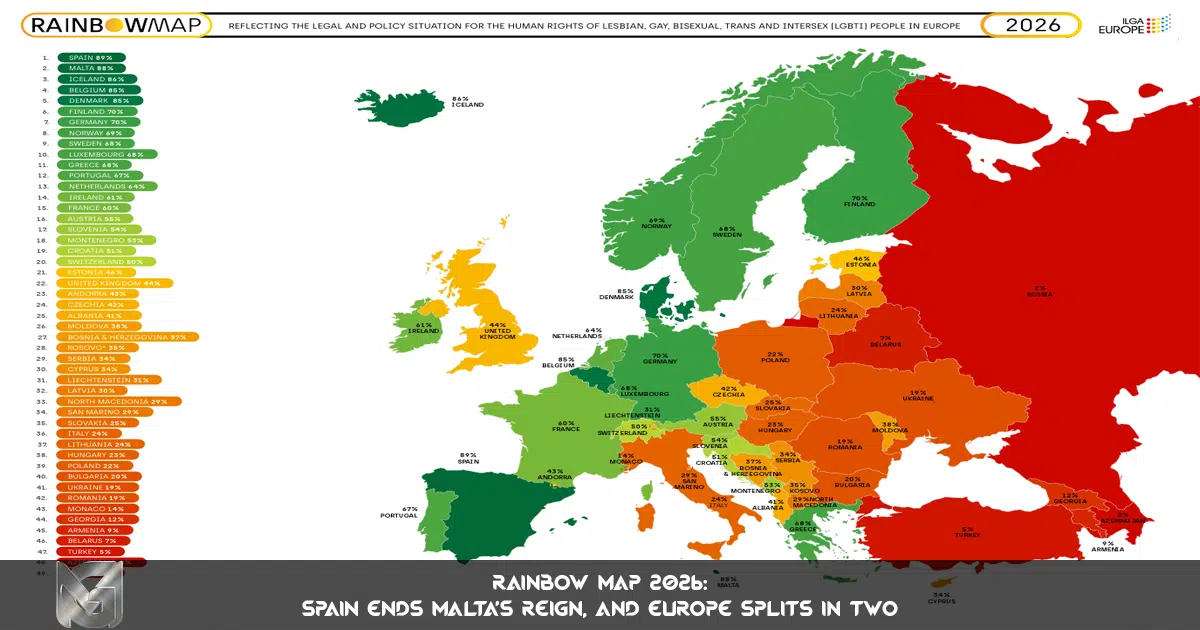
According to ILGA-Europe’s Rainbow Map (Family category), 22 European countries have marriage for same-sex couples. This overview of same-sex marriage in Europe is a useful marker, but it does not automatically reflect how protected people feel day to day.
Countries where marriage is open (2025 reference)
The list evolves, but Europe notably includes:
Belgium
Netherlands
Spain
Portugal
France
Germany
Luxembourg
Ireland
Malta
Denmark
Sweden
Norway
Iceland
Finland
United Kingdom
Switzerland
Austria
Slovenia
Estonia
Greece
Note: for a fully up-to-date, country-by-country view (marriage, partnership, adoption, etc.), the Rainbow Map is the fastest reference.
“How many marriages” in total across Europe?
It’s the question everyone asks, and also the hardest to answer properly.
To my knowledge, there is no single official pan-European counter consolidating all same-sex marriages (all countries, all years, identical definitions). Most statistics exist at national level, with:
different methods,
different time periods,
sometimes non-comparable categories.
What Gay Mag can do responsibly (for a data-led follow-up) is:
select 6–8 key countries (France, Spain, Germany, Netherlands, Belgium, UK, Sweden, Portugal),
pull official series from national statistical institutes,
build a harmonised table (year, number, share of all marriages, trend).
Recognition: the practical playbook (and the traps)
Recognition: in which cases exactly?
In practice, the CJEU recognition requirement attaches mainly to what the EU already protects: free movement and the right to lead a family life when you move from one country to another.
Plain English: if you are married in EU country A and you live, work, or settle in EU country B, country B cannot push you into the “flatmates” box whenever an administration must legally define your relationship. That is where same-sex marriage in Europe becomes very concrete: it is about administrative security, not only symbolism.
Situations where it changes everything
Relocating for a job: the spouse should be treated as a spouse, not as a foreigner with no rights.
Binational couples: recognition prevents one partner from falling “outside the framework” depending on the country.
Life emergencies: hospitalisation, death, urgent paperwork, access to information.
Situations where it still isn’t enough
Parenthood and filiation: some countries remain restrictive, and children are often the first to suffer inconsistencies.
Social benefits: recognising a marriage does not automatically align every social right.
Domestic law: a country may still refuse to celebrate a same-sex marriage on its soil.
The “small” administrative violences to watch for
Even when the rule is clear, the experience may not be. Couples often face:
forms that only exist in “husband + wife” versions,
officials who “don’t know”,
disproportionate requests for evidence.
A useful reflex: ask for a written, dated, reasoned decision. It’s not romantic, but it turns an oral “no” into a document you can challenge.
Why this goes beyond the couple: a citizenship question
A two-speed Europe, and lives that break in the gaps
same-sex marriage in Europe is not only about ceremonies or symbols. It is about continuity of rights.
When a couple is recognised in Berlin but not in Bucharest, that is not a cultural nuance, it is a risk of losing rights at the border. And that is exactly what the case law around same-sex marriage in Europe aims to limit.
Backlash: when non-recognition becomes a strategy
In several countries, the strategy is not always to ban outright. It is to:
allow couples to exist “elsewhere”,
but refuse to give them legal reality “here”.
It’s a way of saying: “you may be visible, but not in our country.” The CJEU breaks part of that mechanism, at least within the EU space. In that context, talking about same-sex marriage in Europe is also talking about civil liberties.
What Gay Mag can do: inform without panic
Useful editorial angles:
Practical checklist: documents, translations, steps, appeals.
First-person stories: couples who relocated, binational couples, families with children.
Explainers: the difference between marriage, partnership, recognition, parenthood.
Conclusion
same-sex marriage in Europe: the CJEU ruling does not magically turn every country into an equality champion, but it imposes a reality check: a marriage that is legal in the EU cannot be erased at the border. For couples, that means less fear, less arbitrariness, and more continuity.
And for Europe, it is a test: whether it can protect people’s lives in practice, even when some governments would rather those lives remain invisible. On that point, same-sex marriage in Europe has become a political marker.
For comments or projects, please contact me.