The Rainbow flag of Stonewall is not just a piece of fabric. In New York, in the heart of Greenwich Village, the Stonewall National Monument is one of the most memory-laden sites in modern LGBTQ+ history. When a rainbow flag disappears there, even temporarily, the event goes beyond logistics, it becomes instantly political, cultural, and emotional.
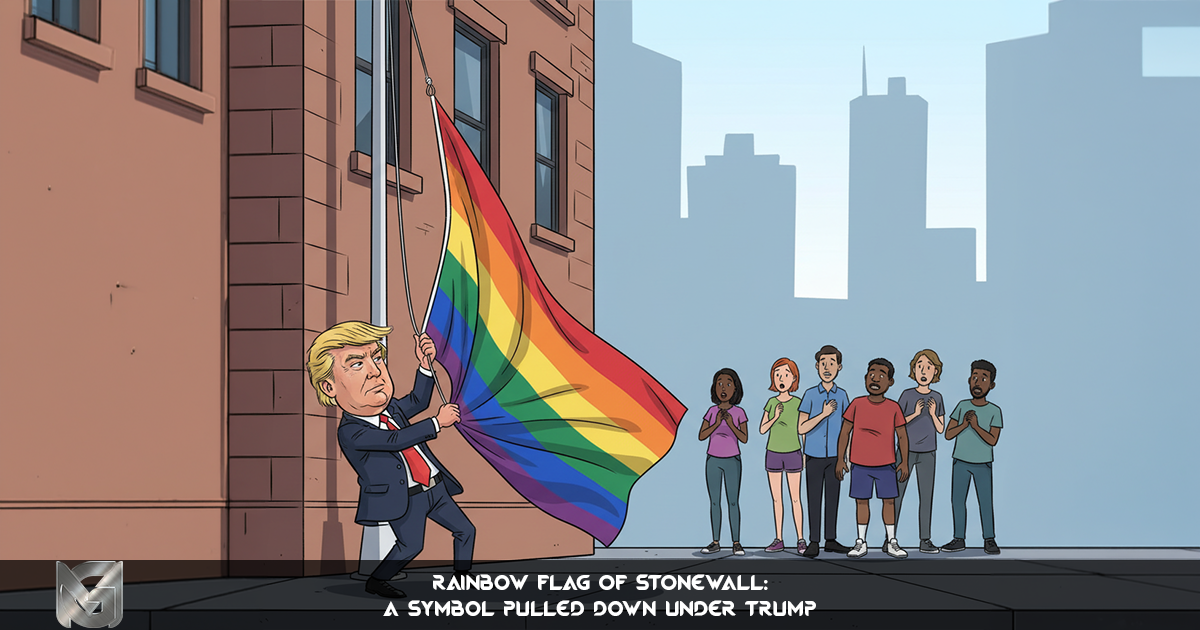
In early February 2026, several US outlets reported that the Pride flag displayed within the monument’s perimeter had been taken down. In the context of a Trump administration and a period in which LGBTQ+ symbols are once again contested in public space, the news sparked a wave of reactions, ranging from anger to calls for transparency, and renewed debate over flag-display rules on federal sites.
This article takes stock, without speculation, of what is known, what is not yet clear, and the history of the rainbow flag at Stonewall, which over the years has become both a visibility marker and a political barometer. And because symbols matter, we also revisit the trajectory of the Rainbow flag of Stonewall, from activist commemoration to a flashpoint.
What the media report: a Pride flag removed from the monument
A removal noticed and quickly amplified
According to multiple pieces published around 10 February 2026, the Pride flag that had been visible at the Stonewall National Monument was removed. Accounts converge on one point, its absence was first noticed on site, then relayed by local actors and LGBTQ+ organisations, before reaching national media.
In these narratives, the Rainbow flag of Stonewall is the trigger for a broader discussion that goes far beyond a flagpole and a protocol. The same sources indicate that the decision would fall under federal management of displays, as the monument is overseen by the National Park Service (NPS). On this kind of site, the display of flags and banners is often regulated and may vary depending on administrative guidance.
The link to the Trump administration, and how to frame it
The articles cite a political context, a Trump administration, and present the removal as a signal or a consequence of new guidance. However, two levels must be kept distinct.
The fact: the flag is no longer displayed (at the time of publication).
Attribution: the claim that the removal stems from a “Trump” directive or a political orientation.
At this stage, outlets mention context and sources, but the full decision chain is not documented publicly in the same way everywhere. For rigorous reporting, it is essential to request, and wait for, formal clarification from the NPS on the rule applied, its timeline, and its scope.
In public opinion, the Rainbow flag of Stonewall then becomes a test, not only of visibility, but of institutional transparency.
Local reactions: officials, organisations, community
The removal prompted immediate reactions.
LGBTQ+ organisations and community voices see it as an attempt at symbolic erasure.
Local elected officials and political representatives have demanded explanations, and for some, the flag’s reinstatement.
Commentators have stressed that Stonewall is a site of memory, and that symbols there play a role in education and recognition.
Even without every administrative detail, one thing is clear, Stonewall’s symbolic weight makes any visual change highly sensitive. In this context, the Rainbow flag of Stonewall is not a decorative extra, it is perceived as part of the story.
Stonewall National Monument: why this place is a global symbol
Stonewall, 1969: a historic rupture
Stonewall refers to the events of June 1969, when LGBTQ+ people resisted a police raid at the Stonewall Inn and in the surrounding streets. Those nights of uprising are often presented as a catalyst for the modern LGBTQ+ rights movement in the United States.
Stonewall became a foundational narrative, not because it was the first act of queer resistance, but because it crystallised momentum, visibility, and political organising that later spread.
A federal monument, therefore political ground
Stonewall National Monument is managed at the federal level. That means its public image, signage, and certain display elements can be subject to national rules.
That status is precisely what makes the flag question so explosive. An LGBTQ+ symbol on a federal site can be seen as official recognition, or conversely, as a “position” by those who contest that visibility.
Within this framework, the Rainbow flag of Stonewall is read as a message, even when it is simply lived as a sign of memory.
History: how the rainbow flag became inseparable from Stonewall
The rainbow flag: an activist invention that became a universal language
The rainbow flag, created in the late 1970s, has over the decades become the most widely recognised emblem of the LGBTQ+ community. It has evolved, been adapted, and complemented by other flags (trans, bi, Progress flag), but it remains an immediate reference.
Its role is twofold.
A visibility signal: saying “we are here” in public space.
A memory tool: recalling a history of struggles, losses, and solidarities.
That trajectory helps explain why the Rainbow flag of Stonewall has become, for many, an obvious extension of what Stonewall represents.
Stonewall and flags: from commemoration to institutionalisation
At Stonewall, Pride flag displays have long been linked to commemorations, Pride events, gatherings, and local initiatives. Over time, the presence of the flag became, for many, a landmark, a visual continuation of the place.
But that “obviousness” is not necessarily stable within a federal framework. Depending on the period, display may be more or less tolerated, more or less institutionalised, and sometimes challenged.
This is where the history of the Rainbow flag of Stonewall matters, it tells a story of visibility built, negotiated, and sometimes contested.
Why the flag’s history at Stonewall matters so much
The debate is not only “a flag, yes or no.” It touches a deeper question.
Who decides how LGBTQ+ history is told in public space?
Can a site of memory be “neutral” when its very existence is political?
Does removing a symbol, even in the name of a rule, weaken recognition of an inheritance?
In a time when LGBTQ+ rights are under attack in several US states, the symbolism takes on an added dimension. And the Rainbow flag of Stonewall sits at the centre of that tension.
What federal display rules say (and why this angle matters)
Flags, banners, and “government speech”
On many federal sites, flag display is regulated. The aim is often to prevent a public site from being used to promote a partisan message. But the boundary between “partisan” and “human rights” is precisely what is debated.
In Stonewall’s case, the argument of administrative neutrality collides with historical reality. Stonewall is an LGBTQ+ monument by definition, not a general park to which a symbol is added.
That is why the Rainbow flag of Stonewall is perceived as historical context, not campaigning.
Transparency: the question everyone asks
The central question, for solid journalism, is simple.
What exact rule was applied?
Since when?
Who made the decision?
Is there a waiver process, or an official framework allowing display during commemorative periods?
Without these answers, the debate feeds on assumptions. On such an inflammatory topic, rigour is protection. When institutions stay silent, the Rainbow flag of Stonewall becomes a screen onto which everyone projects their reading.
The Trump era and LGBTQ+ symbols: a climate of confrontation
Symbols as a battleground
In American political cycles, symbols often act as markers of power. A flag, a plaque, a word in a brochure, a mention on an official website, everything can become an ideological test.
The removal of a Pride flag at Stonewall, whether intentionally political or administratively “technical,” is immediately interpreted as a step back. That is the logic of culture wars, the battle is fought over what is visible.
In that logic, the Rainbow flag of Stonewall is no longer only a community symbol, it becomes a contested object.
Why the community reacts so fast
The speed of reactions makes sense.
Stonewall is a global landmark, not only a New York one.
Symbolic rollbacks sometimes precede concrete rollbacks.
LGBTQ+ memory has often been erased, minimised, or rewritten.
In that context, vigilance is a collective reflex. And the absence of the Rainbow flag of Stonewall is perceived as an alarm bell.
What can be verified, and what should not be claimed
What can be said cautiously
The Pride flag is no longer displayed (at the time outlets published).
The event triggered political and community reactions.
The monument’s federal status means display is subject to rules.
Those three points are enough to explain why the Rainbow flag of Stonewall became a national story.
What should be avoided without official confirmation
Claiming a specific directive was signed or publicly announced if it is not published.
Assigning a single intention (deliberate erasure) without evidence.
Turning a local fact into definitive proof of a national policy without documents.
This caution does not reduce the symbolic gravity, it protects credibility. It also allows the Rainbow flag of Stonewall to be treated as a journalistic fact, not a slogan.
Why the Rainbow flag of Stonewall is more than a symbol
A marker of safety and belonging
For many, seeing a Pride flag is not decorative. It is a signal.
Here, you can exist.
Here, your history is recognised.
Here, the memory of struggles is visible.
At Stonewall, that signal has particular intensity, because it overlays a history of police violence, stigma, and resistance.
That is also why the Rainbow flag of Stonewall is experienced as a safety marker.
A tool for transmission
The flag is also a pedagogical tool. It helps visitors, including those unfamiliar with LGBTQ+ history, immediately understand the nature of the site.
Removing the flag risks making Stonewall less legible to the general public, and therefore weakening transmission. In that sense, the Rainbow flag of Stonewall is a way of reading the monument.
What happens next: possible outcomes
Scenario 1: quick reinstatement
If the controversy pushes the NPS or relevant authorities to clarify and authorise display, the flag could return quickly, with an official framework.
In that case, the Rainbow flag of Stonewall would again be an acknowledged, framed, and protected symbol.
Scenario 2: compromise (periods, formats, locations)
Another possible outcome is a compromise, display during commemorative dates, or in a specific space, or via permanent signage that replaces the flag.
Such a compromise would turn the Rainbow flag of Stonewall into an intermittent symbol, which for some would already be a step back.
Scenario 3: a long standoff
If the removal fits within a more restrictive line, the issue could become a recurring conflict, with mobilisations, symbolic actions, and litigation.
In that scenario, the Rainbow flag of Stonewall would remain a friction point, and a political thermometer.
Conclusion
The removal of the Pride flag at Stonewall National Monument is not a minor story. It is revealing, because it touches memory, visibility, and how a state recognises, or does not recognise, LGBTQ+ history.
Whether the decision is framed as administrative or political, the effect is the same, it puts a fundamental question back on the table. Who does Stonewall belong to? To the rules of a federal apparatus, or to the community whose resistance it tells?
For Gay Mag, the challenge is to stay precise, document, ask for evidence, and remind readers of the essential. Stonewall is not a backdrop. It is a site of struggle, and the rainbow flag, whether loved or contested, has become one of its languages.
And in this battle of symbols, the Rainbow flag of Stonewall is not a detail, it is the visible heart of a collective memory.
For comments or projects, please contact me.