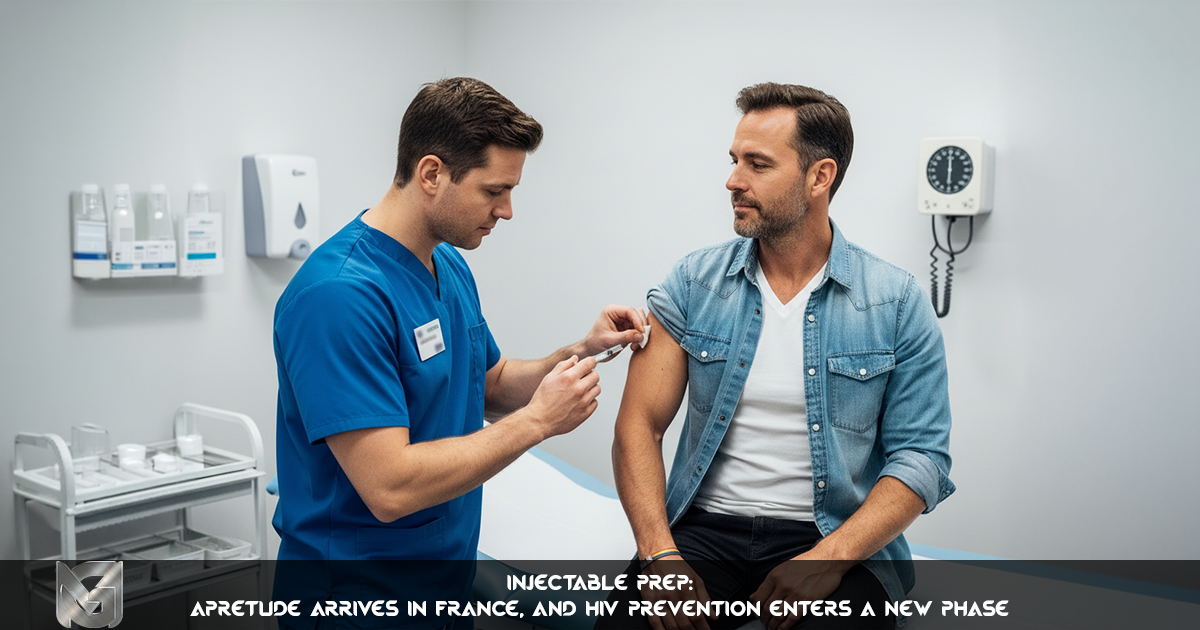
Injectable PrEP has been awaited for a long time by community organisations, clinicians and, above all, by people for whom day-to-day HIV prevention can be a real obstacle course. Oral PrEP has already changed the landscape, but it relies on something very concrete: taking pills regularly, not forgetting, planning ahead, and managing periods of life when adherence becomes harder.
With France authorising the commercial rollout of a long-acting injectable prevention option, cabotegravir (brand name Apretude, by ViiV Healthcare, a GSK company), the tempo changes, and potentially the audience too. The injection is given every two months, and press reports indicate it will be fully covered because it is considered “irreplaceable and particularly costly”.
Here’s a clear, non-sensational breakdown of what this arrival means, what it doesn’t mean, and how it fits into the broader toolbox of prevention and HIV treatments.
Understanding PrEP: prevention, not treatment
PrEP stands for pre-exposure prophylaxis. It is a preventive antiretroviral strategy for HIV-negative people who are at risk of acquiring HIV. The idea is straightforward: by having the medication in your system before exposure (either continuously or “on demand”, depending on the regimen), the virus is prevented from establishing infection.
Oral PrEP: what already exists in France
Oral PrEP is already available in France. When taken correctly, it is highly effective and has helped many of us regain a sense of control over prevention.
But oral PrEP also has practical limits:
It requires frequent dosing, which means routine.
It can be difficult to maintain during periods of fatigue, mental health struggles, substance use, financial insecurity, or simply a very busy life.
It can feel like a daily, anxiety-inducing reminder of risk.
That’s exactly where injectable PrEP becomes interesting: it aims to reduce the mental and logistical load.
Apretude (cabotegravir): what changes with injectable PrEP
Apretude is an antiretroviral (an integrase inhibitor) used here for prevention. Its main value is long-acting protection.
A simpler rhythm: one injection every two months
Based on the information currently available, injectable PrEP is administered by injection on a two-month schedule. For many people, this could mean:
fewer missed doses,
fewer daily “micro-decisions”,
a more structured follow-up within the healthcare system.
Why it took time: price negotiations
Several sources report that France’s rollout was delayed by price negotiations between health authorities and the manufacturer. The public price mentioned in the press is over €1,000 per dose, while the exact reimbursed price would remain confidential.
This is not a footnote: access to prevention depends on economic and political decisions, not only on science.
Who is it for? Promises and access limits
The French NGO Aides welcomed the move, especially for people for whom adherence to oral PrEP is difficult. Put simply: those who most need robust prevention tools are sometimes those for whom a “daily pill” model is least realistic.
Lab follow-up: a potential friction point
One concern raised in press coverage is that access to injectable PrEP may require a HIV viral load test. Some tests linked to PrEP pathways may not be reimbursed at 100%, which could create an out-of-pocket cost (potentially covered by private insurance).
This matters. Prevention should not become a privilege. If an innovation adds even a small financial barrier, it risks excluding the people most exposed.
Pregnancy potential: caution and informed choice
According to information reported by the media, French health authorities would not recommend this medication for women of childbearing potential due to a potential risk of foetal malformations. In certain situations, prescribing could be considered with clear counselling about risks and the need for effective contraception.
It’s a reminder of a basic rule: no prevention tool is “universal” without nuance, and information must be clear, accessible and non-judgemental.
What injectable PrEP does not do (and we should say it plainly)
A new tool can bring justified excitement, but also misunderstandings.
PrEP does not protect against other STIs
PrEP, whether injectable or oral, protects against HIV, not other sexually transmitted infections. Regular testing, vaccination where available (hepatitis, HPV), and stigma-free access to care remain essential.
It is not treatment for people living with HIV
PrEP is for HIV-negative people. For people living with HIV, the strategy is different: it relies on antiretroviral therapy (ART) to suppress viral replication.
Reminder: where are HIV treatments today?
Talking about prevention without talking about treatment is incomplete.
Antiretrovirals: living with HIV is not what it used to be
HIV treatment has evolved dramatically. The goal is to reach an undetectable viral load, which protects the person’s health and, crucially, reduces the risk of transmission.
Undetectable = Untransmittable (U=U)
While every medical situation is individual, the public health message “Undetectable = Untransmittable” has changed lives. It fights fear, shame and a significant part of stigma.
Modern prevention is therefore a trio:
PrEP for HIV-negative people at risk,
effective treatment for people living with HIV,
regular testing and easy access to care.
Why this matters for the gay community
In France, as elsewhere, gay and bisexual men remain disproportionately affected by HIV, not by “nature”, but because of social realities: dating networks, statistical exposure, stigma, unequal access to care, prevention fatigue, and sometimes isolation.
Injectable PrEP could:
reduce mental load,
offer a discreet option for those who don’t want visible pills,
secure periods of life that are less stable.
But it will not replace the need for welcoming services, easy testing, and an active fight against HIV-related stigma.
Practical questions: how might this work in real life?
On the ground, adoption depends on very concrete details.
Where will injections be given?
Injectable PrEP implies regular visits within a care pathway. Depending on where you live, access may be smooth or complicated. The risk is a two-speed system: well-resourced big cities versus underserved areas.
Who will switch to injectable PrEP?
Several profiles are likely:
people already on oral PrEP who want simplicity,
people who tried oral PrEP and stopped,
people who never felt able to start.
The key will be avoiding a scenario where injectable PrEP benefits only those already well connected to healthcare.
The real issue: widening access, not just adding an option
Apretude’s arrival is good news, but it raises a political question in the best sense: who gets access to prevention, and under what conditions?
If coverage is broad, if out-of-pocket costs for tests are limited, if information is clear, and if prescribing sites are numerous, injectable PrEP could help reduce new infections.
If it becomes a heavy, expensive pathway limited to a few centres, the innovation will remain symbolic.
What to take away (Gay Mag version)
Injectable PrEP isn’t a magic wand. But it is a prevention tool that may reach people oral PrEP did not convince or did not retain. It fits into a continuum where HIV treatments have already transformed lives, and where prevention must keep adapting to real life, which isn’t always regular, organised, or “perfect”.
Progress isn’t only about inventing. It’s about making it accessible.
Method note: this article synthesises press information about France authorising the commercial rollout of Apretude (injectable cabotegravir) and reported access conditions and cautions (lab follow-up, recommendations). Personal decisions should always be made with medical advice.
For comments or projects, please contact me.