
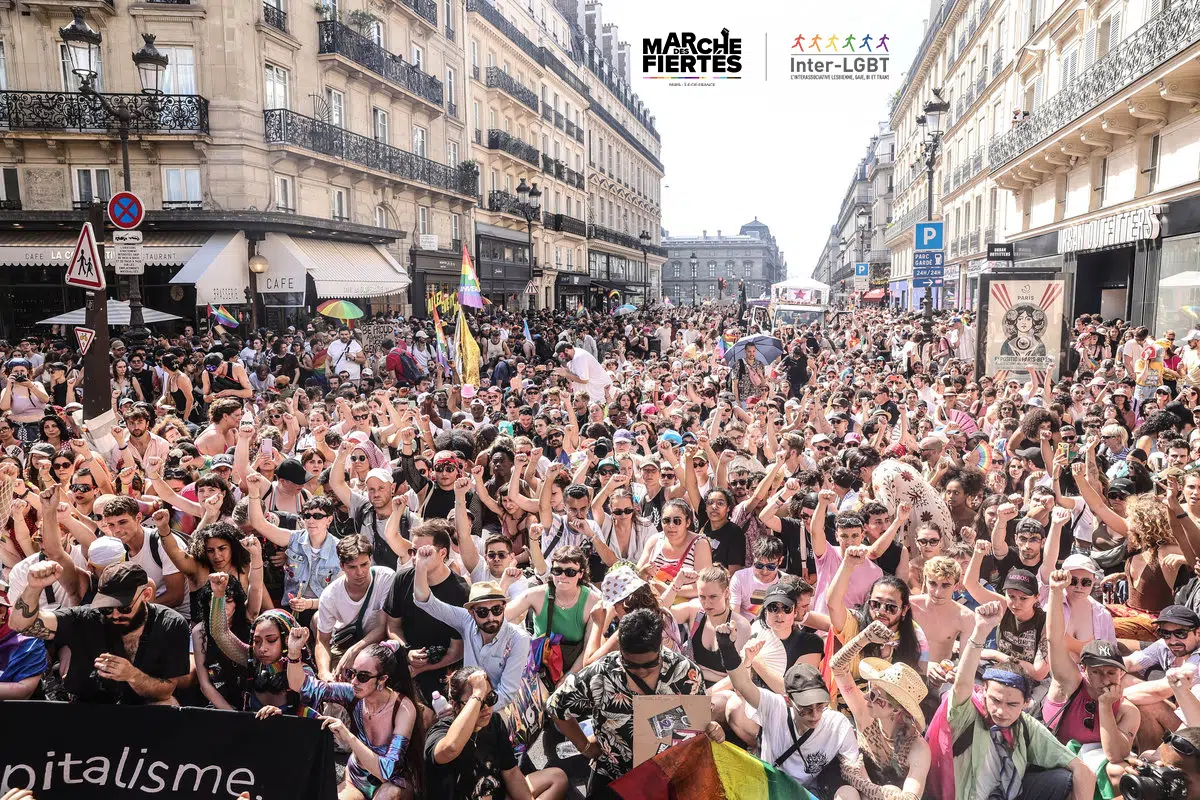




Paris Pride March 2026. Three words for a date that matters, loud, joyful, visible, but above all political. On Saturday 27 June 2026, Paris and the wider Île-de-France region will host the 49th edition of the Pride March, organised by Inter-LGBT. It is a moment that brings people together, protects, and pushes forward, while reminding us of a hard truth, rights are never permanently secured.
In this Gay Mag guide, we break down what the Paris Pride March is, why it still matters in 2026, and how to take part, whether you’re coming with friends, joining a group, registering a contingent, or volunteering behind the scenes.
The Paris Pride March is a yearly landmark, sitting right at the intersection of demonstration and celebration. For Gay Mag, Paris Pride March 2026 is also a major editorial moment because it tells the story of a community as much as it gathers it.
Numbers help you picture the scale, but they don’t capture the whole point. Pride is also about taking public space, being counted, recognising each other, and making visible lives that are still too often pushed to the margins. In that sense, Paris Pride March 2026 is both a mass event and a collection of personal stories.
The Pride March is not “just a parade”. On the official website, it is presented as one more step towards equality and one more voice against discrimination. That double nature is essential, and it is precisely why Paris Pride March 2026 can never be reduced to “a vibe”.
Marching means stating, clearly, that discrimination and violence against LGBTQI+ people still exist, through insults, assaults, exclusion, unequal access to housing and work, barriers in healthcare, family rejection, and everyday hostility in public spaces.
That is why Pride is also democratic pressure. It’s where people demand public policies, protections, resources, and consistency between what leaders say and what institutions actually do. In that framework, Paris Pride March 2026 functions as a yearly reminder, and sometimes as a wake-up call.
The party is not an “extra”. It is part of the message. Dancing, singing, kissing, laughing, showing up, is also a response to the pressure to stay discreet, to feel shame, to disappear.
Celebration is a language. It says, we are here, we exist, we have cultures, communities, histories, bodies, and loves. That’s why Paris Pride March 2026 needs to remain both joyful and demanding.
The question comes back every year, sometimes with a hint of fatigue, “Again?” And the answer is simple, as long as real equality is not here, as long as safety is not guaranteed, as long as rights can roll back, we march.
The official website frames 2026 as another year to keep moving forward. Pride is not a frozen commemoration, it’s a social barometer. And Paris Pride March 2026 fits squarely into that logic.
Visibility doesn’t solve everything, but it changes the balance of power. It creates reference points for younger people, offers models, and breaks isolation.
The march is also where associations, collectives, unions, allies, and communities meet. You see struggles intersect, health and prevention, trans rights, anti-racism, fighting precarity, and resisting violence.
Good news, it’s simple. The official website is clear, to take part, you just have to show up. In practice, Paris Pride March 2026 is open and designed so everyone can take their place.
You can come alone, with friends, as a couple, with your chosen family. You can be discreet or flamboyant, in shorts, leather, drag, a t-shirt, a harness, sportswear, office clothes, or full Pride look.
The point is elsewhere, being present, being visible, being in solidarity. And yes, Paris Pride March 2026 is also for people who are not used to “taking the streets”.
Without turning this into a survival guide, a few obvious things make the day easier.
If you are part of an association, collective, activist group, union, or organisation that wants to march together, the website offers a contingent pre-registration process. It’s another way to experience Paris Pride March 2026, more structured, more collective, and often more explicitly political.
The pre-registration page provides a key document, the 2026 requirements/specifications (available for download). It sets a framework, and that’s a good thing, an event of this size needs rules to stay aligned with its values and safety.
If your organisation already marched in the previous edition, the page also includes a route for returning participants.
A contingent is not just “a group with a banner”. It is a public statement. It implies respecting the spirit of the march, joining a collective dynamic, and not turning Pride into a disconnected marketing operation. In that sense, Paris Pride March 2026 carries an implicit rule, you march with others, not above others.
We talk a lot about floats, slogans, outfits, and photos. We talk less about the people who make it all possible. Yet the march relies on massive mobilisation. And without them, Paris Pride March 2026 simply wouldn’t have the same scale.
The website highlights 300+ volunteers. Concretely, that means stewarding, logistics, welcoming, coordination, safety, and information.
The “Volunteer” page provides a 2026 Volunteer Charter (downloadable). That’s important, volunteering means joining a collective organisation with responsibilities.
If you want to live Pride differently, closer to the teams and the real mechanics of the day, it’s a strong, useful, and often deeply human option. For many people, Paris Pride March 2026 is also experienced from the backstage.
The march doesn’t happen in isolation. The website invites visitors to explore Pride Week, with a link to the dedicated programme. In spirit, it’s a perfect runway into Paris Pride March 2026.
Pride Week expands Pride beyond a single day. It typically includes cultural events, community gatherings, parties, discussions, prevention-focused moments, and spaces for memory.
For Gay Mag, it’s also rich editorial ground, because Pride is not only the final image, it’s everything that gets built beforehand. And Paris Pride March 2026 makes more sense when you follow what leads into it.
The Pride March is carried by Inter-LGBT, which also supports other events referenced on the website, such as Printemps des Assoces and the Course des Fiertés.
Without diving into organisational charts, the idea is simple, Paris Pride is structured by an association ecosystem. That provides continuity, memory, and the ability to defend political positions.
The website provides contact addresses, including a general email and a press-focused contact. If you are covering the event, proposing a partnership, or asking an organisational question, that’s where to go. For editorial teams, Paris Pride March 2026 is also something you prepare well in advance.
Pride is freedom. But it is also shared space. To keep the day beautiful, a few simple principles help.
Don’t touch people without consent, even for a photo. Don’t comment on bodies. Don’t turn identities into “debate topics”.
Yes, you come for celebration. But you also come because celebration has meaning. Take time to read signs, listen to slogans, spot associations, and talk.
If you shoot images, think about consent, especially for people who could be put at risk by unwanted exposure. Pride is public, but people’s safety comes before “content”. In a city like Paris, Paris Pride March 2026 must remain a space where people feel safe.
Paris Pride March 2026 is not just a date to tick off. It is a moment when the community looks at itself, tells its story, protects itself, sometimes argues, and keeps moving.
It is also a message to those who would prefer us silent, invisible, obedient, you will not get our shame, and you will not get our erasure.
And if you are still hesitating, remember this, Pride is not only for the confident. It is also for people who doubt, who are newly out, who are looking for a place to breathe. For many, Paris Pride March 2026 begins right there, the moment you decide to come.
See you on 27 June 2026, in the streets of Paris.
For comments or projects, please contact me.