Brussels Pride 2026 is shaping up to be a landmark edition. First, because it marks 30 years of Pride in Brussels, and second, because it lands in an international climate where LGBTQIA+ rights remain fragile, sometimes attacked, often debated. The official website sets the tone with a message that is both clear-eyed and energising: when the times get darker, the community chooses to shine brighter, together.
In this article, we lay out what we already know in a clean, readable Gay Mag style: the date, the spirit, the headline moments (Pride March, Pride Village), plus practical habits to plan a weekend in Brussels.
The essentials at a glance
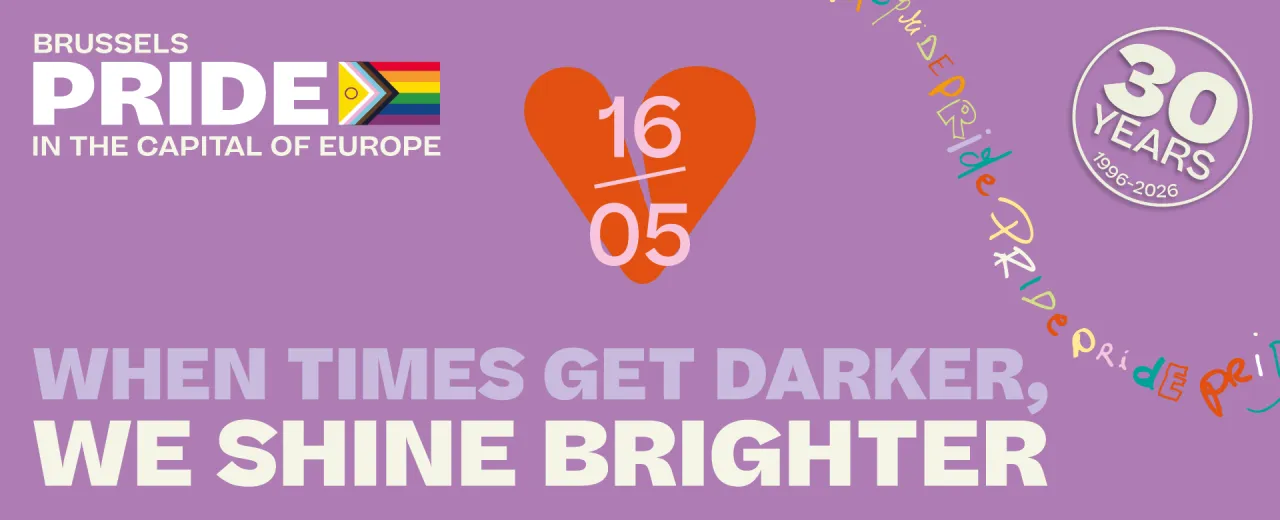
- Date: Saturday 16 May 2026 (Brussels Pride 2026).
- Anniversary: 30 years of Pride in Brussels.
- 2026 theme: “When Times Get Darker, We Shine Brighter” (Brussels Pride 2026).
- Key highlights: Pride March and Pride Village (registrations open to associations, non-profits and companies via the official Brussels Pride 2026 website).
30 years of Pride in Brussels: a story of visibility
A Pride that has lasted
Thirty years is not just a round number, it is a shared memory. A Pride is a celebration, a march, a space for demands, and a mirror of its time. In 2026, Brussels celebrates three decades of presence in public space, three decades of alliances, internal debates, progress, and sometimes backlash. That is what gives Brussels Pride 2026 its particular weight.
A rare form of institutional recognition
The official website highlights a striking milestone: in October 2024, the Brussels-Capital Region added Brussels Pride to its list of intangible cultural heritage. That kind of recognition places the event in a strong symbolic category, alongside other cultural markers, and strengthens the legitimacy of Brussels Pride 2026.
Another interesting point: a transnational initiative (led by Amsterdam) would aim, in the coming years, for UNESCO recognition on a global level. The idea is simple: Prides are not just “events”, they are markers of rights, freedoms and safety for LGBTQIA+ people, an issue Brussels Pride 2026 puts front and centre.
The 2026 theme: “When Times Get Darker, We Shine Brighter”
A slogan that matches the moment
The 2026 theme, “When Times Get Darker, We Shine Brighter”, is not decorative. It responds to an unstable international climate where LGBTQIA+ rights are, depending on the country, contested, weakened or weaponised. In that context, Brussels Pride 2026 positions itself as a signal.
The message is twofold:
- acknowledge that the times can harden,
- reaffirm that visibility, unity and pride remain social, cultural and political answers.
A promise of unity
The site insists on the idea of shining “brighter”, “prouder”, “more united” and “more visible”. It is a call for a broad, inclusive Pride, aware of what it represents: a space where people gather even when the media or political environment becomes hostile. That is precisely the DNA of Brussels Pride 2026.
Announced highlights: Pride March and Pride Village
Pride March: the beating heart
The Pride March remains the strongest image of any Pride: a procession, placards, flags, slogans, bodies taking up space in the city. On the official website, a “Registration Pride March” area is planned for associations, non-profits and companies. For readers, it is one of the concrete markers of Brussels Pride 2026.
Even if the full route details are not yet visible on the homepage, the essentials are there: the march is one of the pillars of Brussels Pride 2026, and the organisation is already structuring participation.
Pride Village: the meeting point
The Pride Village is the other major piece of the puzzle. It is where you wander, get information, meet organisations, discover initiatives, sometimes partners, often practical resources. Here too, Brussels Pride 2026 highlights “Registration Pride Village”, aimed at associations, non-profits and companies.
For Gay Mag, this matters editorially: the Pride Village is not only a “party village”, it is a community hub, a space for health, prevention, culture and rights at the heart of Brussels Pride 2026.
Planning your weekend: Brussels in Pride mode
Book early: big-date logic
An anniversary Pride draws crowds. And Brussels is extremely accessible from France, the UK, the Netherlands and Germany. Result: accommodation goes fast, especially around Brussels Pride 2026.
The official website highlights the option to stay in “Queer Destinations” certified hotels, via a partnership with visit.brussels. The idea is to guarantee inclusive hospitality, trained staff, and an environment presented as safe and respectful, which fits the kind of experience many people want during Brussels Pride 2026.
Getting around easily
Brussels is walkable depending on the neighbourhood, and public transport makes moving around simple. For a Brussels Pride 2026 weekend, the best habit is straightforward: stay central enough to alternate between walking, meet-ups and quiet breaks.
Build an LGBTQIA+ itinerary beyond Saturday
The site also points to useful city resources:
- an LGBTQIA+ calendar,
- an LGBTQIA+ guide (bars and parties, but also exhibitions, films and events).
It is a perfect lead for your Gay Mag angle: Pride is not just one day, it sits inside a local scene, venues, collectives and culture. Brussels Pride 2026 can be the ideal entry point.
Gay Mag tips: enjoy Pride without losing the plot
1) Come for the party, stay for the meaning
Pride is music, looks, encounters. But the 2026 edition clearly insists on context: “shining” is not only an aesthetic metaphor, it is a response to very real threats. Holding that balance is also a way to respect the event, and it is one of the keys to covering Brussels Pride 2026 accurately.
2) Think inclusion
A successful Pride is one where everyone feels they belong: trans people, non-binary people, intersex people, racialised queer people, disabled people, seniors, young people, chosen families. Even if you come “just” to celebrate, you are participating in a shared space, and Brussels Pride 2026 claims that openness.
3) Safety and care
Without dramatising, a Pride is a large gathering. Basic habits still apply: set meeting points, keep an eye on your belongings, stay hydrated, and know where to find help if needed. For Brussels Pride 2026, it is also a way to make the celebration calmer.
Why Brussels Pride 2026 matters beyond Brussels
A European Pride in a political capital
Brussels is not like any other city, it is also a European political symbol. A Pride here resonates differently because the city embodies, for many, institutions, debates, fault lines and compromises. That is what gives Brussels Pride 2026 a European dimension.
An anniversary Pride, therefore more visible
“30 years” adds narrative depth: you can tell where we come from, what has changed, what still needs defending. For a publication like Gay Mag, it is an editorial opportunity: connect memory, present and future, and use Brussels Pride 2026 as a thread.
Mini practical FAQ
What is the date of Pride in Brussels in 2026?
The official website announces Saturday 16 May 2026. That is the central date of Brussels Pride 2026.
What is the 2026 theme?
“When Times Get Darker, We Shine Brighter”, the slogan of Brussels Pride 2026.
What are the highlighted events?
The Pride March and the Pride Village, with registration forms for associations, non-profits and companies as part of Brussels Pride 2026.
Where can I find official information?
On the website: https://www.brusselspride.eu/ (the main reference for Brussels Pride 2026).
Conclusion
Brussels Pride 2026 already ticks every box for a major edition: a clear date, a symbolic anniversary, a theme that speaks to the present, and an organisation structuring participation around the Pride March and the Pride Village.
For Gay Mag, the angle is obvious: tell the story of a Pride that celebrates, but does not forget why it exists. A Pride that dances, but can also name the threats. A Pride that, at 30, chooses to shine brighter.
For comments or projects, please contact me.



 Visit Brussels