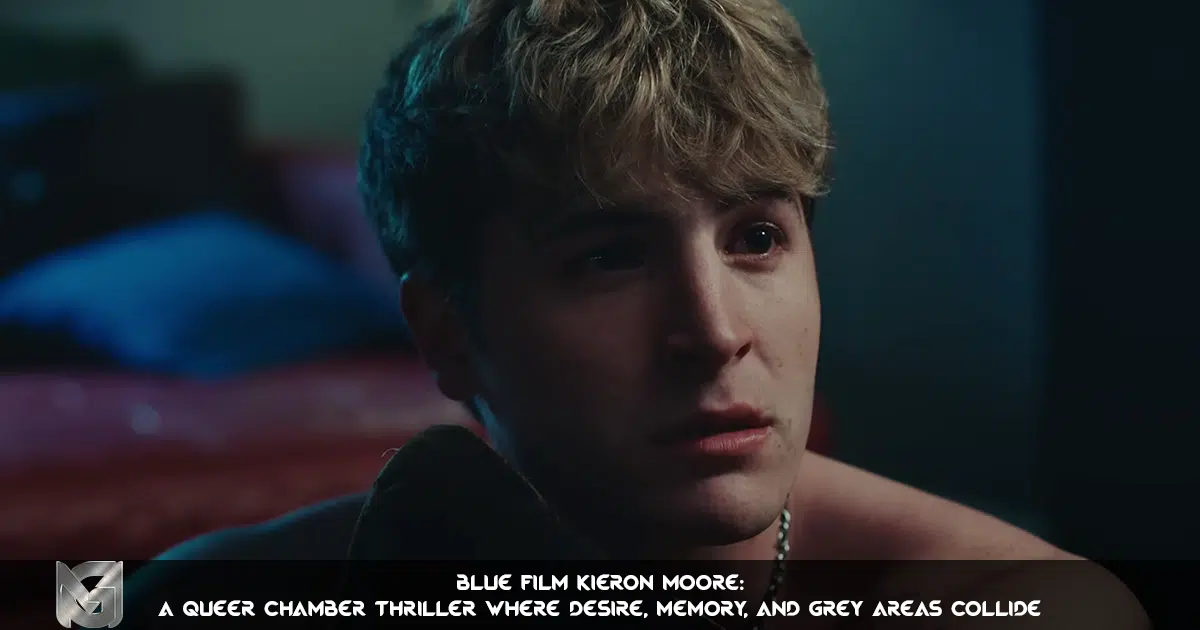
Blue Film arrives with a rare promise: a queer drama that refuses the easy way out. No postcard romance, no neatly packaged feel-good coming-out arc, but one night, two men, one room, and a past that pushes its way back to the surface. At the centre, Kieron Moore, magnetic, plays a fetish cam boy whose defences begin to crack during an anonymous encounter. Blue Film positions itself as a film of tension, skin, and language, and above all, consequences, an object less interested in pleasing than in sparking a real conversation.
What grabs you straight away is the form: a chamber piece, a near single-location pressure cooker designed to build intensity without hiding behind action. What holds you is the subject matter: the film moves through delicate terrain around desire, memory, and connections that can wound as much as they reveal. For Gay Mag, this is exactly the kind of proposition that deserves a proper, spacious feature, because queer cinema needs stories that do not apologise for being complex.
What Blue Film is about, without unnecessary spoilers
The premise of Blue Film is simple, and therefore brutally effective: a cam boy agrees to spend the night with an anonymous client. Very quickly, the situation shifts, not towards a cheap twist, but towards a discovery that ties the encounter to a darker past. The film seems to run on a gradual reveal, where every detail, every pause, every gesture reshapes what we thought we understood.
That deliberately restrained summary is also what makes the film interesting. The promise is not “what will happen?”, but “what does it mean?”. Blue Film appears to observe how desire can be a refuge, a mask, a survival tool, or a repetition. And how memory, for its part, never simply stays where you put it.
Kieron Moore: an exposed, physical role, but above all an interior one
In Blue Film, Kieron Moore carries much of the film on his shoulders. His character, Aaron (presented as a fetish cam boy), is not written as a mere erotic figure. He is jaded, protected by armour, and yet shot through with a vulnerability that surfaces in flashes.
This kind of role is a trap, because it can easily slide into cliché: the “sexy, damaged boy” we watch suffer. Here, the interest is that the performance is described as layered. In other words, the film does not only ask Kieron Moore to be frontal, it asks him to be contradictory: seductive and defensive, lucid and in denial, in control and overwhelmed.
A character that forces the viewer to stay uncomfortable
Contemporary queer cinema sometimes smooths its characters down to make them instantly likeable. Blue Film seems to do the opposite. Aaron is not there to be a model, he is there to be real. And that is precisely what can give the film its power: it forces the viewer to sit with ambivalence.
Opposite Reed Birney: an actors’ duel, a duel of narratives
The cast also highlights Reed Birney, the other pillar of the chamber set-up. In this kind of device, everything depends on chemistry, tension, and the ability to make subtext live. If either actor overplays or over-explains, the film collapses. Conversely, when both know how to let the unsaid breathe, the film becomes an echo chamber.
Elliot Tuttle: cinema built on risk, not comfort
Written and directed by Elliot Tuttle, Blue Film sits within a tradition of independent films that prefer precision to grandiosity. The fact that the film was shot over a short period (two weeks of principal photography, according to published information) reinforces the sense of a project made with concentration, almost like a scalpel.
A chamber piece as a moral device
A chamber setting is not only a budget constraint. In Blue Film, it appears to be a strategy: locking the characters (and the audience) into a space where you cannot run away. No cut to the outside for air. No score that tells you what to feel. Just presence, sometimes discomfort, and the necessity of looking straight at what is happening.
Sex, fetish, and queer representation: what the film puts on the table
Making a fetish cam boy the centre of a drama is not neutral. The risk is exploitation, or, on the other side, sanitisation that drains the story of its point. Blue Film seems to look for a third way: treating eroticism as a language, not as decoration.
Desire as political territory
In queer storytelling, desire is often politicised whether it wants to be or not, because it has historically been policed, punished, and caricatured. A film like Blue Film can remind us of something essential: desire is not always “pretty”, but it deserves to be told seriously.
Taboo and responsibility: walking the ridge
The film is presented as tackling particularly thorny “edges of desire”. That is where the writing and direction will be judged: how do you show without indulging? how do you suggest without trivialising? how do you provoke discussion without turning the viewer into a voyeur?
This is also where a Gay Mag feature can help frame reception: a film can address difficult subjects and remain responsible, as long as it does not confuse representation with endorsement.
Festival path: a trajectory that says something about the film
Blue Film had its world premiere at the Edinburgh International Film Festival (16 August 2025), then screened at NewFest (11 October 2025). That circulation is not incidental. It places the film in spaces where queer cinema is discussed, contextualised, and tested against audiences used to demanding work.
“Too controversial” for some major festivals?
Published information indicates the film was rejected by several major festivals. Without turning that into an automatic marketing badge, it can still illuminate the nature of the project: Blue Film looks like a film that is not chasing unanimity.
Critical reception: a signal, not a verdict
On the aggregator side, Blue Film shows a high critical score on Rotten Tomatoes at the time these figures were reported (with a limited sample). It is an interesting indicator, but not an absolute truth. For an indie film, the volume of reviews can be small, and polarisation can be strong.
For Gay Mag readers, the question may be less whether the film is “good” in a school sense, and more what it triggers: discomfort, empathy, debate, identification, rejection. The films that matter are not always the ones that please everyone.
Why Blue Film may speak to Gay Mag readers
1) Because it treats queer sexuality as an adult subject
The film appears to refuse hypocritical modesty without slipping into sensationalism. It takes seriously what many narratives skirt around.
2) Because it stages complexity, not easy morality
Blue Film seems to work with ambivalence: desire and danger, attraction and memory, intimacy and manipulation. It is uncomfortable, therefore fertile.
3) Because Kieron Moore emerges as a face to watch
Whether you embrace the film or not, a role this exposed can mark an actor’s trajectory. Kieron Moore here is not “just” a filmed body, he is a performer asked to hold emotional tension.
How to present the film without reducing it: editorial notes (Gay Mag)
To cover Blue Film in a way that is both engaging and rigorous, I’d recommend:
- Avoiding an overly detailed plot recap, and focusing on themes (desire, memory, consent, power).
- Emphasising the device (a chamber piece) and the acting duo.
- Reminding readers the film invites dialogue rather than quick consumption.
- Clearly signalling that the film deals with sensitive material, without turning it into a shock hook.
Conclusion: a film that unsettles, therefore a useful film
Blue Film does not look like a product designed to reassure. And that is precisely what makes it interesting. In a landscape where queer representation can be trapped between the softened and the empty provocation, a film that tries to speak about desire as an ambivalent force, capable of revealing and wounding, deserves attention.
With Kieron Moore at its centre, and a chamber set-up that forces you to look without flinching, Blue Film has the potential to be one of those films you leave needing to talk about, not simply rate.
For comments or projects, please contact me.