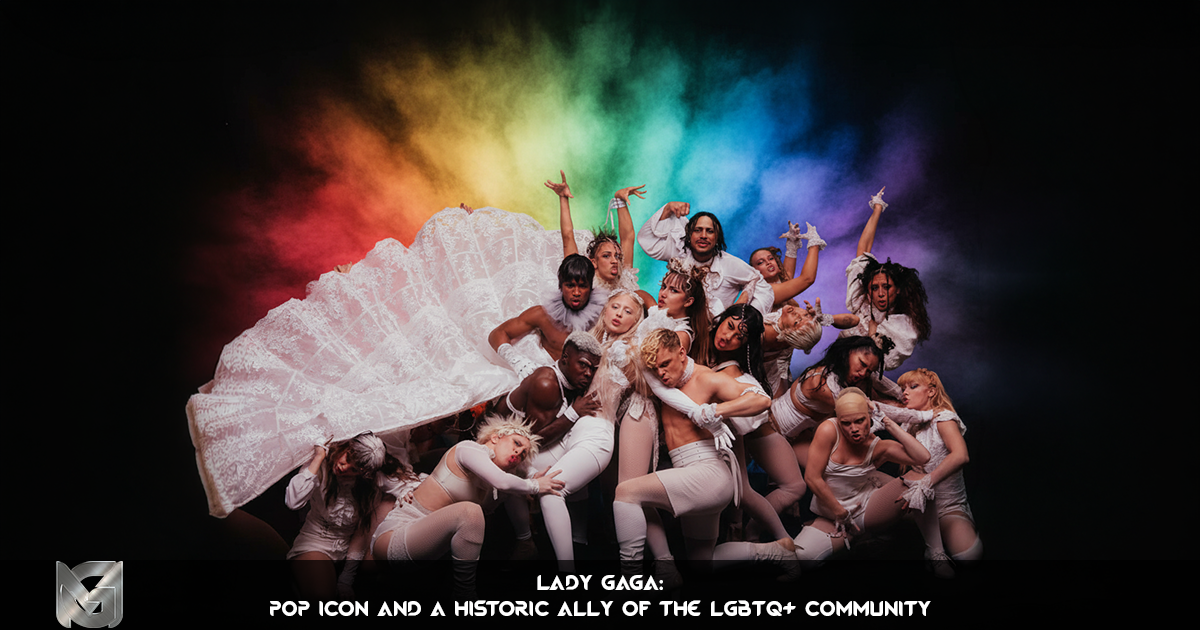
Lady Gaga is not only a global superstar, she is a figure who has mattered, and still matters, in the imagination and real lives of millions of LGBTQ+ people. Her relationship with the community cannot be reduced to a flag waved in June, or a conveniently “Pride-friendly” chorus. It has been built over time, through songs that became landmarks, public statements, and structured actions, especially for young people.
This article offers a Gay Mag-style read, informative and accessible, of that specific bond: how a pop artist became an icon, why Born This Way went far beyond hit status, and how Gaga’s commitment also played out in political and community spaces. For many readers, Lady Gaga is also a personal reference point, a name associated with survival, pride, and the right to exist.
Before the icon: an “outsider” DNA and a promise of self-acceptance
Pop has always had its divas, but not all of them become LGBTQ+ icons. For a star to be embraced, it takes more than style, it takes a shared emotional grammar. Very early on, Lady Gaga embodied a simple idea: difference is not a fault, it is power.
An aesthetic that speaks to camp and queer culture
Impossible outfits, theatrical performances, deliberate excess, humour, self-parody, arty references, Lady Gaga has played with the codes of gender and representation. This camp dimension is not a detail. In queer cultures, camp is a way to turn marginalisation into spectacle, and spectacle into a space of freedom.
“Little Monsters”: flipping stigma into belonging
Her fanbase language, the “Little Monsters”, works as a reversal. Where “monster” has long been used to exclude, she turns it into a sign of belonging. Many LGBTQ+ people instinctively understand this mechanism: take what hurt, reframe it, and make it a tool for pride. In that sense, Lady Gaga did not just build a fandom, she helped build a community vocabulary.
Born This Way: the moment pop becomes a refuge
When Born This Way was released in 2011, the song quickly became a cultural marker. NPR described it as an LGBT anthem, and Lady Gaga presented the track as a “freedom song”. It is not only a song about acceptance, it is a song for acceptance, designed to be sung together.
Why the impact hit so hard
The message is direct: you don’t have to apologise for existing.
The format is pop: mass radio play, clubs, stadiums.
The appropriation was immediate: coming-outs, Pride, videos, placards.
At a time when mainstream LGBTQ+ representation was still often coded, timid, or kept in niches, hearing a superstar affirm identity as legitimate had a validating effect. For many, Born This Way was a first sentence of support, said out loud, without detours, and Lady Gaga became the voice attached to that sentence.
What the song does not do, and what it still does
A song does not change a law, and pop can be co-opted by marketing. But the importance of Born This Way lies in its social use. It became a shared language, a collective ritual, and sometimes an intimate lifeline. That is where music goes beyond entertainment, and where Lady Gaga moved from pop star to cultural symbol.
From stage to politics: when Gaga uses her megaphone for rights
The relationship between Lady Gaga and the LGBTQ+ community is also visible in episodes where she used her platform to push political issues into mainstream media.
“Don’t Ask, Don’t Tell”: a highly visible stance
In the early 2010s, Lady Gaga spoke out against the US policy “Don’t Ask, Don’t Tell”, which prevented LGBTQ+ people from serving openly in the military. Press round-ups, such as Billboard, highlight several moments where she tied her media presence to that fight.
What matters here is the method: taking a pop space (red carpets, interviews, major events) and injecting a topic that many would rather leave to NGOs. This kind of “shift” has a concrete effect: it forces mainstream outlets to cover the issue, and it shows how Lady Gaga used fame as leverage.
Speeches, marches, visibility: the pop star outside the studio
Transcripts of speeches by Lady Gaga at activist events circulate, notably around the National Equality March (2009). Again, the point is not to sanctify a celebrity, but to note a choice: being physically present, lending her voice, and accepting that this becomes part of her public image.
The Born This Way Foundation: when commitment becomes structure
Creating a foundation means moving from message to infrastructure. The Born This Way Foundation focuses on young people’s wellbeing, mental health, and anti-bullying work. These are central issues for LGBTQ+ teenagers, who are overrepresented in experiences of rejection, isolation, and school-based violence.
Why this is a turning point in the Gaga–LGBTQ+ relationship
Because the action is lasting, not only event-based.
Because the target group, young people, is particularly vulnerable.
Because it connects pop culture and prevention, without moralising.
The Obama White House archives even published a post about a meeting with Lady Gaga on inclusion and equality for young people, a sign that her commitment was taken seriously beyond the spectacle.
An LGBTQ+ icon: how it’s built, and why it lasts
The word “icon” is often used too loosely. In Lady Gaga’s case, it can be explained by a convergence: a queer-friendly aesthetic, a message of acceptance, and an intense emotional bond with part of her audience.
An emotional relationship, not only admiration
Many LGBTQ+ fans do not “consume” Lady Gaga as a product. They attach to her as a presence. For some, she was the first mainstream figure to say clearly: you are not a problem. That sentence, when you grow up in a hostile environment, can change a trajectory.
Representation: visibility, queer codes, and a sense of belonging
LGBTQ+ representation is not just “having gay fans”. It plays out in images, narratives, bodies, references, and the space given to people on the margins.
A queer-friendly aesthetic, without an instruction manual
Gaga has often delivered pop where gender is performance: costumes, characters, metamorphoses, theatricality. That approach speaks to a queer culture that has learned to build identity, sometimes to protect itself, sometimes to reveal itself.
What stands out is that this aesthetic is not presented as a “lesson” about diversity. It exists, full stop. And for many LGBTQ+ people, seeing a global star treat eccentricity as a possible norm is already a statement, and Lady Gaga has made that statement repeatedly.
The audience as co-author
An LGBTQ+ icon is built by two forces: the artist and the community. Fans reinterpret songs, looks, and videos, and turn them into recognition signals. Born This Way is the most obvious example, but the attachment to Gaga goes beyond one track: it is rooted in a fan experience where you feel less alone. In that process, Lady Gaga becomes a shared reference, not just a celebrity.
From ally to political symbol: what that implies
When a star becomes a symbol, they inherit an implicit responsibility. Not an obligation to be perfect, but an obligation to be consistent.
The ally is not the centre, but can open doors
A key nuance: Lady Gaga is not “the voice” of the LGBTQ+ community. She is an artist who chose to amplify issues, sometimes at the cost of controversy, sometimes by taking image risks.
That kind of visible allyship can have concrete effects: it draws mainstream media attention, normalises topics, and gives courage to people who do not have a microphone. In other words, Lady Gaga can function as a bridge between mainstream culture and community realities.
The limits: celebrity does not replace struggle
It also has to be said clearly: a pop star replaces neither NGOs nor activists nor public policy. The risk is to confuse emotion with structural change.
But the opposite is also true: emotion can be a trigger. For an isolated teenager, a song, a speech, a figure saying “you have the right to exist” can be the first step towards self-affirmation, and Lady Gaga has often been that first step.
“Rainbow capitalism”: the critique, and why Gaga can’t be reduced to it
Pride has become a market. Brands and the cultural industry know how to monetise LGBTQ+ symbols. That critique is legitimate, and the community is right to stay vigilant.
Why the critique exists
Because some companies “put a flag on it” without changing their practices.
Because visibility can be used as decor, not commitment.
Because the rainbow can become a product, not solidarity.
Why Gaga partly resists that reduction
Reducing Lady Gaga to a marketing operation does not hold up against the length of her commitment, repeated public stances, and the existence of a foundation focused on youth wellbeing and mental health. Billboard, for example, lists many moments where she publicly expressed support for the LGBTQ+ community.
That does not mean she escapes every industry logic. No one does, entirely. But the useful question, from a Gay Mag perspective, is: what, in her trajectory, produced visibility and concrete help? On several points, the answer is tangible, and Lady Gaga is part of that tangible record.
Legacy: what Gaga changed in mainstream pop
Gaga’s impact can also be measured by what she made possible for others.
A more explicit pop conversation about identities
After Born This Way, it became harder for the industry to claim LGBTQ+ themes were “too risky” for the general public. The door was opened: you can be mainstream and talk about acceptance, pride, and rights. That shift is tied to many forces, but Lady Gaga is one of the names most often cited.
A shared emotional grammar
Gaga popularised a way of talking about the self, difference, shame, and pride that travelled far beyond her music. In coming-outs, in slogans, in tattoos, in placards. An icon is also a bank of symbols people draw from, and Lady Gaga has supplied many of them.
Pop as a survival space
For part of the LGBTQ+ audience, pop is not just entertainment. It is a space where you learn to stand tall. Gaga belongs to that history, like other major figures embraced by the community, because she embraced the “refuge” dimension of her art. For many, Lady Gaga is the name attached to that refuge.
Why the bond keeps evolving
A lasting relationship shows its strength in its ability to move through change: new albums, new audiences, new fights.
A community that loves, but also demands
The LGBTQ+ community does not “hand out” icon status for free. It builds it, carries it, and also questions it. Fans have a long memory: they can tell opportunism from commitment that lasts.
That standard is healthy. It reminds us that no symbol is above criticism, and that allyship is proven over time. It also explains why Lady Gaga is still discussed, still referenced, still expected.
An icon, ultimately, is a presence
Lady Gaga remains a name that matters because she was there at key moments: in clubs, in headphones, in teenagers’ bedrooms, in marches, in speeches. She gave a pop form to a political idea: dignity.
Lady Gaga, an icon because the bond is real
Lady Gaga became an LGBTQ+ icon because her commitment showed up on several levels: cultural (an anthem), symbolic (a queer-friendly aesthetic), political (public statements), and structural (a foundation focused on young people and mental health).
We can discuss the limits of pop, the contradictions of the industry, and the risks of co-option. But we cannot erase what many people say very simply: Lady Gaga helped them feel legitimate. And in a world where homophobia and transphobia remain realities, that legitimisation is not a detail, it can be a condition of survival.
For comments or projects, please contact me.