Mpox in gay men has been a major community health topic since the international outbreak of 2022. It matters to talk about the facts clearly, without panic or stigma, because prevention works, and because good information helps avoid complications and preventable transmission.
In this article, we look back at the 2022 picture, and also at the current situation, with a Gay Mag approach: precise, useful, and readable. Above all, we remind readers that mpox in gay men is best handled as a sexual health topic: testing, vaccination, practical risk reduction, and fast access to care.
What mpox is (in brief)
Mpox (formerly “monkeypox”) is a viral infection. It can cause a rash that is often painful, swollen lymph nodes, fever, fatigue, and other general symptoms.
Since 2022, in many countries, a large share of transmission has occurred within networks of intimate contact, including among men who have sex with men (MSM). That is why community media often talk about mpox in gay men, without implying that mpox is a “gay disease”.
Why mpox affected some gay networks in 2022
It is not a “gay disease”. But infections spread where close contact is frequent.
In 2022, the virus circulated efficiently in some sexual networks, with prolonged skin-to-skin contact, sometimes with multiple partners, and with festive settings that increased proximity. Naming these realities is not about blaming anyone, it is about targeting prevention where it is most effective, and therefore responding better to mpox in gay men.
2022 overview: what the data showed (and its limits)
Figures vary by country and period, but several trends were very robust during the 2022–2023 episode.
An outbreak mostly observed in men, often via intimate contact
Surveillance analyses reported that the vast majority of cases with available data were in men, and that a substantial proportion reported sexual or intimate contact with other men in the weeks before symptoms.
That framing explains why campaigns focused on mpox in gay men and on MSM with multiple partners.
Transmission in sexual networks: a strong signal
Health authorities described sexual or intimacy-related transmission as a central driver of the 2022–2023 outbreak. This had two positive consequences:
- Risk-reduction messages could be targeted, including for mpox in gay men.
- Vaccination (when available) could be prioritised for people most exposed.
Limits to keep in mind (important)
- Data often rely on self-reporting (potential bias).
- Diagnosed cases reflect access to testing and care.
- “Gay community” figures are often MSM figures (an epidemiological category) and do not map perfectly onto identities.
Current situation (2024–2026): what has changed, and what remains true
The situation is no longer what it was in 2022 in most European countries, but mpox has not disappeared.
Health authorities describe circulation that can return in waves, with different dynamics depending on world regions and on viral clades (lineages).
1) The virus still circulates, but differently depending on the area
- Globally, WHO continues to monitor an evolving situation.
- In Europe, ECDC publishes updates: trends may fall for a while, then rise locally.
- In the UK, reports describe cases linked to specific clades.
This is crucial: even if people talk less about mpox in gay men than in 2022, risk can rise locally, especially during high-mobility periods (travel) or major events.
2) Clades: why they matter (without unnecessary jargon)
For the public, the key points are:
- some lineages have been associated with different transmission contexts and geographic areas,
- genomic surveillance helps detect introductions and local transmission.
In practice, this does not change the core actions: mpox in gay men is still mainly about close contact, recognising symptoms, and getting rapid access to care.
3) What this changes for the gay community
- Prevention remains centred on intimate contact and early symptom recognition.
- Vaccination still plays an important role for people most exposed.
- Risk-reduction messages remain relevant, especially during events, travel, or periods of resurgence.
In other words, even today, mpox in gay men is best prevented with realistic strategies, not moralising instructions.
Symptoms: how to recognise possible mpox
Mpox can resemble other infections, including STIs. What matters is spotting compatible signs and seeking medical advice.
Common symptoms
- Rash: bumps, blisters, pustules, scabs, sometimes localised (genital, anal, mouth).
- Pain: lesions can be very painful, especially anal lesions.
- Swollen lymph nodes.
- Fever, chills.
- Fatigue, aches, headache.
Features observed in the 2022 outbreak
Many patients had lesions in the genital/anal/oral area, sometimes with few general symptoms. This can lead to confusion with other STIs.
This matters for mpox in gay men: an unusual genital or anal lesion deserves a consultation, even if you feel “mostly fine”.
When to seek care quickly
- New unexplained rash, especially genital/anal/oral.
- Significant anal pain, bleeding, difficulty urinating.
- Fever + swollen nodes + lesions.
- Recent intimate contact with a diagnosed or suspected case.
Transmission: what really increases risk (and what tends to be lower risk)
Mpox is mainly transmitted through close contact, especially skin-to-skin contact with lesions, scabs, or fluids, and through intimate contact.
In sex: higher-risk situations
- Sex involving prolonged skin-to-skin contact.
- Contact with lesions (even small ones).
- Oral or anal sex when lesions are present in the relevant area.
- Sharing sex toys without cleaning/disinfection.
To summarise: mpox in gay men is mainly a risk when there is proximity, friction, skin-to-skin contact, and exposure to a lesion.
Outside sex: possible, but generally less frequent
- Prolonged close contact (hugging, massage) with a symptomatic person.
- Laundry, towels, bedding in contact with lesions (depending on context).
Sexual prevention: reduce risk without moralising
The most effective prevention is the one you can actually apply. The goal is not “zero sex”, it is less risk.
1) A quick self-check before a hook-up (simple, useful)
- Look for bumps, scabs, sores, especially on penis/anus/mouth.
- Pay attention to unusual anal pain.
- If in doubt: postpone, or switch to practices without skin-to-skin contact.
This is a very concrete measure against mpox in gay men.
2) Adapt practices during periods of circulation
- Prefer practices with less skin-to-skin contact (depending on what you enjoy).
- Avoid sex if you have a rash or fever.
- Temporarily reduce your number of partners if the outbreak restarts locally.
The idea is not to shame anyone, it is to make mpox in gay men less “profitable” for the virus.
3) Condoms: useful, but not enough
Condoms protect very well against several STIs, but for mpox they do not cover all skin in contact. They remain relevant, but should not create a false sense of security.
So: yes to condoms, and yes to other measures, because mpox in gay men can be transmitted via uncovered areas.
4) Hygiene and equipment
- Do not share towels, sheets, harnesses, gloves, or toys without cleaning.
- Clean/disinfect sex toys.
- Wash hands after intimate contact.
These simple steps also reduce the risk of mpox in gay men in sexual and party settings.
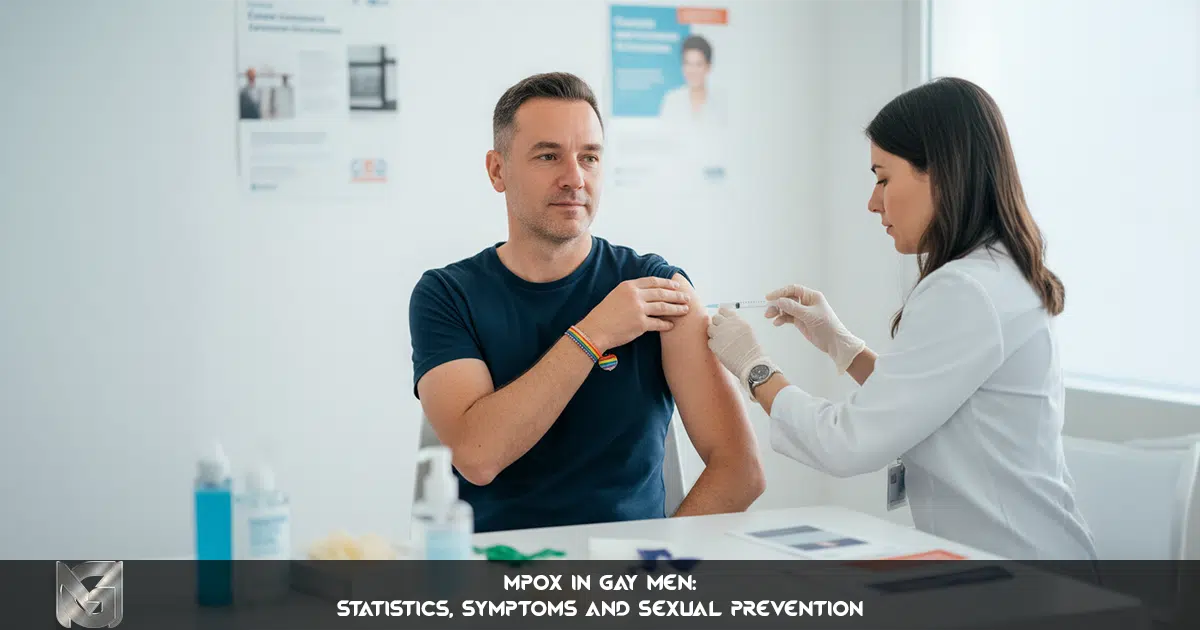
Vaccination: a major lever when available
Health authorities have integrated vaccination into the mpox response, often with strategies targeting people at higher exposure risk.
Who may be concerned?
Depending on the country, vaccination may be offered to:
- MSM with multiple partners.
- People attending certain venues/events with close contact.
- People living with HIV (depending on local recommendations).
- Contacts of a confirmed case (post-exposure vaccination).
In many countries, targeted vaccination has been central to reducing mpox in gay men.
Key takeaways
- Vaccination does not replace common sense, but it strongly reduces risk.
- Schedules (number of doses, timing) depend on local guidance.
Testing, diagnosis, isolation: what to do if you suspect mpox
If you have compatible symptoms:
- Avoid intimate contact until you have medical advice.
- Contact a sexual health service or your GP.
- Ask whether an mpox test is indicated.
How long are you contagious?
Contagiousness is mainly linked to lesions. In practice, people are advised to avoid contact until lesions have fully healed.
This reflex is essential: it is how we break chains of mpox in gay men.
Mpox and other STIs: think “sexual health bundle”
The mpox episode highlighted a key point: sexual health is managed better as a bundle.
Useful checklist
- Regular STI testing.
- PrEP if indicated.
- Hepatitis A/B and HPV vaccination (depending on profile).
- Open discussion with partners (without judgement).
This bundle is particularly relevant when we talk about mpox in gay men, because symptoms can mimic an STI.
Stigma: the trap that pushes prevention backwards
When an infection is associated with a group, shame and fear can delay care.
The right message:
- You can be gay and responsible, informed, sexy, and cautious.
- Prevention is a community skill, not a moral order.
This is also how we manage mpox in gay men better: by keeping access to care simple, fast, and judgement-free.
Key points (actionable summary)
- Mpox is mainly transmitted via close contact, often intimate.
- Genital/anal/oral lesions were common.
- Vaccination and risk reduction work.
- If in doubt: pause intimate contact, seek care, test.
Mini guide “before/after a hook-up”
- Before: check your skin, no hook-up if fever/rash.
- During: limit skin-to-skin contact if risk is high, condoms are useful but incomplete.
- After: watch for symptoms, seek care early if unsure.
For comments or projects, please contact me.