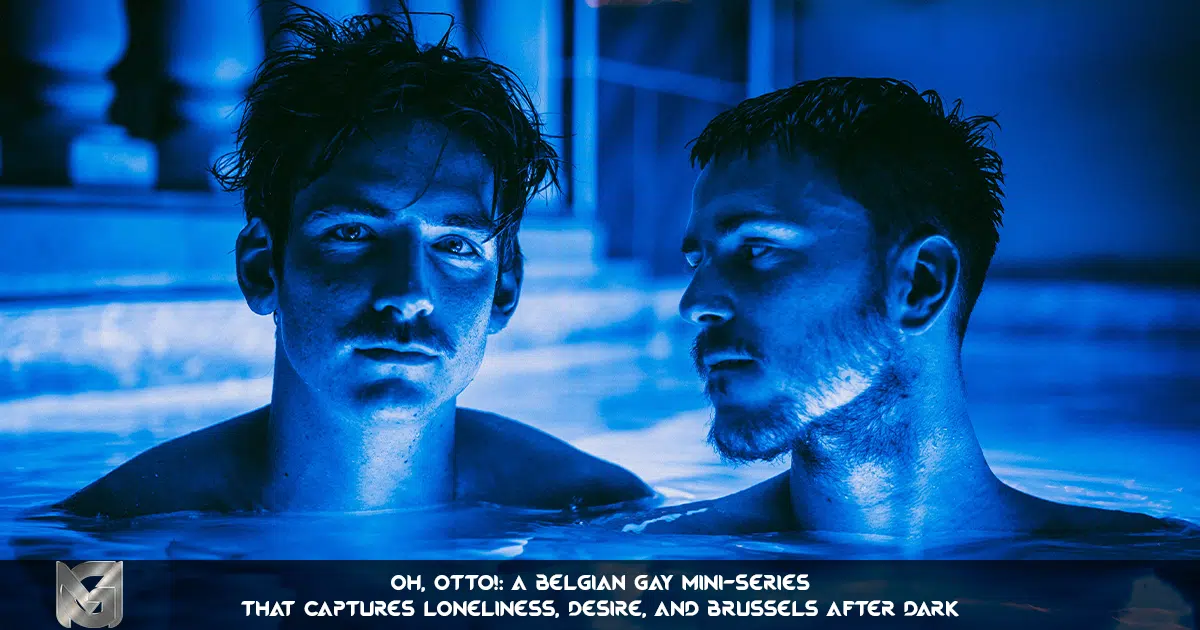
Oh, Otto! is not just another gay series you scroll past in an endless LGBTQ+ carousel. It is a Belgian mini-series that chooses a rarer angle, the aftermath. After the breakup, after the rush, after the promises. In that “after”, there is a body still looking for warmth, a city that absorbs everything, and a string of encounters that sometimes feel like bandages, sometimes like mirrors.
Premiered in a festival context at CANNESERIES, the series follows Otto, a young man newly single, moving through Brussels in search of a little heat, presence, sex, validation, or simply a moment when you don’t feel so alone. The result is fast, intimate, and at times blunt, a story that speaks as much about desire as it does about emotional fatigue.
A Belgian mini-series with a tight format, built like a chronicle
The format is a signal. Oh, Otto! is presented as a mini-series, with a first season listed as 7 episodes of around 25 minutes. That choice sets the pace, a chronicle, a sequence of fragments rather than a big, sprawling TV novel.
7 episodes, 25 minutes, and a “fast-paced” narrative
On IMDb, the series is described as a fast-paced gay story in which a newly single man wanders Brussels looking for fleeting yet comforting encounters. That promise of speed is not just a gimmick, it matches a contemporary reality, nights that blur together, messages that stack up, bodies that cross paths, and the feeling that everything can shift with a single notification.
Brussels as a setting, but also as a state of mind
Brussels is not a postcard backdrop. The city becomes an atmosphere, a maze, a hunting ground, sometimes a shelter. The series fits into a European tradition of urban storytelling where the city shapes behaviour, desire, fear, and momentum.
Otto: a character closer to lived experience than fantasy
What makes Oh, Otto! interesting for a Gay Mag audience is its closeness to lived experience, without moralising and without forced glamour.
A single man searching, but not always sure what for
Otto is not framed as an exemplary hero. He is a character in motion, sometimes contradictory. He wants contact, yet fears attachment. He wants to be desired, yet grows tired of the mechanics. He wants to forget, yet keeps finding himself.
That ambivalence is the point. Gay storytelling has often been trapped between two poles, tragedy (shame, violence, HIV, rejection) and romantic comedy (meet-cute, couple, happy ending). Here, the interest lies elsewhere, in the grey zone, where you live, mess up, and start again.
Jonathan Michiels in the lead role
Otto is played by Jonathan Michiels, according to public listings (IMDb). In a series so centred on one character, performance is decisive, everything runs through presence, silence, micro-reactions, the way fatigue or desire sits in the body.
Sex, hookups, apps: does the series speak to us today?
There is a question many gay viewers ask, sometimes unconsciously, when watching a series like this: does it ring true? Oh, Otto! seems to answer with a direct approach.
Fleeting encounters as an emotional language
The official description insists on encounters that are “fleeting” and “comforting”. That matters. In many contemporary gay lives, a hookup is not only sexual, it is also an emotional language. Sometimes you are not looking for a “plan”, you are looking for a pause. A touch. Proof that you exist.
The series can be read as a map of consolation, and of its limits. Because consolation, when it becomes repetitive, can turn into routine, avoidance, numbness.
A sexuality shown without lectures, but with intention
With a “steamy” series, the risk is sliding into illustration or marketing provocation. The interest of Oh, Otto! is to make sex a narrative element, not a sales pitch. Sex is not there to “look gay”, it is there because it is part of life, and because it reveals things, about loneliness, tenderness, and the need to feel chosen.
A European gay series, far from US codes
Several English-language pieces have framed Oh, Otto! as the kind of gay series that American TV rarely makes, precisely because it centres adult gay themes without smoothing them out.
Realism as an aesthetic
Realism here is not only visual. It is moral. The series does not seem to aim for a spotless protagonist, nor to turn every episode into a lesson. It shows a man moving through a period of his life, with questionable choices, impulses, and backtracks.
Writing that favours sensation over demonstration
The short format and quick pace encourage a touch-based writing style. Less speechifying, more impression. That approach is particularly effective for intimate subjects because it leaves viewers space to project their own experience.
CANNESERIES: what the selection says about the moment
The presence of Oh, Otto! at CANNESERIES (announced as a World Premiere) is not trivial. Series festivals now act as cultural filters, signalling works that attempt something beyond formatting.
Visibility beyond the niche
When a gay series is programmed in a mainstream festival context, it steps outside the purely community circuit. That does not guarantee quality, but it increases the chances that a gay story is treated as a story, not as a category.
Where to watch Oh, Otto! and what to expect
Based on public information, Oh, Otto! is associated with Streamz for distribution. For French-speaking audiences outside Belgium, availability may vary, and the series may later circulate via other platforms or international sales.
Who should you recommend it to?
- Anyone who likes intimate, urban gay storytelling with little filter.
- Viewers who prefer chronicle and atmosphere over twist-heavy plotting.
- People who want gay sexuality treated as reality, not as set dressing.
Who might it be less for?
- If you want a classic romcom with a linear path to coupledom.
- If you expect a strongly plot-driven series with big external stakes.
What Oh, Otto! is really about: the search for presence
Beyond sex, beyond hookups, Oh, Otto! seems to be about something universal, but particularly sharp in some gay lives: the search for presence. To be seen. To be touched. To be chosen, even for an hour.
That is where the series can become precious. Because it does not sell a model. It shows a moment. A passage. A period where you wrestle with yourself, with the city, with desire, with the idea that maybe you deserve more than a 2 a.m. message.
For Gay Mag: angles and reading paths
If you want to cover Oh, Otto! for Gay Mag, here are three possible angles, without overpromising.
1) “Gay Brussels, after dark”
A piece centred on the city as a character, the geography of encounters, urban culture, and what the series captures of a scene.
2) “After the breakup: sex, consolation, and emotional fatigue”
A more social-psych angle, without over-psychologising, on the role of fleeting encounters as an affective survival strategy.
3) “The adult gay series we rarely get”
A media angle, on the place of adult, un-softened gay storytelling in festival selections and platforms.
For comments or projects, please contact me.