Rob Jetten has, in just a few years, become one of the most talked‑about figures in Dutch politics. His rise tells several stories at once: a country where coalition culture makes compromise a daily craft, a generation of leaders who speak about climate, energy and Europe without hesitation, and an LGBTQ+ visibility that is no longer confined to symbolism.
In a European landscape where LGBTQ+ rights are sometimes weaponised, contested or quietly rolled back, Rob Jetten’s trajectory draws attention. Not because he is “the gay candidate” of a party, but because he represents a form of normalisation: a senior politician who is open about his private life, while being assessed primarily on his files, his choices and his ability to govern.
Who is Rob Jetten, in a nutshell
Rob Jetten is a Dutch politician and a leading member of D66 (Democrats 66), a party typically described as centrist, social‑liberal and pro‑European. International profiles tend to highlight three recurring markers: a modern, direct style, a clear pro‑EU stance, and a strong association with the energy transition.
Public biographies describe a fast, structured progression: early experience in local politics, then a move to the national parliament, and eventually a prominent leadership role within D66. Exact dates and job titles can vary depending on how sources are updated, but the overall arc is consistent: rapid national prominence built through parliamentary work and party responsibilities.
D66: Dutch centrism, “progress + pragmatism”
To understand Rob Jetten, you need to understand D66’s place in the Netherlands. In a political system where coalitions are the norm, D66 has often acted as a pivot party, shaping key trade‑offs, especially around:
- European integration and international cooperation
- education and innovation
- civil liberties and fundamental rights
- climate policy
This coalition culture has a concrete effect: it produces politicians who can negotiate, but who must also accept being criticised, sometimes harshly, when compromises disappoint parts of their electorate.
Rob Jetten and climate politics: the issue that shapes his public image
If Rob Jetten is frequently framed as part of a “new generation”, it is not only about age or communication style. It is also because his public image is tightly linked to climate and energy.
International coverage often portrays him as a politician associated with transition policies and the difficult balancing acts they require: climate targets, energy security, cost of living pressures and social acceptability. In post‑crisis Europe, these questions have become politically explosive, and they separate leaders who can hold a long‑term line from those who govern week‑to‑week.
A hard political equation
Climate policy is where public ethics and household economics collide. Voters may support ambition in principle, then turn against it if bills rise or measures feel unfair. In that context, Rob Jetten is often described as trying to reconcile:
- climate ambition
- economic competitiveness
- household protection
- coalition stability
That kind of equilibrium is precisely what makes, or breaks, a centrist career.
An LGBTQ+ visibility that is not “just a symbol”
Rob Jetten is openly gay, and that fact appears regularly in profiles because it carries political and cultural weight. In the Netherlands, often perceived as advanced on LGBTQ+ rights, openly LGBTQ+ elected officials are not new. But visibility at the top level remains, in any country, a marker.
What stands out in recent portraits is the tone: his private life is present, but not sensationalised. It is treated as one biographical element among others, alongside his political trajectory.
Why visibility still matters, even when it looks “normalised”
Normalisation does not erase backlash. In a Europe where some governments and movements explicitly target LGBTQ+ people, an openly gay politician at the centre of power has several effects:
- it challenges the idea that homosexuality is incompatible with political authority
- it offers a counter‑narrative to “anti‑woke” rhetoric that caricatures LGBTQ+ rights
- it shows that the defence of liberties can also come from centrist parties, not only from activist left politics
For a publication like Gay Mag, the editorial interest is clear: to show how representation can be both ordinary and politically meaningful.
The partner, the engagement, and the media’s appetite for narrative
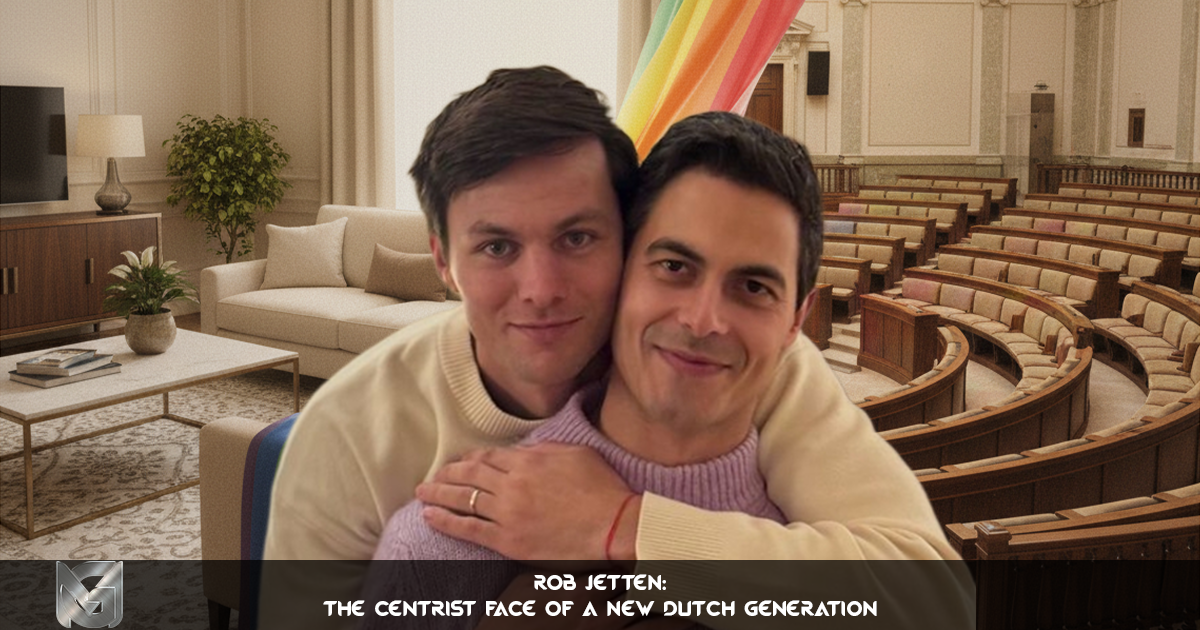
Press coverage has also highlighted his relationship with Nicolás Keenan, an Argentine field hockey player. Several outlets report that they have been together since the early 2020s and that their engagement was later publicly announced.
This kind of storyline “the political leader and the athlete” is obviously media‑friendly. But it needs careful reading: celebrity coverage and political reporting do not have the same aims. For Gay Mag, the point is not to write a romance novel, but to observe what this visibility produces in the public sphere.
What this visibility produces in the public sphere
- positive identification
- curiosity that can become intrusive
- a renewed discussion about the role of partners in political communication
Rob Jetten’s style: modernity, media presence, direct language
International profiles often stress a contemporary style: clear messaging, controlled media presence, and an ability to embody a line without sounding purely technocratic.
That does not mean everything is “branding”. In today’s democracies, especially where coalitions blur programme lines, personal embodiment has become part of the job. Voters look for anchors, and leaders become anchors.
The risk: being reduced to an image
The downside is simplification. A politician can be boxed into:
- a generational story (“the young leader”)
- an identity story (“the gay leader”)
- a style story (“the communicator”)
But the reality of a career like Rob Jetten’s is decided by the ability to hold files, manage crises, build coalitions, and survive the media cycle.
What his trajectory says about Europe right now
Rob Jetten matters beyond the Netherlands because he crystallises broader European tensions.
Three tensions he embodies
- Europe vs national retrenchment, in a context of crises and war on the continent’s borders
- ecological transition vs social anxiety, as households fear paying the price of transition
- LGBTQ+ rights vs backlash, as visibility becomes a target
In that frame, a pro‑EU centrist leader who is openly gay becomes “readable” to international media: easy to narrate, but also easy to attack.
A key question: how resilient is the centre?
The centre is often accused of softness, or conversely of technocratic harshness. The truth is simpler: centrism governs through compromise, and compromise always disappoints someone.
If Rob Jetten consolidates his position over time, it will be less because of novelty and more because of his ability to:
- build majorities
- hold a climate line without losing consent
- defend liberties without turning everything into posture
For Gay Mag, Rob Jetten’s story is not only about LGBTQ+ representation. It is also about power: how an openly gay man navigates a coalition‑driven system, how he is perceived abroad, and how his visibility is sometimes used occasionally against him.
The core question
The question is not “is he a symbol?” The question is: what does he do with his position, and what does the political system do with him.
Rob Jetten is, in his own way, a test. A test for European centrism and whether it can still offer a readable project. A test for the ecological transition, which requires unpopular but necessary decisions. And a test for LGBTQ+ visibility, which advances, yet remains exposed to backlash.
For Gay Mag readers, the point is not to celebrate a “hero”, nor to look for a perfect role model. The point is to understand how an openly gay, pro‑European, climate‑focused centrist becomes a figure that matters, and why that resonates far beyond the Netherlands.
For comments or projects, please contact me.