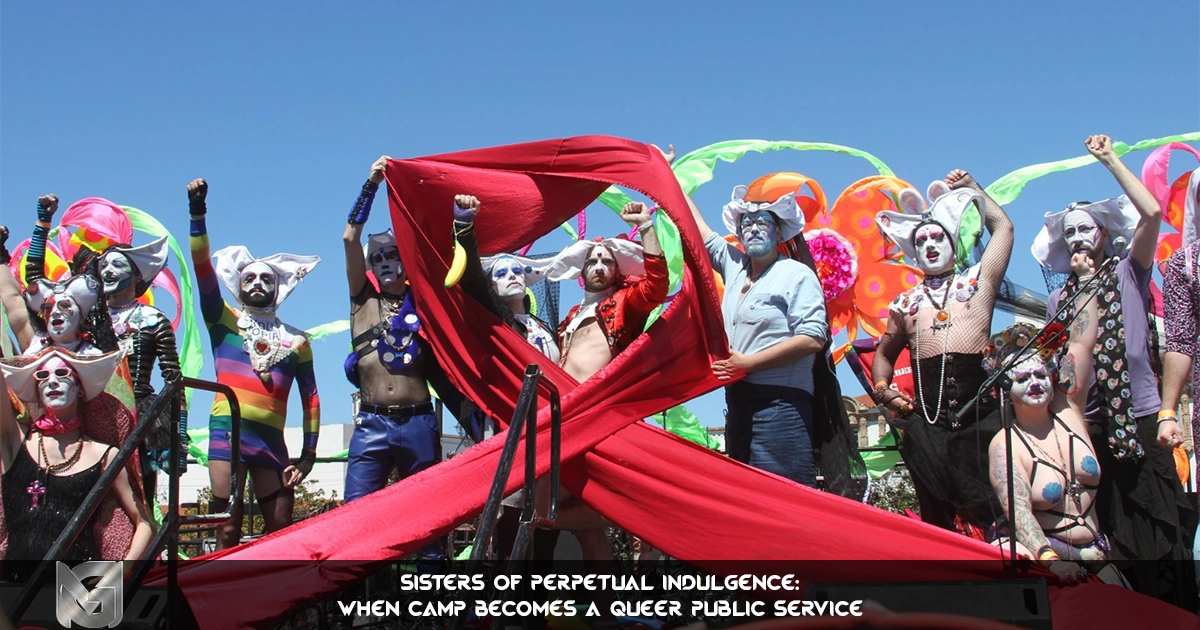
Sisters of Perpetual Indulgence. The name lands like a manifesto, half prayer, half wink. Since the late 1970s, this San Francisco-born order has blended street performance, irreverent humour and very real community work. Their promise, repeated like a creed, rests on two simple ideas: defending everyone’s right to express joy, and helping people free themselves from stigmatising guilt.
Behind the white face paint, veils, stage names and slogans, there is an organisation that lived through the arrival of HIV/AIDS, years of moral panic, and culture wars around sex and gender, before spreading into an international network of autonomous chapters. Here’s a clear, accessible deep dive: history, key moments, how new Sisters are brought in, and a focus on a lesser-known but essential part of the order’s DNA, the Guards.
A birth in the Castro: 1979, irreverence as a shield
The Sisters of Perpetual Indulgence first appear in the Castro, San Francisco’s iconic gay neighbourhood. Historical accounts place the beginning in spring 1979, when a small group of gay men walk out dressed as Catholic nuns. It isn’t just a gag: at the time, the neighbourhood is regularly targeted by preachers and conservative campaigns that turn homosexuality into a public object of shame.
Very quickly, the costume becomes a language. “Nun drag” flips the stigma: it takes religious imagery, often used to induce guilt, and turns it into street theatre, satire, and a conversation starter. The point isn’t “against faith”, but against the moral and social violence carried out in the name of a single moral order.
First turning point: formalising the order and the first fundraisers
From 1979 onwards, the Sisters of Perpetual Indulgence organise, recruit, take on a name, and stage events. Early public actions already combine the two pillars that will remain constant: visibility and fundraising for community causes. The idea is straightforward: be there, in the street, in bars, at parties, close to people, and turn presence into support.
The AIDS years: prevention, care, and a “ministry of presence”
If there is one thread that explains why the Sisters of Perpetual Indulgence matter in LGBTQ+ history, it runs through the 1980s. The HIV/AIDS epidemic changes everything: fear, misinformation, stigma, institutional abandonment. The Sisters step into a role many structures fail to hold: to inform, to protect, to accompany, to stay.
“Play Fair!”: a key moment in sex-positive prevention
In 1982, members and health professionals associated with the Sisters of Perpetual Indulgence contribute to “Play Fair!”, often presented as one of the first safer-sex pamphlets to speak plainly, with humour, without moralising. Its tone cuts through shame: practical advice, accessible language, and a way of talking about risk without humiliating people.
This matters for two reasons:
It shows the order isn’t only spectacle, but a community health actor.
It sets a method: defuse without minimising, speak honestly, and use humour as an entry point.
Memorials and collective grief
The Sisters of Perpetual Indulgence also take part in collective mourning and memory at a time when deaths multiply. They refer to their departed as “Nuns of the Above”, and contribute to rituals that help communities hold on together through the scale of loss.
One order, many chapters: international growth and autonomy
Over time, the Sisters of Perpetual Indulgence become an international network: chapters form across the United States, Canada, Australia, Europe, and beyond. Each “house” is generally autonomous, rooted in local realities, while sharing an aesthetic, a humour, and a mission.
That structure helps explain their longevity: the Sisters of Perpetual Indulgence are not a centralised franchise, but a constellation. San Francisco remains a symbolic and organisational reference point, but local orders adapt their work to the urgencies on the ground.
How membership profiles evolved over time
Like many LGBTQ+ movements born in a specific context, the Sisters of Perpetual Indulgence have also evolved around the question of who can join. Depending on chapters and eras, recruitment and profiles broadened, with a more visible place given, in some contexts, to people of diverse genders, including trans people. In the order’s logic, what matters most remains commitment, community service, and the ability to hold a public presence.
Key moments: when pop culture meets politics
The Sisters of Perpetual Indulgence have a history of headline-grabbing moments, often on the border between politics and performance.
Sister Boom Boom and city politics
In the early 1980s, one of the best-known figures of the Sisters of Perpetual Indulgence, Sister Boom Boom, runs in a municipal election in San Francisco and attracts significant media attention. The episode captures a strategy: use the absurd to force society to look at what it would rather ignore.
Recurring controversies: religious satire and conservative backlash
The Sisters of Perpetual Indulgence’s use of Catholic imagery regularly sparks conflict. For opponents, it’s an offence; for supporters, it’s a legitimate critique of institutions that historically produced guilt and sometimes justified exclusion.
More recently, public disputes (including around US sporting events and Pride Nights) show the debate is still raw: the question isn’t only “can you parody?”, but “who gets to be visible, and at what cost?”
How do you become a Sister? Initiation, step by step
Contrary to the “put on a veil and you’re done” fantasy, joining is described as a long, demanding, tightly framed process. On the San Francisco official site, the Sisters of Perpetual Indulgence stress that being a Sister takes time, skills, the ability to work collectively, and a real sense of service.
What they look for
Commonly highlighted qualities include:
motivation, passion, commitment;
a drive for community service;
the ability to juggle multiple tasks with grace;
honesty, character, people skills;
the capacity to integrate into group dynamics.
A journey of at least one year
The path is presented in four stages (with minimum durations):
1) Volunteer
You observe, help out, learn the codes, build relationships. No membership rights.
2) Postulant
You become a member without voting rights. You commit more: meetings, events, and learning the order’s history through archives. Dress is codified (white cassock, “mask” make-up), without a veil.
3) Novice
You begin to “manifest” the outward appearance of a Sister: white face make-up, wimple, white veil. Public interactions shift dramatically, because the figure becomes instantly recognisable.
4) Fully Professed (Black Veil)
The culmination: voting rights, representing the order, taking on responsibilities. The message is clear: the end of the formal path is the beginning of the real work.
The Guards: what protection represents inside the order
In the Sisters’ imagery, people talk a lot about joy, humour, camp. But there’s another, less glamorous word that is central: protection.
The Guards (a term that, depending on chapters and countries, can sit close to the idea of benevolent guards or escorts) embody something very practical: enabling the Sisters of Perpetual Indulgence to be present in public spaces, sometimes in tense contexts, while ensuring safety, flow, and respect.
What do they represent, symbolically?
Holding space: the Sisters of Perpetual Indulgence work in the street, at parties, in direct contact. The Guards embody the idea that queer visibility isn’t “free”: it is protected.
Reminding us the order is a team: the Sister figure is highly visible, but she doesn’t stand alone. Guards make the backstage real: logistics, vigilance, support.
Turning vulnerability into collective strength: in a world where homophobia and transphobia exist, a protection setup says: “we don’t hide, we organise.”
And in practice?
Guards can help to:
manage interactions with the public (curiosity, photos, questions, sometimes aggression);
secure movement and transitions;
support organisation during events (entries, circulation, prevention, distributing materials).
Important: roles and labels vary by country and chapter. But the idea remains: care isn’t only symbolic, it is operational.
Why they still matter today
The Sisters of Perpetual Indulgence remain relevant because they occupy a rare space: useful counterculture. They make people laugh, they sometimes shock, they often unsettle, but they also provide services, raise funds, educate, and create moments where the community can breathe.
In a period where LGBTQ+ rights roll back in several countries, where moral panic is recycled around trans people, and where queer sexuality becomes a battleground again, the Sisters of Perpetual Indulgence’s formula keeps its power: joy + irreverence + solidarity.
Key takeaways (quick scan)
Born in San Francisco in 1979, the Sisters of Perpetual Indulgence use nun drag as satire and a tool of visibility.
They anchor themselves in prevention and support during the HIV/AIDS crisis, notably through “Play Fair!”.
They operate as an international network of autonomous chapters.
Bringing in new Sisters is a long, structured, service-oriented process.
Guards embody the protection/logistics side: making sustained, safe queer public presence possible.
For comments or projects, please contact me.