Delta Drag is not just another drag competition to add to the list of “buzz” shows. It feels more like a marker of the moment. After the global shockwave of Drag Race and the steady mainstreaming of drag on television, a “second wave” is taking shape: shorter formats, more rooted in specific places, closer to local scenes, and sometimes more openly political in the way they embrace a language, a landscape, and a community.
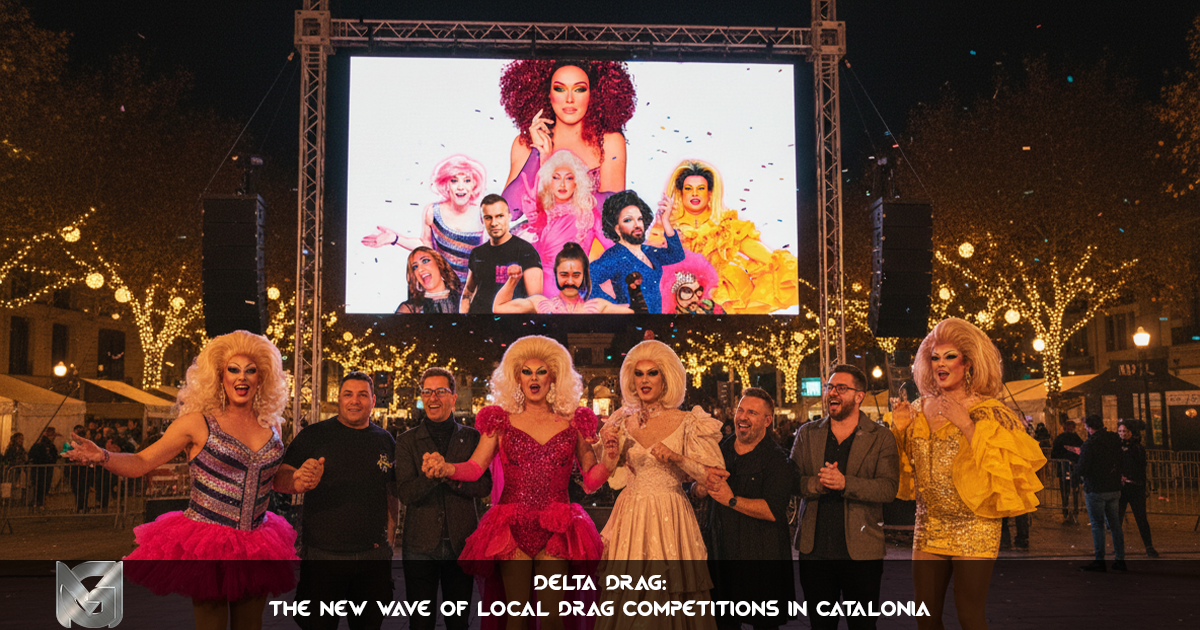
In this context, Delta Drag is arriving in Catalonia as a programme presented as the first drag TV competition created in the region, produced by Okay Productions in collaboration with the Ajuntament d’Amposta. Broadcast on La Xarxa+ and local television networks, the show claims a dual aim: spotlighting drag artistry while positioning the Ebre Delta as an LGBTIQA+-friendly destination. In other words, drag is not a backdrop here, it is the cultural engine.
A post-Drag Race era that no longer wants to be a copy
Drag on TV: from niche to pop culture
In barely a decade, drag has moved from an art form often confined to clubs, bars, activist stages, and cabarets, into a full-blown pop culture phenomenon. Drag Race played an obvious role: it created a global shop window, launched careers, built shared references, and offered a media language that many audiences could access.
But that visibility also produced a side effect: the temptation to replicate the formula endlessly. Even devoted fans eventually tire of clones. Artists, meanwhile, need spaces that respect local specificities: humour, language, codes, styles, and economic realities. This is precisely where Delta Drag sets itself apart.
The “second wave”: local, short, and rooted
Rather than aiming for the international “big machine”, these newer formats bet on:
local distribution (regional platforms and local channels),
shorter runtimes (more agile, easier to try),
a clearly stated cultural identity (language, place, references).
In that sense, Delta Drag looks less like a copy and more like a smart adaptation: a competition designed for a local audience, but with the potential to travel.
A Catalan drag competition: what we know about the format
Dates and broadcast
The programme is built around three key moments:
Two introductory and selection episodes on La Xarxa+: 28 February and 7 March.
A live grand final on 14 March 2026, announced for 21:30, broadcast on local TV and on La Xarxa+.
As for duration, the first two programmes are described in some communications as short formats, around 25 minutes. That choice is not trivial: it matches current viewing habits (platforms, catch-up, mobile consumption) and lowers the barrier for curious viewers who are not necessarily hardcore fans. Again, Delta Drag aligns with a more agile kind of television.
Hosts and drag figures involved
The show is carried by names that resonate both within the community and with audiences already familiar with drag on screen:
Sharonne, announced as host of the final and identified as the winner of Drag Race España.
Brigitta Lamoure, linked to the presentation of the earlier episodes and to the jury.
Zafiro d’Or (often referred to simply as Zafiro), announced as part of the final.
The professional jury includes, among others, Estrella Xtravaganza, Drag Steinburg, Capitano Barbacoño, Vayatella Bersatxe, Ori Maurici, and Brigitta Lamoure. On paper, Delta Drag therefore ticks two boxes: drag credibility and mainstream readability.
A hybrid voting system
The final uses a voting system that mixes expertise and public voice:
50% professional jury,
25% vote from the audience in the venue,
25% televote via streaming.
That split says a lot: the show wants an artistically credible result, but it also embraces the “popular event” dimension. For Delta Drag, that balance is central.
When the territory becomes a character in the programme
The Ebre Delta as setting, but also as narrative
One of the most distinctive aspects of this competition is its insistence on the Ebre Delta and the wider Terres de l’Ebre. In the way the project is presented, the landscape is not just a postcard. It becomes a space for challenges, movement, and storytelling.
La Xarxa mentions sequences filmed in strategic locations across the Delta, with challenges that also aim to raise awareness about the landscape. This is far from a single studio set. It leans into a hybrid format: drag, performance, and territorial narrative. And that is exactly what can make Delta Drag stand out.
Tourism, institutions, and LGBTIQA+ visibility
The project is supported by several institutional and territorial actors, and it is framed as an opportunity to strengthen the Ebre Delta’s tourism appeal as an inclusive destination.
This is where nuance matters:
Yes, visibility can create safer spaces.
Yes, inclusion can be an economic lever.
But the question remains: how do you avoid drag being instrumentalised as a simple “friendly” label?
The answer will depend on how much room the artists are truly given, how queer local culture is narrated, and what remains once the cameras are gone. On that front, Delta Drag will be watched closely.
The choice of Catalan: a detail that changes the reach
A language, a stage, an address to the audience
The programme foregrounds performances in Catalan. For some international viewers, that might sound secondary. In reality, it is a strong choice.
Drag is an art of language as much as of the body: punchlines, storytelling, parody, references, songs, double meanings. Performing in a language means choosing a public, an intimacy, a rhythm. It also states that drag culture is not “placeless”. In that sense, Delta Drag embraces an identity.
Accessibility: barrier or uniqueness?
Of course, a language can exclude those who do not speak it. But it can also create a distinctive signature that attracts. In a saturated content world, identity is a competitive advantage. And for artists, it often means freedom: you do not adapt your humour to a standard, you own it. That is also what can give Delta Drag real texture.
Drag artists, a scene, and a real economy
What these competitions bring to artists
For drag artists, a local TV competition can be:
a showcase,
a booking accelerator,
a way to reach audiences who do not go to clubs,
a form of cultural legitimation.
The announced prizes remain modest compared to large-scale television production, but the stakes are elsewhere: visibility, performance opportunities, and links to events such as Unicorns Pride Ebre. For many, Delta Drag can function as a springboard.
The risk: standardising an art that thrives on the unexpected
Any competition carries a risk: smoothing styles, rewarding what reads best on camera, pushing escalation. Drag is, by nature, plural: glamour, punk, political, absurd, cabaret, performance art, classic transformism, hyperpop, burlesque.
A good competition is not the one that manufactures copies. It is the one that provides a frame without suffocating diversity. That is where Delta Drag will need to convince.
A final designed as an event, not just an episode
La Xarxa describes a final inspired by the Benidorm Fest format, with numbers built for live performance, choreography, original songs, and a full gala dimension. Around it, there is talk of a broader atmosphere: food trucks, DJs, and a bar.
The strategy is clear: turn the final into a cultural appointment, almost a mini-festival. And it is probably one of the best ways for a local programme to exist: create an in-person experience, a collective moment, a memory. If the promise is delivered, Delta Drag could become a fixture.
Why this kind of programme matters, even beyond Catalonia
Because it decentralises the queer map
Big cities concentrate scenes, media, and opportunities. A competition based in Amposta tells a different story: queer culture can be visible outside the usual capitals. In that sense, Delta Drag goes beyond entertainment.
Because it offers a reproducible model
If the format works, other territories could take inspiration: a local platform, a cultural partnership, a drag scene, a landscape narrative. That can open doors for artists who do not live in the usual hubs. Again, Delta Drag acts as a laboratory.
Because it restates an obvious truth
Drag is not just a TV product. It is a living, community-rooted art form, often born on the margins. When a programme manages to keep that truth while speaking to a wider audience, it does not only “popularise”. It transmits. And that is exactly what one can expect from Delta Drag.
Conclusion: a “second wave” worth watching
This competition arrives at an interesting moment: drag no longer needs to prove it exists, but it still has to fight for visibility that is not superficial. The promise is strong: drag art as a cultural engine, language as identity, territory as narrative.
The most important question remains, and only the screen will answer it: will the programme let drag artists breathe, surprise, sometimes disturb, and often move? If yes, then Delta Drag will not only be “the first Catalan-language drag TV competition”. It could become a real model.
For comments or projects, please contact me.