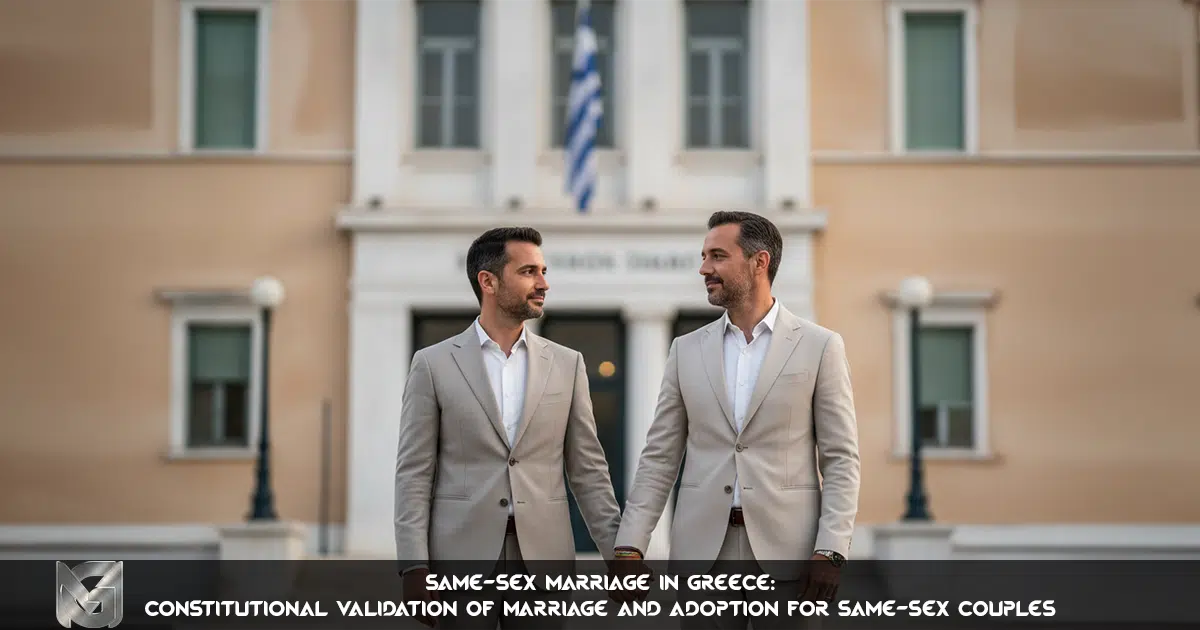
Same-sex marriage in Greece has just crossed a decisive threshold, and it is not only symbolic. By confirming the constitutionality of civil marriage and adoption for same-sex couples, Greece’s highest administrative court has strengthened a reform passed by Parliament in February 2024. In other words, we are no longer talking about a law that is merely “possible” or “contestable”, but about a legal framework that withstands judicial challenges and is built to last.
For Gay Mag, the stakes are twofold. On the one hand, same-sex marriage in Greece is a major step forward in a country with a Christian Orthodox majority, often portrayed as more conservative on family issues. On the other, it is a very concrete reminder: rights do move forward, but they move forward under pressure, at the pace of courts, political majorities, and culture wars.
In this article, we look at what the ruling validates, why it matters, what it still does not settle, and what it changes for couples, children, and Europe.
What was upheld: civil marriage and adoption confirmed as constitutional
The decision issued by Greece’s Council of State confirms that opening civil marriage to same-sex couples is consistent with the Greek Constitution, and compatible with the European Convention on Human Rights. Crucially, it also upholds the possibility of adoption for married same-sex couples. For the families concerned, this is a legal lock-in that strengthens the durability of same-sex marriage in Greece.
A response to a very concrete legal challenge
The case was not about an abstract question. It targeted practical administrative adjustments, for example how spouses and parents should be recorded on marriage and birth certificates so that official documents align with the 2024 law. By rejecting the challenge, the court locks the system in place, not only in principle, but also in implementation, which matters enormously in the day-to-day lives of couples.
Adoption and the “best interests of the child”
One argument repeatedly surfaces in debates about adoption by same-sex couples: the best interests of the child. Greece’s Council of State addresses it head-on, stating that recognising the right to adopt does not violate constitutional protections for children, nor the child’s best interests.
This matters because it pushes the discussion back where it belongs in a rule-of-law state: case-by-case assessment with procedural safeguards, rather than a blanket exclusion based on the parents’ sexual orientation. In public debate, this is also one of the most weaponised knots whenever same-sex marriage in Greece is discussed.
Why constitutional validation changes the game
A law can be passed, then weakened by legal challenges, restrictive interpretations, or political change. When a higher court states that a reform is constitutional, it increases the stability of the law.
A judicial “seal” on the 2024 reform Greece adopted marriage and adoption equality in February 2024.
The Council of State’s decision, reported by several outlets as having been delivered in 2026, functions as a judicial seal: it confirms that lawmakers could evolve the definition of civil marriage without contradicting the Constitution. For opponents, it narrows the room for legal obstruction. For couples, it makes same-sex marriage in Greece less vulnerable to procedural attempts to roll it back.
Marriage and family as evolving institutions
The reasoning is central: the institutions of marriage and family are not “static and immutable”, but capable of evolving. It is a way of saying that the Constitution protects principles, dignity, equality, the free development of one’s personality, without freezing a single model of family for all time.
This approach is not neutral. It stands against an “originalist” or strictly historical reading of marriage, and aligns with a broader European trend in which family rights have expanded gradually.
An Orthodox-majority country, a historic step, and a society in motion
The Greek reform has been described as historic, notably because Greece is a country with a Christian Orthodox majority. That does not mean Greek society is monolithic, but it does highlight the political significance of the decision. In this context, same-sex marriage in Greece also becomes a cultural marker, beyond the law.
A reform carried by a political majority, with cross-party support
According to press accounts, the 2024 law was adopted under a centre-right government, with support from left-wing opposition parties. This detail matters because it shows that equality can sometimes advance outside the expected political scripts.
The role of civil society and European dynamics
European LGBTI rights organisations, such as ILGA-Europe, welcomed the 2024 law, noting that it also recognises marriages concluded abroad and family ties for children born outside Greece to same-sex parents.
This last point is essential for mobile families, those who live, work, or marry across borders. In Europe, the question is no longer only “can I marry here?”, but also “will my marriage and my parenthood be recognised elsewhere?”. That is where same-sex marriage in Greece fits into a larger conversation: continuity of rights.
What the decision does not say, and the limits that remain
Constitutional validation does not erase every form of discrimination, nor every grey area.
Dissents exist, and they matter politically According to English-language
Greek press, a minority of judges expressed reservations, defending a conception of marriage as a union between a man and a woman, and citing a lack of evidence about long-term outcomes for children.
Even if this position is legally minoritarian, it can feed public debate. And we know it: in Europe as elsewhere, LGBTI rights are attacked not only through laws, but through narratives, fears, and manufactured “controversies”. In that climate, every advance like same-sex marriage in Greece becomes a symbolic battleground.
The “gaps” in family rights
ILGA-Europe notes that the law does not remove all discrimination, notably around certain aspects of parenthood and access to medically assisted reproduction, depending on national frameworks.
This touches a recurring point: marriage and adoption are pillars, but LGBTQ+ family realities also depend on access to fertility pathways, automatic recognition of parentage, and the protection of children in cross-border situations.
Marriage equality: what changes in real life for couples and families
Beyond headlines, marriage equality changes very practical things. And this is often where same-sex marriage in Greece takes on its full meaning: in everyday life.
Legal security and day-to-day protection
Civil marriage opens rights: inheritance, spousal protection, social benefits, medical decision-making, tax status, and administrative recognition. In countries where civil unions already existed, the argument “it changes nothing” is often wrong, because marriage remains the most complete legal status.
Adoption: recognition and stability for children
The ability to adopt, and especially the constitutional confirmation of that ability, reduces uncertainty for families. It protects the child by securing the legal bond with their parents, and by preventing situations where one parent is “invisible” in the eyes of the administration. This is one of the most concrete effects of same-sex marriage in Greece.
Symbolic, yes, but not only
In a context where homophobia can still surface in public space, state recognition also has a cultural effect. It states, officially, that same-sex couples are part of the family landscape, and that their children are not tolerated exceptions, but protected citizens.
Greece on the European map of LGBTQ+ rights
The Greek decision fits into a broader European movement, but also into a two-speed Europe.
A Europe where rights advance, and sometimes retreat
We see legal advances in some countries, and rollbacks or blockages in others. The Greek case is a reminder that equality is never “acquired” by magic: it is built, defended, and consolidated.
The challenge of cross-border recognition
Even when marriage is legal in one country, couples can face difficulties elsewhere, especially around parentage and the recognition of civil status documents. European dynamics, between case law, conventions, and EU law, therefore become key terrain for families. In that sense, same-sex marriage in Greece is also a signal sent to other states, and to European institutions.
What Gay Mag takes away: a legal victory, and a political signal
The constitutional validation of marriage and adoption in Greece is a legal victory, but also a political signal. It shows that a country can modernise its family law without renouncing its traditions, and that a court can state that equality is not a threat, but a necessary update to the protection of people.
For the community, the message is clear: marriage equality is not only about ceremonies or visibility. It is an architecture of protections, for couples, for children, for dignity. And within that architecture, same-sex marriage in Greece becomes a reference point.
And for Europe, it is a useful reminder: each national advance matters, but the horizon is real recognition of LGBTQ+ families everywhere they live, travel, work, and raise their children.
Quick reference (to understand in 30 seconds)
- In February 2024, the Greek Parliament adopted a law opening civil marriage and adoption to same-sex couples.
- In 2026, Greece’s Council of State confirmed the constitutionality of these provisions and rejected a legal challenge.
- The reasoning emphasises the evolution of marriage and family institutions, and the protection of the child’s best interests through case-by-case safeguards.
- Limits remain debated, notably around certain aspects of parenthood and reproductive rights.
For comments or projects, please contact me.