LGBTQ+ humor isn’t just a “genre.” For many of us, it’s oxygen. A survival skill. A way to recognize each other in a crowded room, to turn shame into sparkle, and to keep going when the world feels heavy.
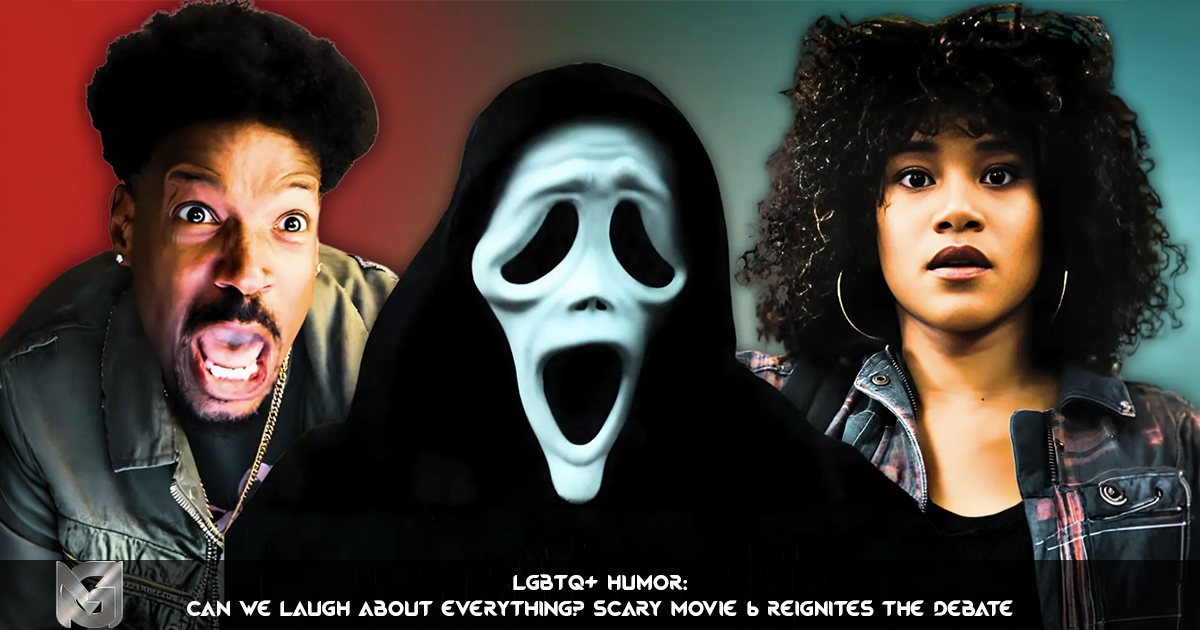
That’s why the recent backlash around the Scary Movie 6 trailer matters beyond movie discourse. It reopens a classic question with very current stakes: can we laugh about everything? Probably yes. But the real question is how we laugh, who we laugh with, and who ends up paying the price.
The trailer leans into a “no sacred cows” posture, even flashing “THERE ARE NO SAFE SPACES,” and the film’s co-writer Marlon Wayans has framed the project as an “equal opportunity offender” kind of comedy. In 2026, though, jokes about gender and pronouns don’t land in a vacuum. They land in a climate where trans and nonbinary people are routinely turned into political talking points.
This piece isn’t here to hand out moral verdicts. It’s here to do what a good queer magazine does: add context, remember history, and offer a compass. Because LGBTQ+ humor can be liberating, and it can also be lazy. The difference matters.
What the Scary Movie 6 trailer shows, and why Gen Z reacted
The most-discussed moment in the trailer parodies a scene from Scream 6. On a subway, a character gets stabbed, someone yells “He stabbed her!”, and the victim snaps back: “Not her! My pronouns are they/them! He stabbed them!”
Gen Z isn’t “too sensitive,” it’s often just tired
A lot of criticism isn’t simply “this is offensive.” It’s “this is stale.” The pronouns gag reads to many viewers as a default switch comedy writers flip when they want a quick laugh: pronouns = funny. In that sense, the frustration is also about craft. LGBTQ+ humor audiences, especially younger ones, are asking for sharper writing than a recycled punchline.
Others defend it as good-faith parody
At the same time, plenty of people argue the joke is meant to be absurd, not cruel. Scary Movie has always been exaggerated, chaotic parody. In that reading, the target isn’t nonbinary people, but the situation, the panic, the melodrama, the meta-ness of horror tropes. LGBTQ+ humor doesn’t have to be “protected” from comedy, it just needs comedy to be clear about what it’s doing.
Context changes reception
The same line can land differently depending on the moment. In 2026, when gender identity is constantly debated in headlines, the line between laughing with and laughing at becomes thinner. That’s where LGBTQ+ humor acts as a cultural barometer: it reveals what feels alive and what feels like a tired reflex.
Can we laugh about everything? Yes, but not in every way.
The phrase we should be able to laugh about everything is often true, but incomplete. It becomes useful when we add three simple questions:
- Who is the real target? Power, hypocrisy, social norms, or a group already exposed to stigma?
- What’s the likely effect? Does it release tension, create connection, puncture fear, or reinforce humiliation?
- Is the intention readable? “I didn’t mean harm” isn’t enough if the audience can’t see the aim.
In other words: freedom to joke doesn’t erase responsibility for impact. And one of the unwritten rules of LGBTQ+ humor is exactly that: you can be sharp without being cruel.
Gay community humor: culture, armor, and refuge
Talking about LGBTQ+ humor means remembering something obvious: queer laughter has never been just entertainment.
A survival tool
When you grow up with silence, shame, or the pressure to shrink yourself, humor becomes an exit door.
- It defuses fear.
- It turns insults into chosen self-irony.
- It creates community: codes, references, camp.
For many people, LGBTQ+ humor arrives before the words coming out. It’s a test balloon, a shield, a signal.
An aesthetic: camp, drag, satire
Camp isn’t superficial. It’s a way of saying: I see the norm, I see its absurdity, and I’m flipping it. Drag, parody, satire, cabaret, stand-up, meme culture, all of it has been a space where we could exist louder and freer. LGBTQ+ humor is also an aesthetic: stylizing reality so we don’t have to submit to it.
And a memory: jokes that hurt
We don’t need to rewrite history. A lot of mainstream comedy in the 2000s normalized homophobic and transphobic gags for laughs. Even when everyone laughed, someone was swallowing it. That’s why defending LGBTQ+ humor doesn’t mean defending every joke. It means defending humor with craft, clarity, and awareness.
Scary Movie 6: the real question isn’t “is it allowed?” but “is it good?”
What’s striking is that many reactions aren’t calling for bans. They’re saying: dated, easy, lazy. That’s not censorship talk, it’s quality control.
Transgression vs autopilot
Comedy can be transgressive and smart. But when transgression becomes autopilot, it loses power.
A pronouns joke can work if it:
- targets moral panic,
- mocks a character’s cluelessness,
- reveals a broader social absurdity,
- or flips the cliché back onto the people who weaponize it.
If it’s just pronouns = funny, it’s a button, not an idea. LGBTQ+ humor deserves better than buttons.
No safe spaces is a marketing line, not a philosophy
“THERE ARE NO SAFE SPACES” sells a return to no filter comedy. But it also muddies what safe spaces mean.
In LGBTQ+ communities, a safe space isn’t a place where laughter is banned. It’s a place where you can exist without being reduced to a target. You can defend comedic freedom without caricaturing the need for safety. And you can defend LGBTQ+ humor without asking people to grit their teeth.
Why humor matters more than ever (and why it’s worth protecting)
We live in an era of exhaustion: nonstop news, political anxiety, social tension, and renewed backlash against LGBTQ+ rights.
In that climate, LGBTQ+ humor matters because it:
Gives us air
A real laugh doesn’t erase reality. It gives us the strength to move through it. LGBTQ+ humor has a special talent for turning fear into energy.
Helps us think sideways
Humor is a shift in angle. It opens a door: what if we looked at it differently? That’s precious when public debate becomes rigid and aggressive. LGBTQ+ humor can be an antidote to stiffness.
Brings people together
Laughter creates complicity, and complicity is a form of care. LGBTQ+ humor connects when it builds recognition, not when it appoints a scapegoat.
A Gay Mag compass: laughing without harm
If we want to move past the sterile censorship vs freedom duel, here’s a simple compass.
1) Punch up
Satire is fairer when it targets power: institutions, hypocrisy, dominant norms. That’s often where LGBTQ+ humor shines brightest.
2) Make the target readable
If the joke can easily be read as mocking a minority, it has a clarity problem.
3) Refuse laziness
A recycled gag on a sensitive topic quickly feels like cheap provocation. LGBTQ+ humor doesn’t need shortcuts, it needs invention.
4) Accept critique without yelling censorship
Critique is part of the game. Saying this is weak or this hurt me isn’t the same as banning.
5) Ask: who pays for the laugh?
If the laugh comes at the expense of a group already targeted, at minimum own that choice, and ideally do better. That question sits at the heart of LGBTQ+ humor ethics.
Conclusion: yes, laugh about everything, but with heart and skill
Scary Movie 6 has at least one merit: it forces us to talk about what we want comedy to be in 2026.
Yes, we need laughter. Yes, we need comedy that dares. But we also need comedy that doesn’t recycle the same mechanisms, and that remembers some people don’t have the luxury of being just a joke.
LGBTQ+ humor has proven for decades that you can be funny, biting, sexy, insolent, and deeply human. So the question isn’t can we laugh about everything? The question is: can we laugh better?
To you, reader
Did you laugh at the scene? Did you roll your eyes? Did you feel targeted?
Whatever your reaction, you’re allowed to have it. And maybe that’s the best news: we can still talk about LGBTQ+ humor instead of letting comedy become either a weapon or a slogan.
For comments or projects, please contact me.