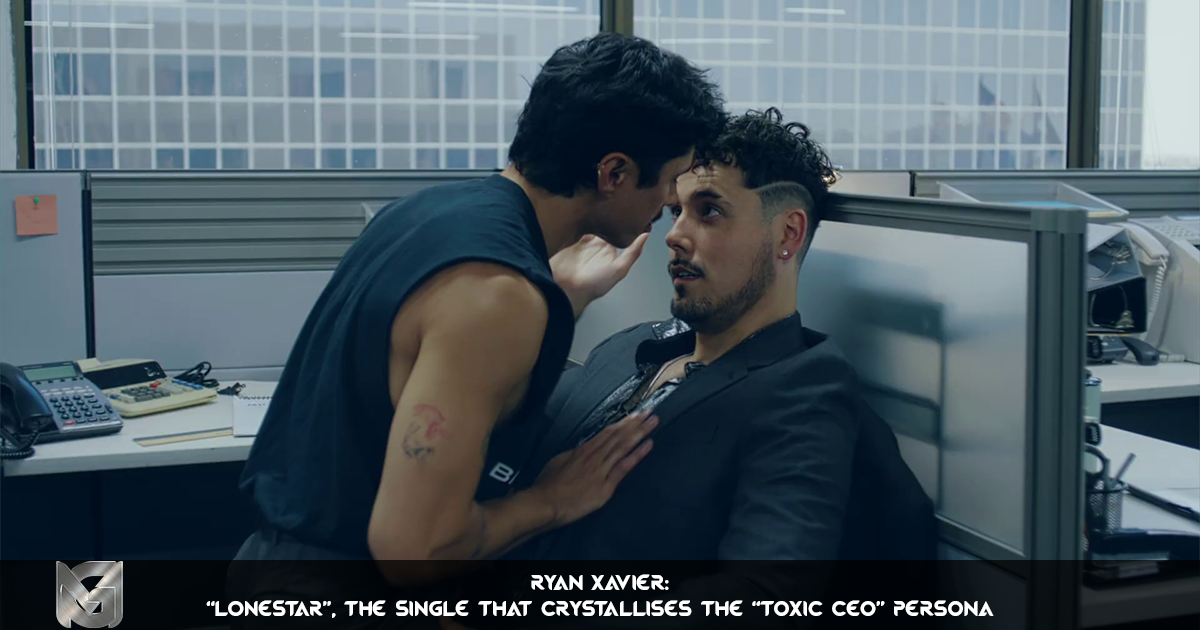
Ryan Xavier is not just a name floating around streaming platforms, he’s a character, a posture, a way of telling stories about desire and power in the age of social media. With “Lonestar”, released in 2026, the artist pushes his storytelling further, blending dark humour, unapologetic seduction, and a “bad boy” aesthetic engineered for attention. At Gay Mag, we like it when an artist offers more than a track, a small mythology, a world, a tone, an angle.
This piece offers a clear, grounded read, without overreaching, of what “Lonestar” suggests, how Ryan Xavier stages himself, and where this kind of platform-first urban pop sits today, especially within queer communities that consume music as much as they comment on it.
Who is Ryan Xavier, what we can say without making things up
You’ll mostly find Ryan Xavier through his official pages and distribution profiles. Public information converges on a few simple points.
A platform-first artist
Ryan Xavier exists first and foremost where music is discovered now.
- On Instagram, he foregrounds his universe, snippets, teasers, and persona-driven messaging.
- On Spotify and Apple Music, he’s listed with a singles-based catalogue.
- On TikTok, he’s presented as a highly followed figure, with direct, punchy communication built for short-form formats.
This platform-first model isn’t a detail, it’s a strategy. The artist doesn’t wait for media to define him, he defines himself continuously through short content, signature phrases, repeated images, and a narrative that feeds on reactions.
The persona: “toxic CEO”, provocation and self-caricature
Across his pages, Ryan Xavier claims a “toxic CEO” persona. At first glance, it can read like a gimmick. In practice, it’s a grammar.
- “CEO” evokes control, ambition, money, status.
- “Toxic” points to dysfunctional relationship dynamics, sometimes fantasised, sometimes criticised, often performed.
The mix creates a deliberately excessive figure, almost satirical. There’s performance in it, and that’s precisely what makes it interesting: you don’t have to “believe” the persona to see what it produces, a playground around desire, jealousy, dominance, and ego.
“Lonestar”: what we know about the release and its context
A 2026 release, distributed via TuneCore
“Lonestar” appears as a 2026 single, available on major platforms, and also present on YouTube via a “Provided to YouTube by TuneCore” upload. These automated releases are common, and they signal a structured digital distribution, even when an artist remains independent.
A track that fits into a logical run
On Spotify, “Lonestar” sits alongside other singles, including “Texas On” (2025) and “Courtside” (2025). Even without line-by-line lyric analysis, an imaginary starts to form.
- “Texas On” and “Lonestar” both draw on a Texan lexical field.
- “Lonestar” directly echoes one of Texas’ best-known nicknames, “The Lone Star State”.
This isn’t just scenery, it’s a symbol: independence, pride, isolation, strength, and sometimes a certain myth of masculinity.
Reading the track: a mythology of masculinity, filtered through contemporary pop
Talking about “Lonestar” means talking about an imaginary. In pop culture, Texas is often used as shorthand: wide-open spaces, masculinity, dominance codes, rough romance, and sometimes a tension between tradition and desire.
Texas as symbolic setting
The point of a setting is what it allows.
- It allows a “cowboy”, “americana”, “road”, “big sky” aesthetic.
- It allows a narrative of conquest, territory, solitude.
- It also allows fantasy, which can be queer, because fantasy often feeds on what looks forbidden or “too masculine”.
Through a queer lens, these codes can be flipped, exaggerated, stylised, and therefore reclaimed.
“Toxic CEO”: when pop stages relational power
The “toxic CEO” persona works like a magnifying mirror.
- It stages ego, control, possessiveness.
- It plays with the idea of love-as-power, where you “win” the other person.
- It turns relationship dynamics into slogans.
That’s where the track becomes a conversation piece, not just something you stream. You can hear it as critique, confession, caricature, or pure role-play. And it’s often that ambiguity that fuels virality.
Why Ryan Xavier resonates with queer audiences, even without a single label
A queer media outlet has relayed Ryan Xavier as an artist close to queer/bi Latino communities. That kind of relay doesn’t replace an official biography, but it does indicate something: circulation.
Circulation matters as much as intention
Today, an artist “belongs” to a scene as much through audiences as through statements.
- If a track becomes a queer TikTok sound, it enters a culture.
- If an artist is discussed in queer spaces, he becomes a reference point, even temporarily.
- If the aesthetic plays with desire and masculinity codes, it can resonate with communities used to decoding these signs.
The appeal of the persona: fantasy and critical distance
“Toxic” in pop is slippery ground. But it can also be a reading space.
- Some hear it as an unapologetic fantasy.
- Others hear satire.
- Others take it as a useful reminder: what’s sexy in fiction isn’t necessarily healthy in real life.
The interesting part is that the persona lets people talk about consent, boundaries, and power without turning it into a lecture, because pop is a space where you can discuss serious things through light objects.
Aesthetic: clips, snippets, and the making of a visual identity
Even without a long list of cinematic music videos, a visual identity still gets built.
Instagram as storefront
On Instagram, Ryan Xavier pushes “Lonestar” and reinforces the persona. It’s direct communication, less about neutrality than about signature.
YouTube as “official” proof of existence
The presence of the track on YouTube via a TuneCore-style distribution matters: it stabilises the song in the ecosystem. For listeners, it’s a reference point. For media, it’s a source.
How to listen to “Lonestar” in 2026 without getting trapped by the marketing
There are two ways to consume a platform-first artist.
1) As a pop character
In this mode, you accept the performance.
- You hear the track as a scene.
- You treat the branding as part of the work.
- You understand exaggeration as intentional.
2) As a cultural signal
In this mode, you watch what the track triggers.
- What comments it attracts.
- What audiences it reaches.
- What codes it puts back into circulation.
Both readings can coexist, and that’s what makes it interesting for a media outlet like Gay Mag.
What “Lonestar” says about today’s urban pop economy
“Lonestar” fits an era where the single is a narrative unit.
- It has to be strong enough to stand alone.
- It has to be memorable enough to be reused.
- It has to be visual enough to become content.
The “toxic CEO” persona is an answer to the attention economy: it offers an instant hook, a promise, a tone. The risk, of course, is becoming trapped by your own gimmick. But when it’s held well, it becomes an artistic brand.
Conclusion: Ryan Xavier is worth watching for what he reveals
Ryan Xavier is interesting because he embodies an urban pop that no longer separates music from staging. “Lonestar” works like a summary: a symbolic setting, an asserted persona, and distribution designed for platforms.
For Gay Mag, he’s exactly the kind of artist worth tracking, not to crown a hype, but to observe how pop figures are made today, how they circulate in queer spaces, and how a single can become a small cultural object.
If you want, I can also propose:
- a more “music review” version (structure, mood, production, vocal delivery), if you confirm the exact link of the version you want to cite,
- or a “profile + sidebars” version with three boxes: Also listen to, Why it’s buzzing, What it says about pop masculinity.
For comments or projects, please contact me.