Jaleo Company. The name is popping up more and more in dance circles, pop culture feeds, and across social platforms, with a promise that’s simple and brutally effective: energy, precision, and an aesthetic that fully embraces spectacle. Based in Spain and presented as an international company, the troupe positions itself as something hybrid: a collective of dancers, a performance showcase, and a visual-creation platform.
For Gay Mag, the appeal is twofold. On one hand, this is a project rooted in contemporary culture, the world of music videos, viral choreography, and collaborations with mainstream artists. On the other, there’s a more sensual, more unapologetic visual grammar emerging, sometimes frankly sexy, that resonates with part of our readership without slipping into parody.
An international company, rooted in Spain
On its official website, Jaleo Company describes itself as an “international company based in Spain”, built around three pillars:
- Delivering high-quality training.
- Collaborating with standout artists.
- Competing on some of the country’s most important stages.
That trio is telling because it reveals a strategy. Training builds technical level, collaboration builds visibility, and competition builds legitimacy. In other words, this isn’t dance as a casual pastime, it’s dance as stagecraft, industry, and reputation.
The “Jaleo” identity: a promise of intensity
In Spanish, “jaleo” evokes noise, commotion, celebration, a kind of charged buzz. It’s exactly the imaginary the company claims: collective energy, physical intensity, and presence that’s as visible as it is felt.
In a landscape where many crews can look interchangeable, identity is everything. Here, identity is shaped through image-making, social platforms, collaborations, and an aesthetic engineered for “wow”.
What their “Work” page shows: artists, videos, competitions
The “Work” section of the Jaleo Company site is organised into three main categories.
Artists
The company highlights collaborations with artists such as Quevedo, Emilia Mernes, Bad Gyal, Ara Malikian, and LaChispa. For audiences, these names work as instant markers: you understand the troupe is positioning itself on visible projects, likely tied to live performances, music videos, or promotional content.
For a dance company, this kind of display is strategic. It’s not only “we dance well”, it’s “we dance where it matters”, in circuits where attention is massive.
Videos
Video has become the primary arena for popular contemporary dance. Even when the stage remains central, video is the proof, the shop window, and often the first point of contact.
Having a dedicated “Videos” section signals that Jaleo Company thinks of dance as a filmed object: edited, stylised, designed. And that’s precisely where the difference lies between a simple recording and a work.
Competition
Competition is a level marker. It implies discipline, the ability to perform under pressure, and recognition through juries or established circuits.
For readers who don’t necessarily follow dance competitions, it’s a simple signal: the company isn’t only aiming to be “trendy”, it’s also chasing validation through performance.
“Go’ds Favorite west”: why this clip grabs attention
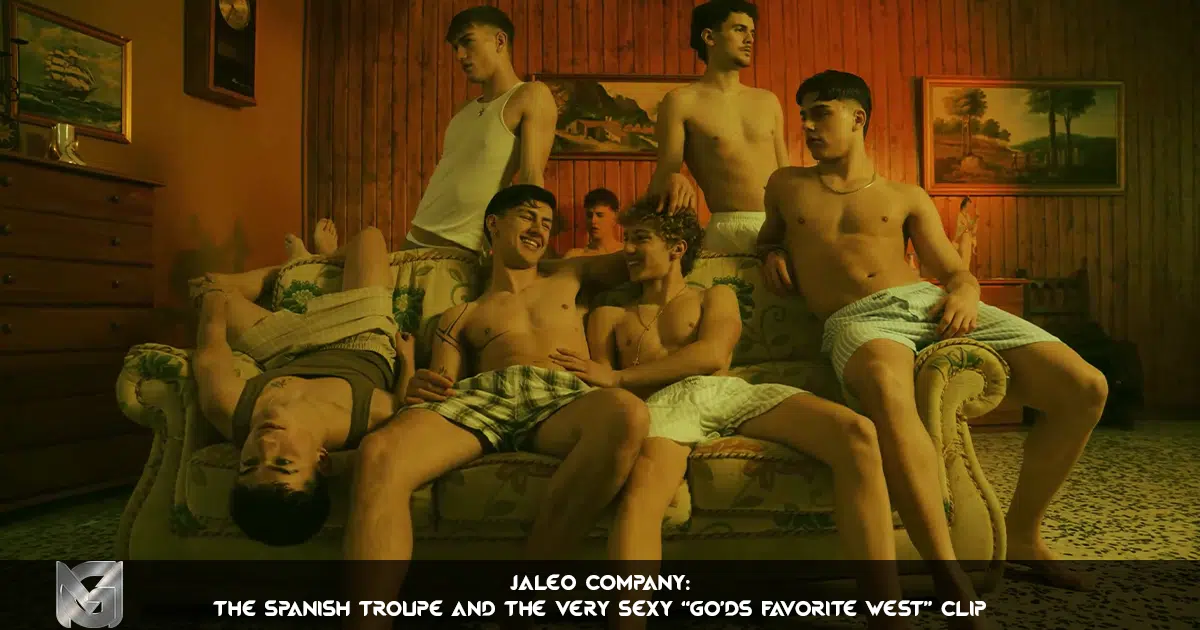
Jaleo Company has recently highlighted a piece titled “A film by Manu Pavón – Go’ds Favorite west”. The wording matters: it’s framed as a film, not just a video. That suggests cinematic intent, staging, and visual storytelling.
Unapologetic sensuality, without the cliché
When we call a clip “very sexy”, it’s not only about how much skin is shown. In dance, sensuality is built through:
- The closeness of bodies.
- Muscular tension.
- Eye contact with the camera.
- Rhythm, pauses, accelerations.
- Light, framing, editing.
These are aesthetic tools. And that’s where dance connects with a broader queer language: desire staged as art, the body as power, pleasure as affirmation.
In a context where images of the male body often swing between hyper-virilisation and neutralisation, a project that embraces choreographed sensuality can become a cultural object, not just “sexy content”.
The male body as narrative
In many mainstream productions, the male body is either functional or heroic. Dance allows something else: the body becomes narrative.
- It tells effort.
- It tells relationship.
- It tells dominance, vulnerability, surrender.
That’s exactly what can interest Gay Mag: sensuality isn’t set dressing, it’s language.
The social strategy: Instagram, TikTok, YouTube
Jaleo Company clearly links its ecosystem to Instagram, TikTok, and YouTube. This trio has become the backbone of choreographic projects today.
- Instagram for image, excerpts, brand.
- TikTok for virality, short formats, repetition.
- YouTube for long formats, films, compilations, archives.
Why it works right now
Dance is an art of the present. It’s consumed on loop, as excerpts, as variations. Platforms have therefore changed the way choreography is conceived.
- You think in memorable “moments”.
- You think in visual “hooks”.
- You think in shots that can live on their own.
A film like “Go’ds Favorite west” fits that logic: it can be watched as a complete work, but also as a source of excerpts, stills, and sequences that circulate.
What Jaleo Company says about European pop culture
A few years ago, many choreographic trends were largely imported from the United States. Today, Europe, and Spain in particular, is asserting itself as a laboratory.
- A blend of urban and contemporary influences.
- A highly crafted music-video aesthetic.
- A performance culture that sits between stage and camera.
Jaleo Company sits right on that border. And it’s a border that speaks to gay culture, because it has always been attentive to image, style, the body, and performance.
A “club” aesthetic, but not necessarily trapped in the club
Sexy dance-on-camera is often tied to club imagery: night, sweat, proximity. But the point of a well-made project is that it can shift those codes.
- An unexpected setting.
- More cinematic light.
- A more open narrative.
That’s what turns a simple “hot clip” into an aesthetic object.
How to cover it on Gay Mag, without overplaying it
The editorial challenge is clear. We want to talk about the sexy element, because it’s there, because it’s part of certain images’ DNA, and because it interests our readers. But we don’t want to reduce the project to that.
Possible angles
- Pop culture: how a dance company builds a brand.
- Image-making: how filming transforms choreography.
- Body: how sensuality is choreographed.
- Industry: how collaborations with artists boost visibility.
Keeping those angles keeps the piece informative and readable, and avoids sensationalism.
What we can verify, and what still needs confirmation
To stay rigorous, it helps to separate:
What is explicitly stated
- The company presents itself as international, based in Spain.
- It highlights training, collaborations, competitions.
- It lists collaborations with several artists.
- It links its social platforms (Instagram, TikTok, YouTube).
What would require direct confirmation
- The exact release date and production context of “Go’ds Favorite west”.
- The full cast and credits (dancers, cinematography, editing).
- Detailed artistic intentions.
For an even stronger article, the ideal would be to pull official credits (YouTube description, press note, or a reply from the company) and cite them.
Why Jaleo Company is worth keeping an eye on
Because we’re looking at a contemporary model:
- A company that thinks of dance as a complete cultural product.
- A structured digital presence.
- An aesthetic that embraces sensuality.
- An ability to plug into visible projects.
And because “Go’ds Favorite west”, presented as a highlighted film, suggests ambition: moving beyond choreography into visual storytelling.
Conclusion
Jaleo Company belongs to a generation of crews that no longer separate stage and screen. They dance for the audience, but also for the camera, for editing, for the image that will circulate.
And when that image becomes “very sexy”, the question isn’t whether to blush or cry scandal. The more interesting question is how desire is staged, how the body becomes language, and how a company turns that energy into a signature.
For Gay Mag, it’s exactly the kind of subject that ticks multiple boxes: pop culture, aesthetics, the body, and unapologetic pleasure, without losing readability or standards.
- Site officiel : jaleo-company.com
- Instagram : @jaleocompany
- TikTok : @jaleocompanyofficial
- YouTube (lié) : youtube.com/@manupavon.
For comments or projects, please contact me.