Troye Sivan is not just another name in international pop. Over the past decade, he has turned an unconventional path, from online creator to arena-ready performer, into a coherent artistic proposition, instantly recognisable, and deeply connected to an LGBTQ+ generation looking for honest, sensual, contemporary storytelling. His strength lies in his ability to hold vulnerability and confidence together, confession and celebration, diary-like writing and pop efficiency.
This feature offers an accessible, well-structured portrait to understand how he broke through, what his discography is really saying, why his visual language matters so much, and what his rise reveals about the evolution of queer pop across the 2010s and 2020s.
Where he comes from, and why his journey mattered
A childhood between continents
Born in South Africa and raised in Australia, he grew up far from the traditional music-industry pipeline. That early distance helps explain the way he built his career, more gradually, more narratively, and often with a stronger sense of direct relationship to the audience.
The YouTube era, or the birth of a direct bond
Before he became a radio artist, he became an online personality. That period left a lasting imprint.
- He learned to speak to a community, not to a marketing “target”.
- He shaped a public image based on continuity, transparency, and a certain closeness.
- He understood early the power of short formats, visuals, and episodic storytelling.
In modern pop, that kind of relationship is a huge advantage. It creates loyalty that goes beyond a single hit, and it partly explains why Troye Sivan was able to establish a world before he even established radio codes.
An intimate pop voice, without excessive caution
Lyrics that own desire
What sets his writing apart is the way it approaches desire and love without detours, with an emotional precision that avoids cliché. Where many queer artists were long pushed towards suggestion, he writes plainly, without turning his stories into riddles.
That frankness is not a gimmick. It becomes an artistic language, and a generational marker, one that Troye Sivan refines from record to record.
A controlled vulnerability
This is not about “oversharing” at random. His work shows a structured vulnerability.
- He chooses what he tells.
- He frames emotion.
- He stages intimacy as an aesthetic material.
As a result, his songs can be moving without collapsing into complaint, and sensual without sliding into voyeurism, a balance Troye Sivan handles particularly well.
Discography: three major phases, three palettes
1) Blue Neighbourhood: building a narrative
His first studio album sets up a coherent world, both melancholic and bright. It carries the idea of a mental “neighbourhood”, a space where you learn to define yourself, to love, and to face other people’s gaze.
What the album brings
- Emotional pop, driven by strong hooks.
- A narrative about youth, first times, fear, and momentum.
- A visual aesthetic that extends the songs, like a serial.
It is also the album that installs the signature of Troye Sivan: pop that tells, that films, and that connects intimacy to carefully crafted imagery.
2) Bloom: sensuality as affirmation
With the second album, the tone shifts. The music opens up, sensuality becomes more central, and the writing gains confidence.
What stands out
- Warmer, more assured pop.
- Songs that celebrate the body and intimacy.
- A stronger “pop icon” image, without losing sincerity.
Here, Troye Sivan moves towards a more carnal writing style, while keeping the delicacy that makes him distinct.
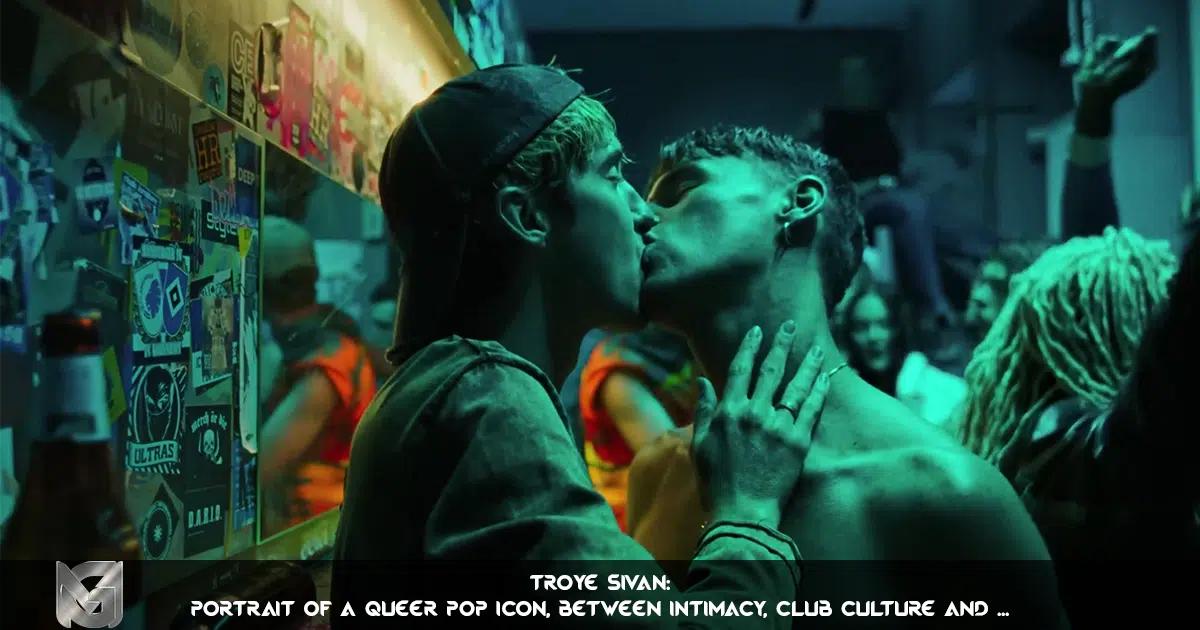
3) Something To Give Each Other: the club turn, joy, the collective
This project marks an important step. Dance and club energy comes forward, with writing that also pays attention to the collective dimension.
Why it is strategic
- Queer pop has always had a strong link to club culture.
- By stepping into it, he joins a tradition while modernising it.
- He proves an artist can move from confession to celebration without losing identity.
That turn works because Troye Sivan keeps the same thread: describing desire and freedom with emotional precision.
Aesthetic: videos, fashion, and the art of staging
Visuals that are not decorative
In his world, the music video is not just a promotional tool. It extends the narrative.
- Colours, framing, bodies, locations, everything carries meaning.
- The image plays with the tension between intimacy and exposure.
- Sensuality is stylised, but never sanitised.
That visual coherence is a language, and Troye Sivan uses it to make what you see complete what you hear.
Fashion and pop culture
His influence goes beyond music. He operates inside an image ecosystem.
- Editorial shoots.
- Carefully curated public appearances.
This matters in today’s pop, where the artist is also a visual signature.
Why he resonates so strongly with LGBTQ+ audiences
Representation that does not ask for permission
His work is not “educational” in the classic sense. It does not try to justify queer existence. It shows it, full stop.
That stance is valuable.
- It normalises without flattening.
- It offers stories people recognise.
- It also allows non-LGBTQ+ audiences to enter through emotion.
This is also why Troye Sivan is often seen as a pop figure who shifted the centre of gravity, from the unsaid to the obvious.
Queer pop is not a sub-genre
He is not positioned in a niche. He occupies mainstream pop with an assumed identity.
That is a cultural signal.
- You can be explicitly queer and still be central.
- You can sing about gay desire without hiding behind neutral pronouns.
- You can make dance-pop and remain personal.
Live presence: body, performance, and control
The stage as an extension of the story
On stage, the artist does not simply “replay” the tracks. He builds an experience.
- Choreography that dialogues with the themes.
- Art direction that extends the video aesthetic.
- A way of being present that is both close and iconic.
The body as language
In a pop culture where the body is often either hypersexualised or neutralised, he chooses a finer route.
- The body is desire, but also fragility.
- It is exposure, but also control.
- It becomes a narrative tool.
Film and choices: when coherence matters
A step into cinema
His acting work, including a film connected to conversion therapy, fits a clear coherence.
- It is not just a line on a filmography.
- The subject reinforces the reading of his trajectory.
- It reminds us queer pop also exists in a political context.
A public figure under scrutiny
Being an LGBTQ+ icon comes with particular attention.
- Every image is commented on.
- Every statement is examined.
- Every video can become a debate.
His strength is staying in an artistic posture, without being reduced to a single role.
What his success says about pop in the 2020s
A generation that wants authenticity, and style
Today’s pop rewards artists who can combine two demands.
- Credible emotion.
- A strong aesthetic proposition.
He embodies that synthesis.
The streaming era and communities
His journey also shows how streaming and social platforms changed the game.
- Fans follow “eras” and worlds.
- Albums become chapters.
- Visuals and performance matter as much as singles.
Conclusion: a trajectory already significant, and still unfolding
He has established himself through a rare equation.
- Intimate, precise, assumed writing.
- A coherent visual aesthetic.
- An ability to evolve, from melancholy to dance, without losing his signature.
For Gay Mag, Troye Sivan remains an artist worth tracking, because he captures something essential about contemporary queer pop.
- Pop that does not apologise.
- Pop that desires.
- Pop that dances.
And above all, pop that keeps creating images and songs where part of the community can finally see itself, without unnecessary filters.
For comments or projects, please contact me.