Bad Bunny is not just another name at the top of the charts, he is a cultural shift. In just a few years, the Puerto Rican artist, born Benito Antonio Martínez Ocasio, has broken a rule the pop industry long treated as unshakeable, the idea that you had to sing in English to dominate the global market. He proved the opposite, and he did it without sanding down his identity, his accent, or his references.
But reducing him to a musical success story would miss the point. His rise also speaks to a moment when pop is political, when image is a language, and when an artist can become a symbol, sometimes in spite of himself. In this piece, we look at what makes him a phenomenon, his trajectory, his era-defining albums, his collaborations with the biggest names, his public stances, and why his impact goes far beyond music.
From Puerto Rico to the world
Internet-era beginnings
He emerged in the late 2010s within a Latin urban scene in full transformation, where SoundCloud, YouTube and social platforms accelerated everything. Bad Bunny belongs to a generation that no longer waits for traditional gatekeepers to validate them, music circulates fast, codes are created in real time, and audiences decide quickly.
What stood out early on was the balance between immediacy and singularity. There are tracks built to explode in a party setting, but also a way of placing his voice, choosing textures, and leaning into melancholy that sets him apart from more standardised production.
An identity with no translation
One of the keys to his trajectory is the absence of linguistic compromise. Bad Bunny did not build global dominance by “transitioning” into English. Instead, he pulled the world into his Spanish, his Puerto Rican references, and a street-level cultural sensibility.
In a globalised market, that is a reversal of power. It is not Latin audiences adapting to international pop, it is international pop adapting to Latin energy.
A discography built like eras
The album as a territory
For him, an album is not simply a bundle of singles. Each project functions like a season, a setting, a mood. This “era” logic is essential to understanding his impact, because it gives the audience a full experience, not just a playlist.
Un Verano Sin Ti, the summer that never ended
Released in 2022, Un Verano Sin Ti is often cited as a turning point. Bad Bunny built an atmosphere that feels sunny, nostalgic, and sometimes bittersweet, and the record landed as a total pop object, equally at home in headphones, on beaches, in clubs, and in conversation.
Its success is not only about hits, it is about tonal coherence. It tells a summer story rather than behaving like a seasonal product. It also helped normalise the idea that a mostly Spanish-language album could become a global reference.
Nadie Sabe Lo Que Va a Pasar Mañana, the sharper pivot
In 2023, Nadie Sabe Lo Que Va a Pasar Mañana offered a different energy, rougher, more rap-driven, more nocturnal. Where Un Verano Sin Ti seduced with light, this project shows a harder, more competitive posture, almost like a reply to the media machine.
That contrast matters. It shows an artist refusing to be locked into a single image. Bad Bunny can be pop and accessible, then return to something more abrasive without losing his audience.
Collaborations: when the pop planet plugs into Puerto Rico
Features as cultural bridges
One of his strengths is his ability to create collaborations that do not sound like marketing operations, but like cultural bridges. Bad Bunny has multiplied features and appearances with major artists, both within the Latin world and across global pop.
Without attempting an exhaustive list, notable collaborations include figures such as J Balvin, Rosalía, Drake, Cardi B and The Weeknd, among others who helped Latin urban music travel into wider audiences.
Why these collaborations matter
These encounters have a double effect. On one hand, they confirm his global-star status, people do not collaborate with him out of charity, but because he brings energy, credibility and an audience. On the other, they show that Latin urban music is no longer a “peripheral” genre, it has become a centre of gravity.
Style: street, luxury and visual performance
An aesthetic that matters as much as the music
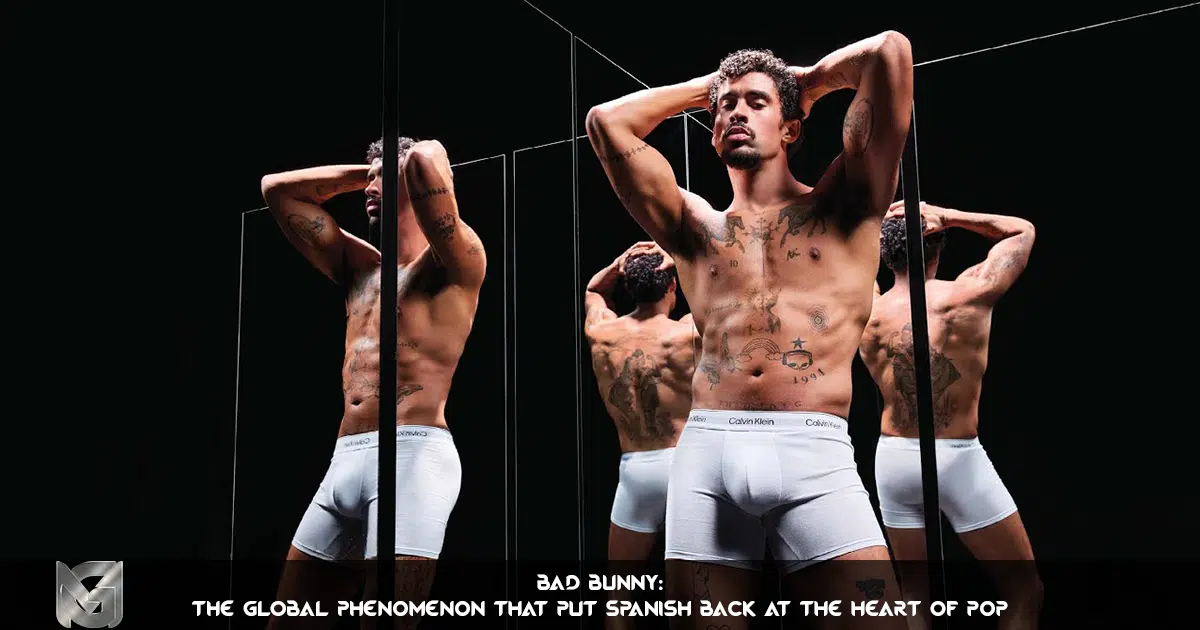
Bad Bunny is also an image-maker in the best sense. Videos, covers, looks and stage design all contribute to the narrative. He belongs to an era where music is consumed with visuals, memes and viral moments, and where an artist must exist as a full “universe”.
But where many settle for packaging, he uses aesthetics as language. He can move from streetwear to couture silhouettes, play with accessories and colour, and turn each appearance into a statement.
Masculinities, codes and the freedom to play
Another frequently discussed aspect is his willingness to play with masculinity codes in a Latin mainstream that can be highly normative. Bad Bunny has made visual choices and gestures that open space, make-up, skirts, accessories, poses, and an attitude that says, “I do what I want.”
For part of the audience, including queer audiences, that is not trivial. He is not an automatic standard-bearer, but he is a pop figure who makes certain freedoms visible, and that matters.
Public stances: Puerto Rico, identity, and opposition to Trump
A political voice rooted in reality
Bad Bunny has repeatedly taken positions on social and political issues, especially around Puerto Rico, the dignity of its people, and the way the island is treated in US public debate.
His opposition to Donald Trump fits into that context. It is not a one-off stunt, but a response to a political and media climate in which Puerto Rico has been instrumentalised, mocked, or pushed aside. For a star at Bad Bunny’s level, speaking out carries a cost, and that is precisely why these stances are worth noting, they remind us that an artist can refuse neutrality when his territory is at stake.
What it changes in pop
In global pop, activism is often carefully calibrated, sometimes lukewarm. Here, the political voice is more direct, more tied to identity and history. It also strengthens his bond with an audience that expects a minimum of coherence.
The Super Bowl: pop coronation or logical next step?
Why the Super Bowl is a symbol
The Super Bowl is not only a sporting event, it is a global cultural showcase. Being invited, performing, or even being strongly associated with it signals a threshold, the status of a mainstream icon able to speak to audiences who do not necessarily follow Latin music.
What his presence says
Whether it is a performance, an appearance, or a broader association, the fact that his name circulates in that universe says something simple, Latin culture is no longer “invited”, it is unavoidable. For Bad Bunny, it also makes sense. His career has been built as a steady rise through bigger stages and moments where it becomes impossible to ignore him.
Why his success goes beyond music
A symbol of Latin soft power
His ascent also tells the story of Latin America’s growing cultural power within global pop. It is not only an individual success, it is part of a movement. Streaming platforms accelerated this shift by allowing non-Spanish-speaking audiences to enter these sounds directly.
In that context, Bad Bunny becomes a symbol of soft power, proof that Latin culture can impose its rhythms, narratives, stars and codes without asking permission.
A direct relationship with the audience
He also communicates with his audience in a way that feels less “manufactured” than classic pop PR. Even when the marketing machine is present, Bad Bunny retains an impression of proximity and spontaneity. That feeds an unusually strong loyalty.
Conclusion: a star of his time, and a cultural revealer
He is a revealer. Bad Bunny reveals the power of platforms, the transformation of taste, the rise of Latin soft power, and the public’s hunger for artists who do not apologise for being themselves. He also reveals that pop, when it is truly pop, can absorb languages, cultures and aesthetics without neutralising them.
For Gay Mag, he is a fascinating subject because he touches music, image, the freedom to play with codes, collaborations that redraw the pop map, and the way a star can, willingly or not, open spaces of representation. And if his story is already huge, it still feels like a trajectory in motion.
For comments or projects, please contact me.