Pour te plaire, Marius isn’t writing a simple love song. He’s writing a negotiation. A list of concessions, fantasies, stances, skins you could peel off, put back on, swap out, just to earn a look. And for a publication like Gay Mag, that’s pure gold, because it speaks as much about desire as it does about identity, as much about sex as it does about vulnerability, as much about performance as it does about truth.
Released in 2026, the track sits inside a French pop landscape that’s no longer afraid of being physical, or blunt. The electro production is taut and precise, almost clinical at times, but the writing bleeds. The result is a song that clings to you, and a video that extends the central question, how far can we transform ourselves to be loved.
Who is Marius, and why this track matters in 2026
Marius is part of a new wave of artists blurring the line between French chanson and electronic music. He was notably spotted on the emerging scene via the RiffX Audience Award at the iNOUïS 2024 (Printemps de Bourges), a strong signal because it reflects both stage potential and real public connection.
What stands out is the combination of highly embodied, almost confessional writing, with a sonic aesthetic that doesn’t chase “pretty” variety-pop. Critics have described his approach as a collision between sharp-edged electro and punchy chanson, with comparisons that evoke both the intensity of Eddy de Pretto and more acidic electronic textures.
In that landscape, Pour te plaire lands like a hinge track, because it embraces a universal theme, the need to be desired, but treats it without decorative romanticism. Here, love isn’t a shelter, it’s a combat sport.
Reading the lyrics: desire, power, and identity
From the opening lines, the song lays down a grammar of the body.
A list of roles, like an intimate casting call
“I can be dirtier, more bestial, animal… I can be softer… on my knees… I can take another form…”
This passage works like a series of offers, almost an audition. The narrator presents himself as adjustable, ready to bend to whatever the other person wants. It’s not only sexual, it’s existential.
It touches a question many people recognise, in straight and queer relationships alike, but it resonates especially in LGBTQ+ lives, when you’ve learned early to adjust your behaviour to survive, to please, to be accepted.
Fragile, virile, versatile: masculinity as shifting ground
The line “Do you prefer me more fragile, more virile, or versatile?” is central. In one sentence, it says what the song keeps exploring, masculinity isn’t a block, it’s a menu. And that menu can be imposed.
In gay culture, we know how quickly these categories can become labels, sometimes exciting, sometimes suffocating. Fragile, virile, versatile, they can describe desires, but also demands. The song doesn’t moralise. It shows the mechanism.
Beauty as a condition
“In your eyes I want to be more beautiful” isn’t vanity. It’s a line about power. The other person’s gaze becomes a mirror that decides your worth. And when you’re ready to “tear your skin off” to get there, you understand the subject isn’t ideal love, it’s conditional love.
A song that speaks to queer audiences without “ticking a box”
What makes the track compelling for Gay Mag is that it can be read on several levels.
- On the surface, it’s a desire song, explicit and tense.
- Beneath that, it’s about performance, what we play to be chosen.
- Deeper still, it’s about identity as something plastic, reconfigured under a dominant gaze.
That’s exactly where it becomes queer-friendly, not because it tells an explicitly LGBTQ+ story, but because it lays bare dynamics the community knows well, role negotiation, norm pressure, the body as language.
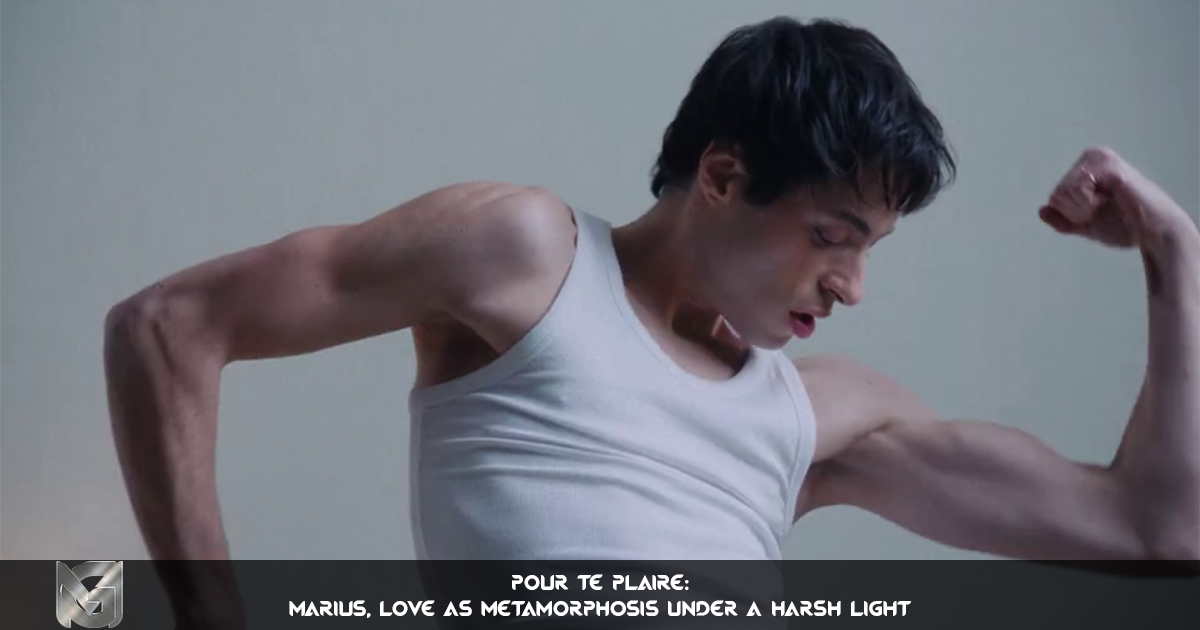
The Pour te plaire music video: staging the body, movement, and control
The official video extends the track’s tension with a carefully built approach.
A co-direction that matters
The video is co-directed by Marius and Nicolas Pradeau, with Nicolas Pradeau also credited as DOP (director of photography). Editing is credited to Marius, which matters, because in a video this physical, editing is breath, and therefore meaning.
The wider team is clearly oriented toward “set” and “movement”, with movement direction/choreography (Marine Andrea Plante), plus styling, set design, and make-up, suggesting a desire to build a world, not just illustrate a song.
Movement as metaphor
When a song talks about bending, kneeling, changing shape, the question is whether you film it as fantasy, or as tension.
Given the credits and the emphasis on movement, the video seems to choose an interesting path, treating the body as a writing surface. Choreography and movement direction aren’t there to “look pretty”, they materialise negotiation, attraction, resistance.
Electro aesthetics, but fully embodied
Electro can sometimes produce cold, abstract, dehumanised videos. Here, the weight given to set work, light, décor, and movement points in the opposite direction, toward embodiment.
That matches the track, which isn’t a style exercise, but a confession under pressure.
Why Pour te plaire could become a breakthrough hit
The track’s potential comes down to three things.
1) A chorus that sounds like obsession
“Tell me how to do it to please you” is simple, repetitive, almost hypnotic. You can hear it as a plea, a provocation, or a sentence you repeat to yourself.
2) Direct writing, without decorative filters
The lyrics aren’t afraid of bodily language. They don’t use it to shock, but to tell the truth of desire, and the soft violence of power dynamics.
3) Production that pushes the song toward the stage
The electro tension gives the track live energy. It’s easy to imagine it working on stage, because it has pulse, build, and physical drive.
What Gay Mag can take from it: desire, norms, and the freedom to define yourself
For gay readers, Pour te plaire opens a useful conversation.
- About how virility norms circulate in our spaces.
- About how desire can liberate, but also trap.
- About being multiple without shrinking into a single box.
The song doesn’t lecture. It points to a truth, sometimes we transform ourselves so much to be loved that we end up forgetting what we wanted, for ourselves.
Quick factual markers
- Artist: Marius
- Title: Pour te plaire
- Year: 2026
- Scene recognition: RiffX Audience Award, iNOUïS 2024 (Printemps de Bourges)
- Video: co-directed by Marius & Nicolas Pradeau, DOP Nicolas Pradeau, editing Marius
Conclusion
Pour te plaire isn’t “sexy” in a decorative way. It’s a song about sex as language, love as an implicit contract, masculinity as a costume you adjust, sometimes too far.
Marius delivers a track that can reach wide, because it speaks to a universal fear, not being enough. And he does it with an intensity that, in 2026, says something about our moment, we want to be desired, but we also want to remain whole.
For comments or projects, please contact me.