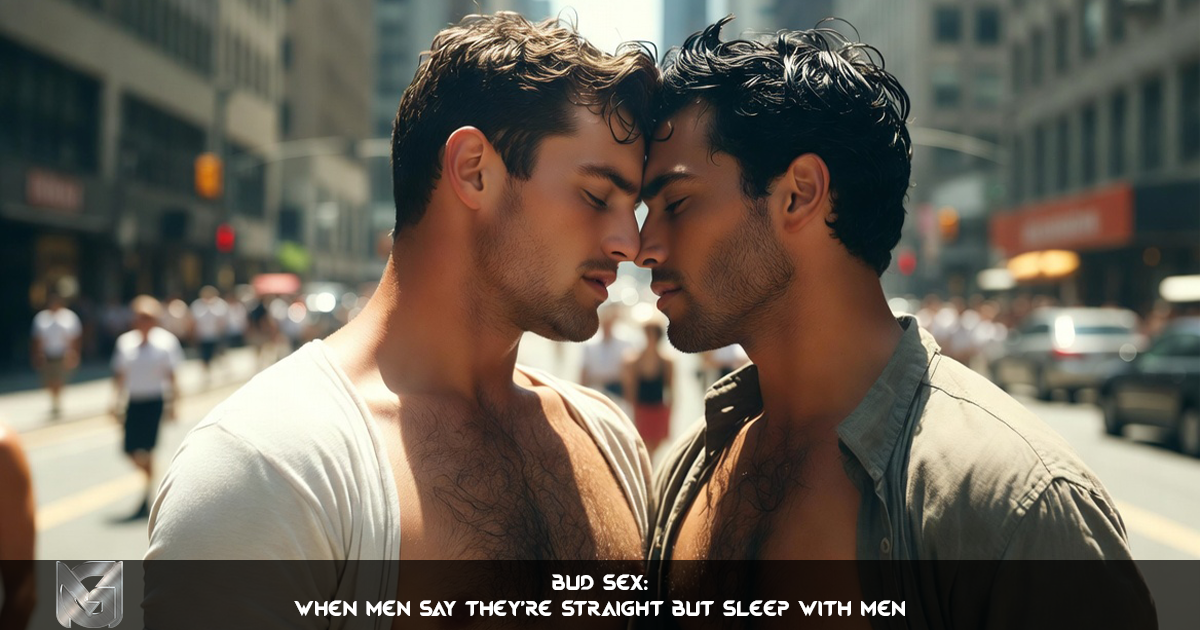
Bud sex. Two words that land like a provocation and, at the same time, like a confession of our era: sexuality doesn’t always fit neatly into boxes. In recent weeks, the term has been circulating again in mainstream media, notably via a UPSOCL piece, to describe men who have sex with other men while insisting they are neither gay nor bisexual. At Gay Mag, we can cover the topic without snickering, without moralising, and without chasing cheap buzz. Because behind the label, there are social realities, self-protective strategies, masculine norms that still weigh heavily, and sometimes, unexpected pockets of freedom.
What are we actually talking about?
A label, not an identity
Bud sex isn’t an “official” sexual orientation. It’s more a way of naming a behaviour, or a scene: sex between men, often described as occasional, discreet, and disconnected from romance. The key point is how these men narrate their own story: they may say “I’m straight” while engaging in sex with men, and they insist on separating sexual acts from identity.
“MSM”: the public health term
In research and prevention work, the common term is “men who have sex with men” (MSM). It’s deliberately descriptive: it talks about practices without presuming identity (gay, bi, straight, etc.). Bud sex is a more cultural, narrative subcategory: it says something about masculinity, secrecy, and the unspoken rules that frame these encounters.
What the UPSOCL article highlights: the “macho rulebook”
The UPSOCL piece popularises the idea that some men maintain a “macho” image through strict rules: no kissing, no cuddling, no eye contact. This is a tightly framed, almost contractual sexuality, where the stated goal is release rather than connection. That detail matters, because it shows the question isn’t only “who sleeps with whom”, but “how a social identity is protected”.
What research says: Tony Silva and normative masculinity
“Bud-Sex: Constructing normative masculinity…”
Sociologist Tony Silva studied rural men in the United States who identify as heterosexual while having sex with men. In a summary published by Gender & Society, he explains that these men reinterpret their practices to make them compatible with straightness (heterosexuality as a social norm) and a valued rural masculinity. In other words: they don’t necessarily experience themselves as “contradictory”, they build a narrative that preserves their social position.
Typical scenarios (and the justifications behind them)
In the accounts Silva reports, motivations vary:
- relieving an “urge” or a sexual need,
- seeking a specific act (often described in very technical terms),
- compensating for a decline in sex within a marriage,
- having an experience without naming it as “gay”.
The shared thread isn’t romantic desire, but managing the norm: keeping the “straight” label, preserving social status, and avoiding association with a devalued femininity.
Why do some men reject the words “gay” or “bi”?
1) The social weight of the label
Saying “I’m gay” or “I’m bi” isn’t just private information. It’s a social declaration, with possible consequences: family, work, friends, reputation. For some, the label feels riskier than the act itself.
2) Confusing behaviour with orientation
Many people still assume a sexual act automatically “defines” identity. Yet in real life, identity, desire, fantasy, behaviour, and emotional attachment don’t always line up perfectly.
3) Masculinity as a fortress
Bud sex often stages a defensive masculinity: “I can do this, but I’m still a real man.” Hence the rules: no tenderness, no romance, no signs associated with “gay couple” behaviour. This isn’t biological truth, it’s social performance.
Bud sex: a liberating grey zone, or a symptom of internalised homophobia?
One reading: sexuality is more fluid than we admit
You can see it as evidence that male heterosexuality isn’t always a solid, unbreakable block. Some men allow themselves experiences, sometimes without words, sometimes by inventing new ones. In this reading, bud sex reveals flexibility, even if it stays hidden.
Another reading: preserving straight privilege
Tony Silva also points to a more political angle: these men can maintain social privilege by remaining publicly “straight”, while enjoying marginalised practices in secret. And when they also demean feminine men or reject “gay behaviours”, it’s no longer just discretion: it touches the hierarchy of masculinities.
The unspoken rules: no kissing, no cuddling… why it matters
These rules aren’t trivial. They draw a symbolic border:
- sex is framed as “mechanical”,
- affection is framed as “gay”,
- tenderness is framed as “feminine”.
This is precisely where the topic becomes interesting through a queer lens: who decided emotion is incompatible with masculinity? And why do some men need that separation to feel “safe”?
Platforms and the logistics of secrecy
Even if every story is different, bud sex is often linked to contexts where discretion is easier:
- dating apps,
- coded language,
- meetings in “neutral” places (car, hotel, isolated spots),
- partners chosen for social similarity (same age, same “masc” style, same status).
It’s not only desire, it’s also organisation. And that organisation says something about the fear of being seen.
Sexual health: the point mainstream articles too often skip
Hidden practices can make prevention harder
When part of someone’s sexuality is clandestine, prevention can become more complicated:
- less frequent testing,
- avoiding conversations about condoms or PrEP,
- multiple partners without clear agreements,
- difficulty speaking to a doctor without feeling judged.
Gay Mag’s message
Labels aside: if you have sex with men, you deserve clear, non-judgmental information and prevention tools that fit your reality. Silence protects no one.
And for gay men, where does that leave us?
Bud sex can also create emotionally uneven situations:
- a gay man may hope for a relationship,
- the other may impose a “no feelings” rule,
- or keep the connection in secrecy that wears people down.
It’s not inevitable, but it calls for clarity: if someone refuses recognition, public space, and tenderness, it’s worth asking who is paying the price of secrecy.
How to talk about it without stigmatising (or romanticising)
Avoid two traps
- The judgement trap: “they’re lying to themselves”, “they’re homophobic”, full stop. Sometimes yes, sometimes no, often it’s more complex.
- The glamorisation trap: “it’s the new sexy trend”, as if secrecy and denial were glamorous.
A fairer approach
Talking about bud sex means talking about:
- masculine norms,
- social control,
- language (the words we accept or refuse),
- sexual health,
- emotional consent (what each person expects, what each person can offer).
Conclusion: what “bud sex” reveals about our time
Bud sex isn’t just a curiosity. It’s a mirror: it reflects the persistence of a masculinity that protects itself, sometimes at the cost of lies, sometimes at the cost of contempt for others, sometimes at the cost of its own freedom. But it also reveals something else: male sexuality isn’t always as simple as labels pretend. The real question may not be “are they gay or straight?”, but “what is it, in our society, that makes certain words so dangerous that some people would rather invent a category than say them out loud?”
Bud sex. Two words that land like a provocation and, at the same time, like a confession of our era: sexuality doesn’t always fit neatly into boxes. In recent weeks, the term has been circulating again in mainstream media, notably via a UPSOCL piece, to describe men who have sex with other men while insisting they are neither gay nor bisexual. At Gay Mag, we can cover the topic without snickering, without moralising, and without chasing cheap buzz. Because behind the label, there are social realities, self-protective strategies, masculine norms that still weigh heavily, and sometimes, unexpected pockets of freedom.
What are we actually talking about?
A label, not an identity
Bud sex isn’t an “official” sexual orientation. It’s more a way of naming a behaviour, or a scene: sex between men, often described as occasional, discreet, and disconnected from romance. The key point is how these men narrate their own story: they may say “I’m straight” while engaging in sex with men, and they insist on separating sexual acts from identity.
“MSM”: the public health term
In research and prevention work, the common term is “men who have sex with men” (MSM). It’s deliberately descriptive: it talks about practices without presuming identity (gay, bi, straight, etc.). Bud sex is a more cultural, narrative subcategory: it says something about masculinity, secrecy, and the unspoken rules that frame these encounters.
What the UPSOCL article highlights: the “macho rulebook”
The UPSOCL piece popularises the idea that some men maintain a “macho” image through strict rules: no kissing, no cuddling, no eye contact. This is a tightly framed, almost contractual sexuality, where the stated goal is release rather than connection. That detail matters, because it shows the question isn’t only “who sleeps with whom”, but “how a social identity is protected”.
What research says: Tony Silva and normative masculinity
“Bud-Sex: Constructing normative masculinity…”
Sociologist Tony Silva studied rural men in the United States who identify as heterosexual while having sex with men. In a summary published by Gender & Society, he explains that these men reinterpret their practices to make them compatible with straightness (heterosexuality as a social norm) and a valued rural masculinity. In other words: they don’t necessarily experience themselves as “contradictory”, they build a narrative that preserves their social position.
Typical scenarios (and the justifications behind them)
In the accounts Silva reports, motivations vary:
- relieving an “urge” or a sexual need,
- seeking a specific act (often described in very technical terms),
- compensating for a decline in sex within a marriage,
- having an experience without naming it as “gay”.
The shared thread isn’t romantic desire, but managing the norm: keeping the “straight” label, preserving social status, and avoiding association with a devalued femininity.
Why do some men reject the words “gay” or “bi”?
1) The social weight of the label
Saying “I’m gay” or “I’m bi” isn’t just private information. It’s a social declaration, with possible consequences: family, work, friends, reputation. For some, the label feels riskier than the act itself.
2) Confusing behaviour with orientation
Many people still assume a sexual act automatically “defines” identity. Yet in real life, identity, desire, fantasy, behaviour, and emotional attachment don’t always line up perfectly.
3) Masculinity as a fortress
Bud sex often stages a defensive masculinity: “I can do this, but I’m still a real man.” Hence the rules: no tenderness, no romance, no signs associated with “gay couple” behaviour. This isn’t biological truth, it’s social performance.
Bud sex: a liberating grey zone, or a symptom of internalised homophobia?
One reading: sexuality is more fluid than we admit
You can see it as evidence that male heterosexuality isn’t always a solid, unbreakable block. Some men allow themselves experiences, sometimes without words, sometimes by inventing new ones. In this reading, bud sex reveals flexibility, even if it stays hidden.
Another reading: preserving straight privilege
Tony Silva also points to a more political angle: these men can maintain social privilege by remaining publicly “straight”, while enjoying marginalised practices in secret. And when they also demean feminine men or reject “gay behaviours”, it’s no longer just discretion: it touches the hierarchy of masculinities.
The unspoken rules: no kissing, no cuddling… why it matters
These rules aren’t trivial. They draw a symbolic border:
- sex is framed as “mechanical”,
- affection is framed as “gay”,
- tenderness is framed as “feminine”.
This is precisely where the topic becomes interesting through a queer lens: who decided emotion is incompatible with masculinity? And why do some men need that separation to feel “safe”?
Platforms and the logistics of secrecy
Even if every story is different, bud sex is often linked to contexts where discretion is easier:
- dating apps,
- coded language,
- meetings in “neutral” places (car, hotel, isolated spots),
- partners chosen for social similarity (same age, same “masc” style, same status).
It’s not only desire, it’s also organisation. And that organisation says something about the fear of being seen.
Sexual health: the point mainstream articles too often skip
Hidden practices can make prevention harder
When part of someone’s sexuality is clandestine, prevention can become more complicated:
- less frequent testing,
- avoiding conversations about condoms or PrEP,
- multiple partners without clear agreements,
- difficulty speaking to a doctor without feeling judged.
Gay Mag’s message
Labels aside: if you have sex with men, you deserve clear, non-judgmental information and prevention tools that fit your reality. Silence protects no one.
And for gay men, where does that leave us?
Bud sex can also create emotionally uneven situations:
- a gay man may hope for a relationship,
- the other may impose a “no feelings” rule,
- or keep the connection in secrecy that wears people down.
It’s not inevitable, but it calls for clarity: if someone refuses recognition, public space, and tenderness, it’s worth asking who is paying the price of secrecy.
How to talk about it without stigmatising (or romanticising)
Avoid two traps
- The judgement trap: “they’re lying to themselves”, “they’re homophobic”, full stop. Sometimes yes, sometimes no, often it’s more complex.
- The glamorisation trap: “it’s the new sexy trend”, as if secrecy and denial were glamorous.
A fairer approach
Talking about bud sex means talking about:
- masculine norms,
- social control,
- language (the words we accept or refuse),
- sexual health,
- emotional consent (what each person expects, what each person can offer).
Conclusion: what “bud sex” reveals about our time
Bud sex isn’t just a curiosity. It’s a mirror: it reflects the persistence of a masculinity that protects itself, sometimes at the cost of lies, sometimes at the cost of contempt for others, sometimes at the cost of its own freedom. But it also reveals something else: male sexuality isn’t always as simple as labels pretend. The real question may not be “are they gay or straight?”, but “what is it, in our society, that makes certain words so dangerous that some people would rather invent a category than say them out loud?”
Bud sex. Two words that land like a provocation and, at the same time, like a confession of our era: sexuality doesn’t always fit neatly into boxes. In recent weeks, the term has been circulating again in mainstream media, notably via a UPSOCL piece, to describe men who have sex with other men while insisting they are neither gay nor bisexual. At Gay Mag, we can cover the topic without snickering, without moralising, and without chasing cheap buzz. Because behind the label, there are social realities, self-protective strategies, masculine norms that still weigh heavily, and sometimes, unexpected pockets of freedom.
What are we actually talking about?
A label, not an identity
Bud sex isn’t an “official” sexual orientation. It’s more a way of naming a behaviour, or a scene: sex between men, often described as occasional, discreet, and disconnected from romance. The key point is how these men narrate their own story: they may say “I’m straight” while engaging in sex with men, and they insist on separating sexual acts from identity.
“MSM”: the public health term
In research and prevention work, the common term is “men who have sex with men” (MSM). It’s deliberately descriptive: it talks about practices without presuming identity (gay, bi, straight, etc.). Bud sex is a more cultural, narrative subcategory: it says something about masculinity, secrecy, and the unspoken rules that frame these encounters.
What the UPSOCL article highlights: the “macho rulebook”
The UPSOCL piece popularises the idea that some men maintain a “macho” image through strict rules: no kissing, no cuddling, no eye contact. This is a tightly framed, almost contractual sexuality, where the stated goal is release rather than connection. That detail matters, because it shows the question isn’t only “who sleeps with whom”, but “how a social identity is protected”.
What research says: Tony Silva and normative masculinity
“Bud-Sex: Constructing normative masculinity…”
Sociologist Tony Silva studied rural men in the United States who identify as heterosexual while having sex with men. In a summary published by Gender & Society, he explains that these men reinterpret their practices to make them compatible with straightness (heterosexuality as a social norm) and a valued rural masculinity. In other words: they don’t necessarily experience themselves as “contradictory”, they build a narrative that preserves their social position.
Typical scenarios (and the justifications behind them)
In the accounts Silva reports, motivations vary:
- relieving an “urge” or a sexual need,
- seeking a specific act (often described in very technical terms),
- compensating for a decline in sex within a marriage,
- having an experience without naming it as “gay”.
The shared thread isn’t romantic desire, but managing the norm: keeping the “straight” label, preserving social status, and avoiding association with a devalued femininity.
Why do some men reject the words “gay” or “bi”?
1) The social weight of the label
Saying “I’m gay” or “I’m bi” isn’t just private information. It’s a social declaration, with possible consequences: family, work, friends, reputation. For some, the label feels riskier than the act itself.
2) Confusing behaviour with orientation
Many people still assume a sexual act automatically “defines” identity. Yet in real life, identity, desire, fantasy, behaviour, and emotional attachment don’t always line up perfectly.
3) Masculinity as a fortress
Bud sex often stages a defensive masculinity: “I can do this, but I’m still a real man.” Hence the rules: no tenderness, no romance, no signs associated with “gay couple” behaviour. This isn’t biological truth, it’s social performance.
Bud sex: a liberating grey zone, or a symptom of internalised homophobia?
One reading: sexuality is more fluid than we admit
You can see it as evidence that male heterosexuality isn’t always a solid, unbreakable block. Some men allow themselves experiences, sometimes without words, sometimes by inventing new ones. In this reading, bud sex reveals flexibility, even if it stays hidden.
Another reading: preserving straight privilege
Tony Silva also points to a more political angle: these men can maintain social privilege by remaining publicly “straight”, while enjoying marginalised practices in secret. And when they also demean feminine men or reject “gay behaviours”, it’s no longer just discretion: it touches the hierarchy of masculinities.
The unspoken rules: no kissing, no cuddling… why it matters
These rules aren’t trivial. They draw a symbolic border:
- sex is framed as “mechanical”,
- affection is framed as “gay”,
- tenderness is framed as “feminine”.
This is precisely where the topic becomes interesting through a queer lens: who decided emotion is incompatible with masculinity? And why do some men need that separation to feel “safe”?
Platforms and the logistics of secrecy
Even if every story is different, bud sex is often linked to contexts where discretion is easier:
- dating apps,
- coded language,
- meetings in “neutral” places (car, hotel, isolated spots),
- partners chosen for social similarity (same age, same “masc” style, same status).
It’s not only desire, it’s also organisation. And that organisation says something about the fear of being seen.
Sexual health: the point mainstream articles too often skip
Hidden practices can make prevention harder
When part of someone’s sexuality is clandestine, prevention can become more complicated:
- less frequent testing,
- avoiding conversations about condoms or PrEP,
- multiple partners without clear agreements,
- difficulty speaking to a doctor without feeling judged.
Gay Mag’s message
Labels aside: if you have sex with men, you deserve clear, non-judgmental information and prevention tools that fit your reality. Silence protects no one.
And for gay men, where does that leave us?
Bud sex can also create emotionally uneven situations:
- a gay man may hope for a relationship,
- the other may impose a “no feelings” rule,
- or keep the connection in secrecy that wears people down.
It’s not inevitable, but it calls for clarity: if someone refuses recognition, public space, and tenderness, it’s worth asking who is paying the price of secrecy.
How to talk about it without stigmatising (or romanticising)
Avoid two traps
- The judgement trap: “they’re lying to themselves”, “they’re homophobic”, full stop. Sometimes yes, sometimes no, often it’s more complex.
- The glamorisation trap: “it’s the new sexy trend”, as if secrecy and denial were glamorous.
A fairer approach
Talking about bud sex means talking about:
- masculine norms,
- social control,
- language (the words we accept or refuse),
- sexual health,
- emotional consent (what each person expects, what each person can offer).
Conclusion: what “bud sex” reveals about our time
Bud sex isn’t just a curiosity. It’s a mirror: it reflects the persistence of a masculinity that protects itself, sometimes at the cost of lies, sometimes at the cost of contempt for others, sometimes at the cost of its own freedom. But it also reveals something else: male sexuality isn’t always as simple as labels pretend. The real question may not be “are they gay or straight?”, but “what is it, in our society, that makes certain words so dangerous that some people would rather invent a category than say them out loud?”
For comments or projects, please contact me.