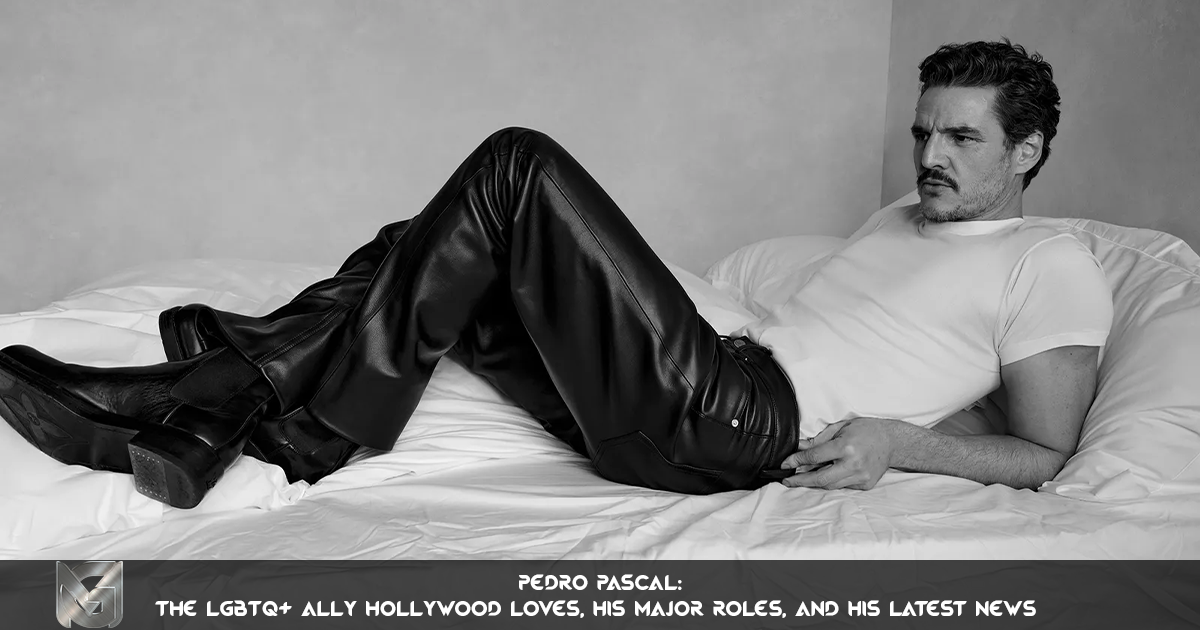
Pedro Pascal has become, in just a few years, far more than a bankable actor. He embodies a kind of masculinity that feels warm, funny, sometimes bruised, and, above all, instantly legible to a section of queer audiences, without ever playing at opportunistic ambiguity. In a media landscape where “allyship” is often reduced to a badge, he gives the impression of doing the opposite: speaking when it matters, staying quiet when it’s right to, and offering concrete support.
This article looks at what connects Pedro Pascal to the LGBTQ+ community, his actions and public positions, his most significant roles on screen, and what his recent news says about his place in pop culture.
Why Pedro Pascal is associated with the LGBTQ+ community
The connection between Pedro Pascal and the LGBTQ+ community isn’t based on a “rumour” or a forced reading of his private life. It comes mainly from three things: his public posture as an ally, a direct family connection to a trans person, and a cultural reception (fandom) that is strongly queer.
A vocal ally, without the theatrical posturing
When waves of anti-LGBTQ+ laws and rhetoric (especially anti-trans) gain momentum, some celebrities settle for a generic message. Pedro Pascal, on the other hand, has shared explicit messages of support, including a post featuring the inclusive LGBTQ+ flag, paired with a reference to Blowin’ in the Wind, a song that has become a symbol of civil-rights struggles.
What resonates is the consistency: he doesn’t “discover” the issue when it becomes trendy. He’s part of a longer continuity, and he also accepts the idea that posting isn’t enough, that you have to remain useful, keep learning, and do better.
The link with his trans sister, Lux Pascal
One point comes up regularly in coverage and fan reactions: Pedro Pascal has a trans sister, Lux Pascal, and he has supported her publicly. This family connection isn’t a marketing argument, it’s a reminder, for many LGBTQ+ people, that these fights aren’t abstract. They’re lived within families, friendships, and everyday life.
Without prying into the intimate, that context helps explain why his comments on trans rights are perceived as more embodied, less “conceptual”.
A pop icon embraced by queer fandoms
There’s also the cultural dimension: Pedro Pascal has become an object of desire, a meme, an “internet daddy”, but also an actor queer audiences love because he often plays men who are protective, vulnerable, loyal, and because he leaves room for emotion.
Important: being adored by an LGBTQ+ audience says nothing about someone’s sexual orientation. And many fans stress this: speculating about an actor’s sexuality because they support the community is not only pointless, it’s intrusive.
His biggest series: from breakout to consecration
Pedro Pascal built his career in stages, from striking supporting parts to characters that became icons of global television.
Game of Thrones: Oberyn Martell, tragic flamboyance
Even if his time in Game of Thrones is relatively brief, Oberyn Martell left a lasting mark. An openly bisexual character, charismatic, political, sensual, he offered rare representation at the time in a mainstream series. The role also established Pedro Pascal as an actor who can be magnetic without slipping into caricature.
Narcos: the anti-hero at the heart of the story
With Narcos, he gains dramatic weight and international visibility. The series lets him play tension, moral fatigue, loyalty, and a kind of courage that has nothing glamorous about it. It’s a turning point: he becomes a familiar face, and, above all, a credible one.
The Mandalorian: the masked icon
In The Mandalorian, he pulls off a paradox: becoming a global star while playing a character whose face stays hidden for a long time. The performance relies on voice, posture, rhythm. And the chemistry with Grogu did the rest: the series turned his character into a symbol of protection and attachment, a register deeply loved by fandoms.
The Last of Us: vulnerability as strength
With The Last of Us, he reaches another level. Joel is a hard, closed-off, traumatised character, but not a monolith. The series, also praised for its queer arcs, reinforced the idea that Pedro Pascal can carry an emotional story without tipping into melodrama.
His standout films: a filmography still expanding
Even if television propelled him, Pedro Pascal is also establishing himself in film, moving between blockbusters, auteur cinema, and hybrid projects.
Supporting roles that steal the scene
He’s often been the kind of actor who, even in a secondary role, leaves a distinct imprint. His humour, his ability to shift from charm to threat, or from tenderness to violence, makes him extremely castable.
A modern star trajectory
His recent filmography shows a clear strategy: refusing to be boxed into a single archetype. He can be heroic, ironic, dark, romantic, and sometimes deliberately offbeat. That’s also what makes him compelling to queer audiences: the sense that he doesn’t need to prove his masculinity, he deconstructs it through performance.
Pedro Pascal and the LGBTQ+ community: actions, signals, limits
Talking about a “connection” to the LGBTQ+ community requires precision. There’s what he does, what he says, and what people project onto him.
What he does: public support and visibility
His support messages, particularly around trans rights, have been widely shared. In a climate where trans people are politically targeted, seeing a mainstream actor show clear support matters, because it normalises the idea that defending LGBTQ+ rights isn’t a “niche issue”, it’s a question of dignity.
What not to do: speculate about his sexuality
Pedro Pascal’s popularity with queer audiences has sometimes led to shortcuts. But supporting the community doesn’t mean “being part of it”, and allyship doesn’t give the public the right to demand an intimate confession.
That’s an important editorial line, especially for an LGBTQ+ outlet: celebrate allies, yes, but without reproducing a culture of outing or insinuation.
His news over the last 12 months: pop culture, interviews, buzz
In the recent period, his news mainly illustrates two things: his status as a mainstream star, and his ability to remain likeable in a media cycle that’s often cynical.
The “Late Show” moment: a kiss that became a micro-event
In May, Pedro Pascal made headlines after an appearance on The Late Show with Stephen Colbert, where he kissed the host on air, as a joke, saying he was “jealous”. The point isn’t to over-interpret it, but to note how this kind of sequence is immediately read as a sign of ease, playfulness with codes, and complicity.
In a culture where public men are often tense about the fear of being “misread”, moments like this, even light ones, contribute to normalisation.
A media presence that avoids overload
What stands out is that he remains highly visible without becoming exhausting. He gives interviews, appears on shows, feeds the pop conversation, but he doesn’t turn himself into an aggressive brand. He keeps the image of someone who works, doubts, thanks people, and doesn’t play the “messiah”.
Why Pedro Pascal matters for Gay Mag
Pedro Pascal is a strong Gay Mag subject because he lets us talk about several things at once.
A model ally, imperfect but consistent
He doesn’t “solve” anything on his own, but he shows that an actor can support the LGBTQ+ community without visible opportunism, and without hijacking the fight. He owns a position, and he also accepts the idea that you have to do more than post.
An actor who embodies a breathable masculinity
There’s a way he plays men that lets emotion through. And that’s precisely what many queer audiences look for: stories where tenderness isn’t weakness, where protection isn’t domination, where vulnerability isn’t punished.
A star who sparks desire without cynicism
The “internet daddy” can be a cliché. But in his case, the phenomenon also speaks to a collective fatigue with toxic masculinities. People project onto him a softness, a sense of safety, humour, a capacity to be sexy without being violent.
Conclusion
Pedro Pascal is now at a rare crossroads: franchise star, credible dramatic actor, and a pop figure embraced by queer fandoms. His connection to the LGBTQ+ community is less about a label than an attitude: support, respect, not centring himself, and letting people breathe.
And if his recent news proves anything, it’s that pop culture can still produce icons who bring people together, without demanding “proof” of intimacy, and without turning the ally into a product.
For comments or projects, please contact me.