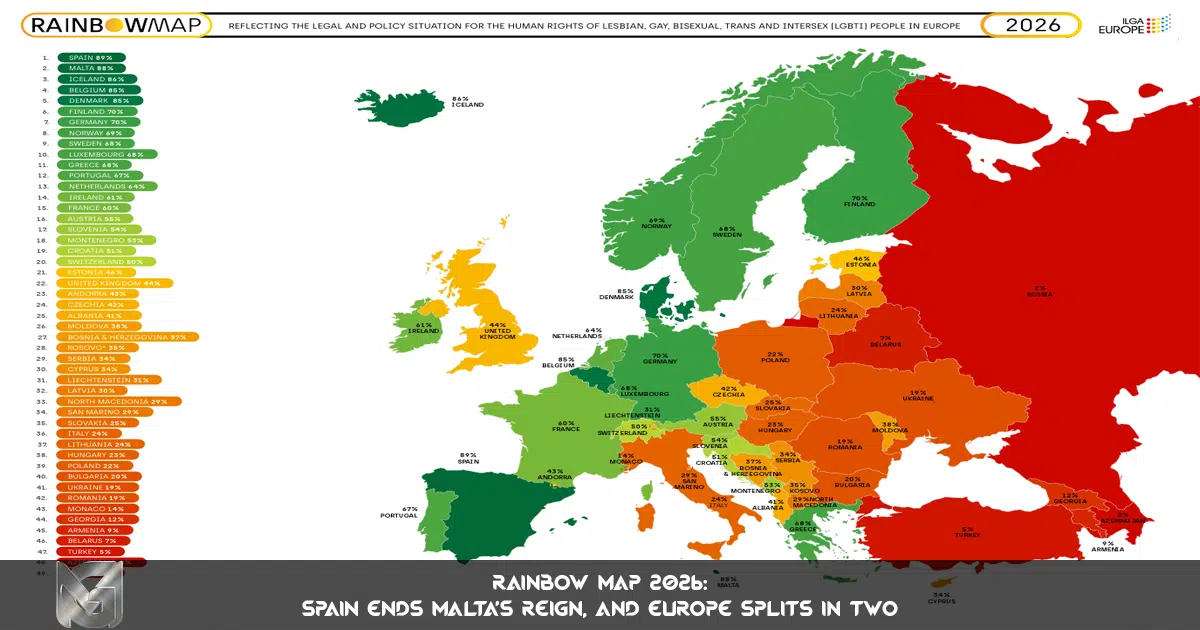
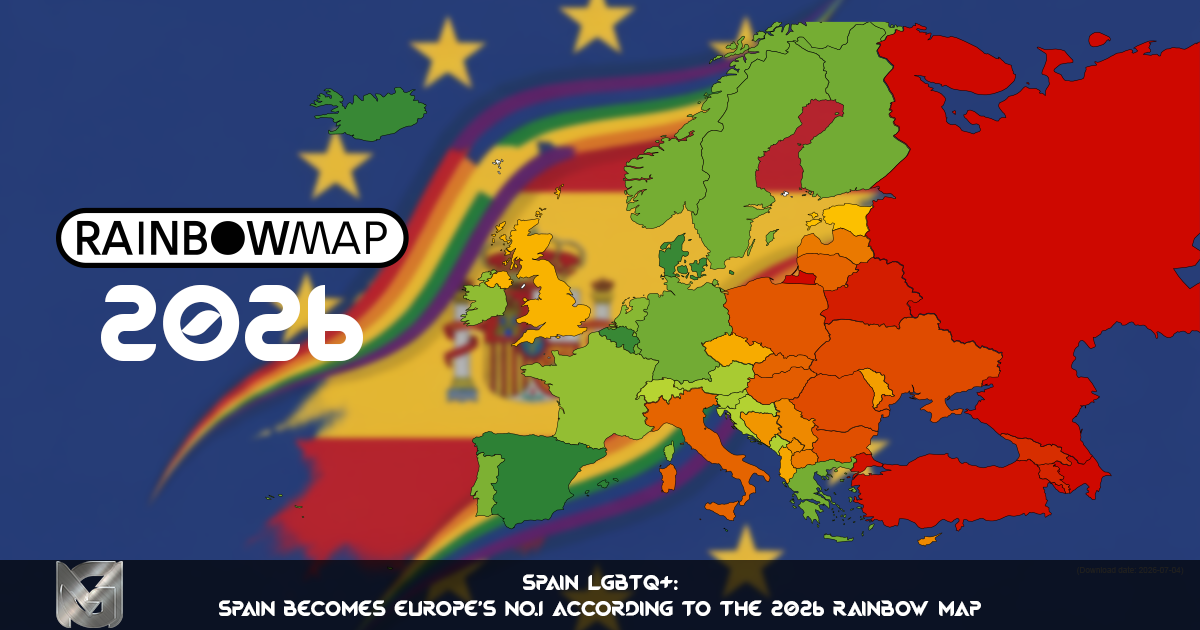
Spain LGBTQ+. Two words that, in 2026, capture a major symbolic and political shift: Spain now tops the European ranking for LGBTQ+ rights in the 2026 Rainbow Map. In a period when rollbacks are multiplying in several countries, seeing a state reach No.1 is not just a trophy, it is a signal. A signal for LGBTQ+ people looking for breathing space, for organisations fighting every day, and for governments that claim to “protect” while quietly shaving away freedoms.
The Rainbow Map is not a popularity contest. It is a political reading tool, built on specific criteria, measuring the state of rights, protections and public policies affecting LGBTQ+ people across Europe. And in 2026, Spain emerges as the best-positioned country. So the question is not only “why Spain”, but also “what does this say about Europe”.
Understanding the 2026 Rainbow Map: a political barometer, not a postcard
The 2026 Rainbow Map (published every year) assesses European countries across a set of indicators: anti-discrimination protections, family recognition, trans and intersex rights, asylum policies, action against hate crime, freedom of expression and association, and many other dimensions.
This kind of ranking has a particular strength: it makes visible what many governments would prefer to keep blurry. A right does not exist because it is “tolerated”. It exists because it is written into law, implemented, funded, defended, and because victims can obtain redress.
The Rainbow Map also has a limitation: it captures laws and policies, but it cannot, on its own, measure the full reality of social violence, everyday discrimination, or territorial inequalities. Being No.1 does not mean everything is solved. It means that, on the criteria used, Spain ticks more boxes than its neighbours.
Spain No.1 in Europe: what that means in practice
Saying Spain has become No.1 in Europe means that, in 2026, it is the continent’s leading institutional reference point on LGBTQ+ rights according to the 2026 Rainbow Map. This leadership is explained by a combination of factors: a robust legal framework, expanded protections, and a political dynamic that, despite tensions, has produced measurable progress.
For the community, the effect is double. On one hand, it is validation: decades of struggle have left durable marks in the law. On the other, it is responsibility, because a country at the top becomes a benchmark, and therefore a prime target for reactionary campaigns.
A more protective framework, and above all a clearer one
In many European countries, LGBTQ+ rights exist in fragments: an anti-discrimination law here, a civil partnership there, partial family recognition elsewhere. Spain, by contrast, has built a more coherent set, where protections do not rely only on legal interpretation, but on explicit texts.
That clarity matters. A vague right is a fragile right. A clear right is easier to defend, to apply, and to enforce through administrations, employers, schools and health services.
Public policy that goes beyond symbolism
The 2026 Rainbow Map also values active policies, not just laws. That includes prevention, training, reporting mechanisms, strategies against hate crime, and the state’s ability to deliver concrete responses.
This is where Spain stands out: when a country invests in protection mechanisms, it sends a simple message, LGBTQ+ people’s safety is not a “cultural” issue, it is a fundamental rights issue.
Why Europe needs this signal in 2026
The European context is not neutral. For several years, we have seen growing polarisation: more openly anti-LGBTQ+ rhetoric, attempts at censorship, attacks on sex education and prevention, and the instrumentalisation of trans people as a political scarecrow.
In that landscape, Spain LGBTQ+ functions as a living contradiction. It shows that it is possible to move forward, even under pressure, even with loud opposition, even when social media turns every debate into a battlefield.
Rollbacks elsewhere are not fate, they are political choices
When protections disappear, it is not “society” deciding spontaneously. It is majorities, coalitions, ministries, votes. The 2026 Rainbow Map is a reminder that LGBTQ+ rights are not set dressing. They are the result of political trade-offs.
And that is precisely why the ranking matters. It allows us to name the countries that progress, but also those that stagnate or regress, without hiding behind vague formulas.
What this changes for travellers, expats, and the queer scene
For Gay Mag readers, the question is also very concrete: what does this leadership mean for those who travel, settle, or work in Spain.
Spain is already a major LGBTQ+ tourism destination, with cities like Madrid, Barcelona, Valencia, Seville, and more coastal areas. But being No.1 in Europe according to the 2026 Rainbow Map strengthens a key element: predictability. And for many, Spain LGBTQ+ becomes a practical reference point.
When you travel queer, you are not only looking for a party. You are looking for a place where you can hold the hand of the person you love, book a room without having to “explain”, see a doctor without being judged, report an assault without being mocked.
Stronger attractiveness, but beware the “everything is fine” illusion
Let’s be clear: a ranking does not automatically protect you from street homophobia, domestic violence, or workplace discrimination. Even in the highest-scoring countries, assaults happen.
But the difference is response capacity. A better-ranked country is supposed to offer more remedies, more protections, more recognition. It is a stronger safety net. And that is also what, on paper, Spain LGBTQ+ promises.
Watch points: because No.1 does not mean invulnerable
The risk, when a country becomes No.1, is to believe the battle is over. Yet LGBTQ+ history is a story of cycles: progress, backlash, new progress, new attacks.
Spain, like others, remains exposed to several vulnerabilities. Even with a high score, Spain LGBTQ+ is not a magic shield.
Political polarisation and the permanent culture war
LGBTQ+ rights have become, in many countries, electoral fuel. Disinformation campaigns target schools, families, health, and especially trans people.
Even with a strong legal framework, social pressure can rise. And when social pressure rises, violence rises too. The law is a shield, but it is not armour.
Territorial inequalities and everyday reality
A country is not homogeneous. Big cities often offer more resources, more organisations, more venues, more visibility. Elsewhere, loneliness and fear can be stronger.
The 2026 Rainbow Map measures national policies, but life also plays out locally: in a school, a police station, a medical practice, a workplace. That is where the Spain LGBTQ+ label must be tested against reality.
What Spain can inspire, and what other countries must stop pretending
What Spain is saying in 2026 is not only “we are the best”. It is “we made choices”. Choices that recognise LGBTQ+ people not as a subgroup to manage, but as citizens to protect.
For other European countries, the message is simple: if Spain can become No.1, then the “it’s complicated” excuse collapses. What is missing elsewhere is not possibility. It is political will. And that is where Spain LGBTQ+ becomes a political benchmark.
An exportable model, if we are honest about resistance
Yes, some measures are transferable. Yes, protections can be copied. But we also need to look at what makes these advances possible: a strong civil society, sustained mobilisation, political allies, and a public opinion that, despite tensions, has integrated part of the stakes.
And we must be lucid: every advance triggers a reaction. The question is not to avoid the reaction, but to contain it, contradict it, and keep moving. That is also the Spain LGBTQ+ challenge.
Conclusion: Spain LGBTQ+, a leadership that obliges
Spain LGBTQ+. In 2026, it is not just a slogan, it is a marker. The 2026 Rainbow Map ranks Spain No.1 in Europe, and that ranking carries particular weight at a time when rights are being attacked head-on.
For Gay Mag, the point is not to hand out gold stars, but to read what these rankings say about our continent. Spain proves that a country can consolidate rights, make them more coherent, and send a protection signal. And that signal, Spain LGBTQ+, deserves close attention.
But leadership obliges. It obliges us to stay vigilant, to document violence when it exists, to support organisations, and to remember that LGBTQ+ rights are never “acquired”. They are defended, or they disappear.
For comments or projects, please contact me.