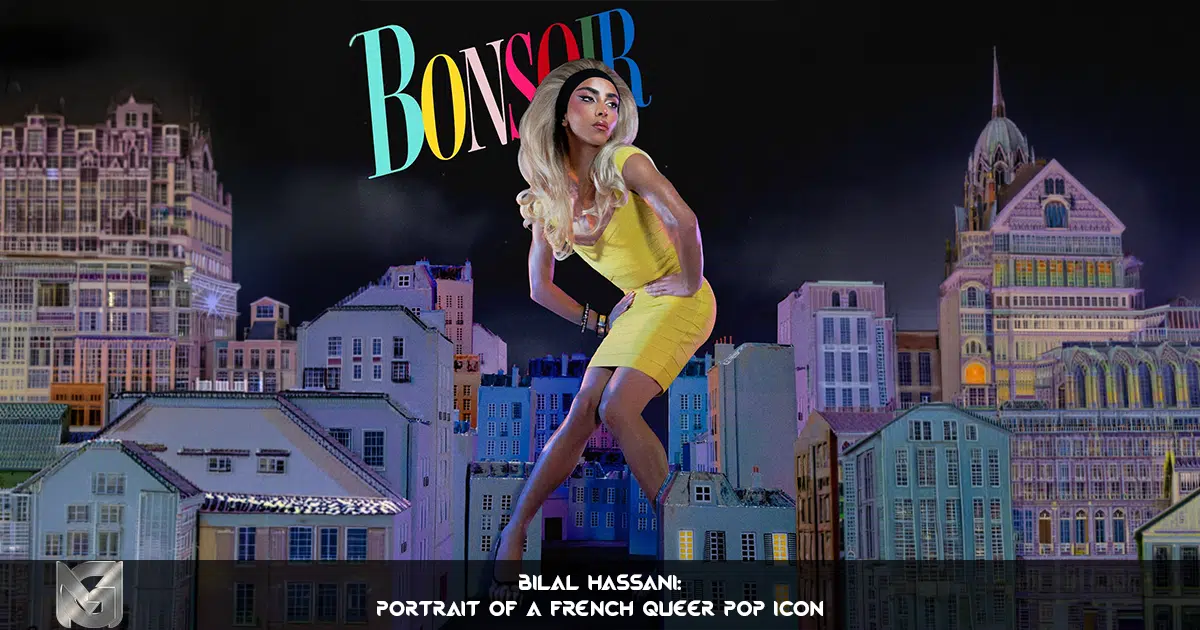
Bilal Hassani is not just a name associated with Eurovision or an instantly recognisable pop aesthetic. In just a few years, the artist has become a generational symbol, at the crossroads of music, social media, performance, and an LGBTQ+ visibility that both unsettles and liberates. For Gay Mag, telling Bilal’s story is also telling the story of a moment in French pop where image is not an “extra”, but a language, and where self-assertion becomes a cultural act.
From YouTube to mainstream pop: a career born online
Before becoming a familiar face on TV sets, Bilal Hassani built a community online. That “digital native” origin matters, it explains a direct closeness with fans, a way of narrating life in episodes, and an instinctive understanding of pop as a visual story.
It is also what makes his trajectory worth following: Bilal did not enter the industry through a single door. He moved through multiple stages, formats, and audiences, and turned each step into a springboard.
The Voice Kids: the first spotlight
Bilal took part in The Voice Kids in 2015. This appearance, often mentioned, marked a first encounter with the general public and established the image of a young artist already very comfortable on stage.
Eurovision 2019: “Roi”, a pop slogan that became a mantra
If one moment crystallised Bilal Hassani’s fame, it was Eurovision 2019, where he represented France with “Roi”. The song, designed as a message of self-acceptance, works on several levels: a memorable chorus, an unapologetic stance of pride, and a simple promise, almost political, without turning into a pamphlet.
Eurovision is also a megaphone, a stage where eccentricity, emotion, and theatricality are part of the code. Bilal found a natural home there. According to the BBC, “Roi” is about self-acceptance and the idea of being fully yourself, without shame.
Visibility exposes you, and it comes at a cost
Bilal experienced the downside of that visibility immediately: cyberbullying, homophobic insults, and attacks on appearance. At the time, organisations such as Urgence Homophobie and Stop Homophobie announced they wanted to take action against hateful remarks targeting the artist, a reminder of a brutal reality: in France too, queer pop sometimes pays a high price simply for existing.
An LGBTQ+ icon: not perfect, but necessary
There is a tendency to reduce Bilal Hassani to an “LGBTQ+ icon” as if it were a marketing label. But with him, the question runs deeper: it is about gender, self-presentation, and the right to be multiple.
Based on widely reported biographical elements, Bilal publicly came out in 2017 and identifies as genderqueer / genderfluid, comfortable with multiple pronouns. In a French pop culture that long remained cautious on these topics, that simple statement carries weight.
Why it matters to part of the gay audience
For many Gay Mag readers, Bilal Hassani embodies something very specific:
- The freedom to be “too much” (too visible, too made-up, too flamboyant) without apologising.
- A French pop scene that embraces the queer heritage of performance.
- A pride culture that is not reserved for big capitals or Pride nights.
And, importantly, Bilal does not speak only to LGBTQ+ audiences. He also reaches a broader public, sometimes new to these issues, who discovers through him concepts (gender, expression, insults, harassment) they might not have encountered otherwise.
Music: albums, aesthetics, and image-driven pop
Bilal Hassani’s music sits within contemporary French pop, often highly produced, where the importance of the video, the look, and staging is palpable. His official website highlights several milestones:
- “Roi” (2019) as a pivotal track.
- A first album, “Kingdom” (2019).
- The creation of his label House Of Hassani (announced in 2020 on his official biography).
- A second album, “Contre Soirée”.
- An album “Théorème”, and a reissue “Iconic Edition” (mentioned on the official bio).
Without turning this article into a dry discography, the idea is clear: Bilal moves forward in aesthetic “chapters”. Each project has its own universe, codes, colours, and vocabulary.
Pop, but also performance
With Bilal Hassani, performance is not decoration. It is part of the message. Make-up, wigs, silhouettes, choreography, everything contributes to a narrative: “I create myself, therefore I exist.”
Danse avec les stars: a TV moment that made history
In 2021, Bilal took part in Danse avec les stars. According to his official biography and encyclopaedic sources, he reached the final and danced with Jordan Mouillerac, in what is presented as the show’s first same-sex pairing.
Why does it matter? Because mainstream television remains a place of norms. When a family programme shows a dance duo that breaks expectations, it does more than entertain, it shifts the centre.
Current news: where is Bilal Hassani today?
Bilal Hassani continues to expand his playground beyond the classic “pop singer” format. According to his official biography, the artist has recently strengthened his presence in the world of image and fiction.
Cinema: “Les Reines du Drame” and what comes next
The official bio mentions a leading role in “Les Reines du Drame” (Alexis Langlois), announced as released in cinemas on 27 November 2024, with a second film also mentioned as part of what follows. For a performer like Bilal, this move to the screen makes sense: it extends the logic of the music video, but with different tools, different narratives, and a different rhythm.
Music projects: pop reinvented through “eras”
Still according to his official biography, Bilal has highlighted the “Iconic Edition” reissue of the album “Théorème”, and continues to carry a strongly identifiable aesthetic, where music, styling, and visual storytelling move forward together.
Bilal Hassani and France: a mirror of cultural tensions
Bilal Hassani is a revealer. He shines a light on very French tensions:
- Fascination with flamboyant pop, but discomfort when it becomes political.
- Surface-level acceptance, then online violence.
- “Let them live”, as long as it stays discreet.
Controversies and instrumentalisation
Like many highly visible public figures, Bilal has gone through controversies, sometimes instrumentalised. Some come from social media dynamics, others from the way part of the public debate tries to disqualify artists by reducing them to a caricature.
For Gay Mag, the point is not to replay the permanent internet courtroom, but to restate a simple principle: queer visibility is often judged more harshly than others, and the artist becomes a screen onto which everyone projects their obsessions.
What Bilal really changes in French pop
You may like or dislike Bilal Hassani’s music. But it is hard to deny the cultural effect:
- He normalised queer flamboyance in mainstream spaces.
- He made gender topics visible without relying on academic language.
- He showed that a career can be born online and then impose itself within the industry.
A door opened for others
Bilal is not “the first” queer artist in France, of course. But he is among those who moved the needle in an era of massive social media, where hate circulates fast, and where pop can become a battleground.
Conclusion: pop that doesn’t apologise
Bilal Hassani is pop that refuses to ask for permission. Pop that knows image is a tool, the stage is a political space, and softness can be a form of resistance. For Gay Mag, his journey tells something essential: queer culture no longer merely exists on the margins, it is written at the centre, on full screen, and sometimes at full volume.
For comments or projects, please contact me.