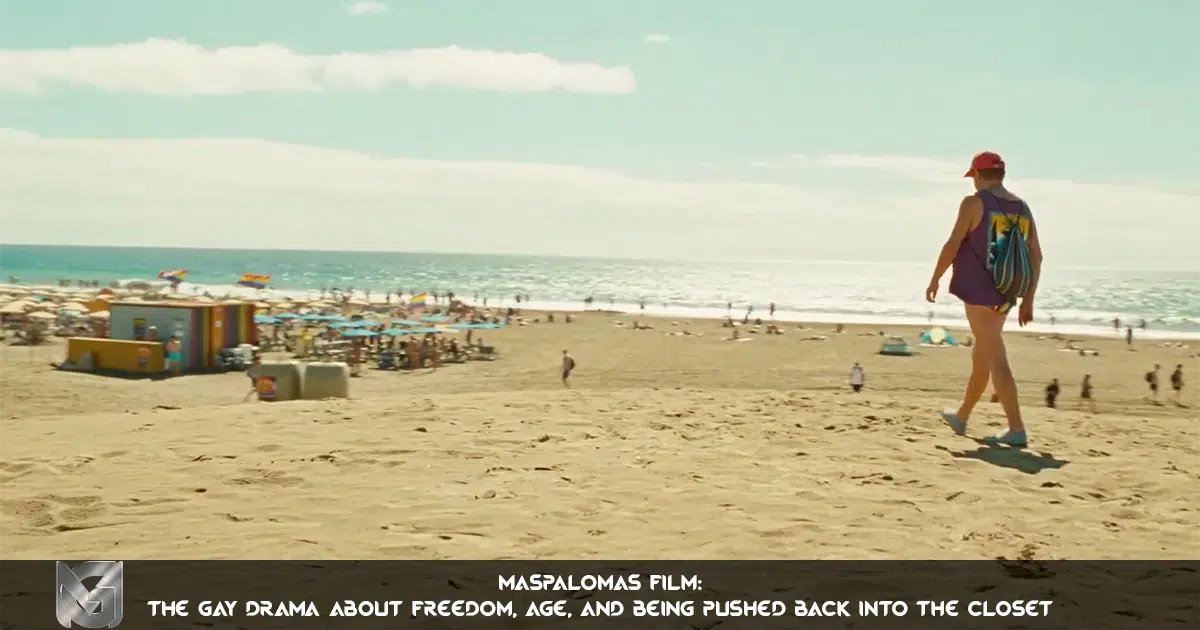
Maspalomas film lands like a soft slap, the kind that doesn’t chase shock value, but leaves a mark. Beneath its intimate, slice-of-life surface, this Spanish feature (2025) takes on a subject cinema still too rarely treats without caricature, gay sexuality at an age when the screen often prefers to look away. And it does so by taking Maspalomas seriously, not as a postcard backdrop, but as a symbol, a place where you can breathe, where you allow yourself, where you reinvent yourself.
In the Gay Mag universe, we love films that tell a social truth without turning into a pamphlet. Here, the question isn’t only “can you still desire?”, it’s “what happens to you when society asks you to hide again?”. The film asks that question with rare emotional precision.
A 2025 Spanish film, between drama and a chronicle of dignity
Directed by Jose Mari Goenaga and Aitor Arregi, the film follows Vicente, 76, an openly gay man who lived a period of freedom in Maspalomas. Then, after a breakup and a return to the Basque Country, he finds himself facing an environment that no longer leaves him room to be himself.
The synopsis, as presented in festival and encyclopedic sources, is clear, almost brutal, a man who once knew open air is pushed to “go back into the closet” in a conservative nursing home. That premise alone makes the stakes obvious, freedom is not a given, it is negotiated, and sometimes it is lost.
Vicente, 76, and the vertigo of regression
What hits hardest is the social mechanism the film brings to light. Vicente isn’t “fragile” because he is ageing, he becomes vulnerable because the frame around him tightens. The film shows how, in certain places, homosexuality becomes something “to manage” again, to keep quiet, to minimise, as if an older person were being asked to become acceptable once more.
Without unnecessary spoilers, you can say the story focuses on how an assumed identity can be destabilised, not by an inner doubt, but by external pressure, family, institutional, cultural.
Maspalomas, more than a setting, a European gay symbol
For many European gay men, Maspalomas is not just a sunny destination. It’s an imaginary, dunes, beaches, bodily freedom, protective anonymity, visible community. The film builds on that reality, Maspalomas as a space to breathe.
The “tourist haven” as a parenthesis of truth
In the Palm Springs International Film Festival presentation, Maspalomas is described as a “tourist haven” and a “pilgrimage site for gay men”. That phrasing matters, it’s not just a place you go, it’s a place you return to, sometimes to find yourself again.
The film plays on that contrast, the Maspalomas parenthesis, where Vicente can be himself, versus the return to a daily life where people watch, judge, infantilise.
Maspalomas and the question of the body, visible or erased
What’s interesting is that Maspalomas also points to the visibility of bodies. The film talks about age, therefore about an ageing body, but above all it talks about the social gaze. In an openly gay space, the body exists. In a conservative space, it becomes a problem.
The film doesn’t sink into misery. It shows a reality, being older and gay can be joyful, sensual, alive, but it remains fragile the moment the environment withdraws its implicit permissions.
A story about being “pushed back into the closet”, a theme rarely handled with such accuracy
Being “pushed back into the closet” is unsettling because it breaks a simplified activist storyline, you come out, you own it, end of story. Life is more complex. The film reminds us that acceptance is not linear, and that it also depends on places, institutions, generations.
The nursing home as a micro-society
The nursing home here isn’t only a place of care. It’s a micro-society with its norms, silences, hierarchies. The film hits a blind spot, how do institutions welcome older gay people? How do you handle intimacy, relationships, desire, when everything is collective, controlled, medicalised?
The film doesn’t need speeches. It’s enough to show the discomfort, the insinuations, the small humiliations, and sometimes the unexpected solidarities.
The father-daughter relationship, between abandonment and a second chance
According to the available summary, Vicente reconnects with his daughter, whom he had abandoned years earlier. That narrative thread adds another layer, old age puts accounts back on the table. The film doesn’t try to “excuse” or condemn, it observes how people attempt repair when time is running out.
In a gay reading, that relationship is also political, how many men had to choose between family and truth, between safety and desire? And what remains when you come back, decades later?
Performance and reception, a film carried by an actor at the centre of every scene
Vicente is played by José Ramón Soroiz. Sources indicate his performance was widely noticed, to the point of earning him a Goya for Best Actor.
A performance that avoids caricature
This kind of role can easily tip into a “message performance”. Here, criticism highlights empathy and truth in the acting. The film rests on a presence, a face, a way of being in the world.
Reported reviews mention a work described as an “ode to hope” and a performance that is “empathetic and involving”. Even when the direction is noted as “not especially cinematic”, the interest remains intact because the character is alive.
Festivals and international circulation
The film premiered at the San Sebastián Festival (September 2025), then travelled through several selections, including screenings in London (BFI London Film Festival) and in specialist festivals. That trajectory makes sense for a film that speaks both to general audiences and to gay audiences, without being reduced to a niche.
Why this film matters for Gay Mag
In a landscape where LGBTQ+ stories often oscillate between teenage coming-out, idealised romance, or tragic drama, this film opens another space. It talks about ageing without making it shameful. It talks about sex without making it grotesque. It talks about Maspalomas without reducing it to a postcard.
A film about freedom, not about permission
The heart of the film is freedom, not as a slogan, but as a concrete experience. The freedom to be seen, to desire, to flirt, to make mistakes, to start again. And the soft, but real, violence when that freedom is taken away in the name of “peace”, “respect”, “decency”.
A current resonance, rights, backlash, and invisibilisation
Without turning the film into a news commentary, it’s hard not to hear the echo. In several countries, LGBTQ+ rights are rolling back, rhetoric is hardening, and the temptation of invisibilisation returns. The film reminds us that invisibilisation is not only political, it is also everyday, in care settings, in families, in institutions.
Who to recommend Maspalomas to
This film will speak to several audiences.
To gay readers, across generations
For younger readers, it’s a window onto a reality we rarely talk about, gay ageing, its joys, its fears, its strategies. For older readers, it may be a mirror, sometimes uncomfortable, but rarely contemptuous.
To loved ones and families
The film can also serve as a starting point for discussion, not about abstract “tolerance”, but about concrete conditions, how do you respect the intimacy of a gay parent? How do you avoid deciding in their place?
To care and social professionals
Without being didactic, the film raises useful questions, about welcome, training, respect for identities, fighting micro-aggressions. It reminds us that an institution can look “neutral” on the surface and yet be deeply normative.
What the film says about Maspalomas, and what it doesn’t
The film uses Maspalomas as a space of freedom, and that’s fair. But it does not claim to summarise the town, or the scene, or the diversity of experiences. Maspalomas can be festive, gentle, sexual, communal, but it can also be shaped by tourist, economic, generational dynamics.
The film chooses one angle, that of a man who finds a second youth there. That’s a narrative choice, not an encyclopaedia.
Conclusion: a rare film, tender, political without slogans
Maspalomas film pulls off a difficult balance, telling an intimate story that touches collective issues, without underlining, without moralising. It reminds us that emancipation can be fragile, that dignity plays out in details, and that Maspalomas, beyond dunes and sun, can stand for a place where you remember yourself.
For Gay Mag, it’s exactly the kind of film worth defending, because it expands the gay story. It says, you have the right to desire at 76. You have the right to be visible. And you have the right not to go back into the closet, even when the world pushes you there.
For comments or projects, please contact me.