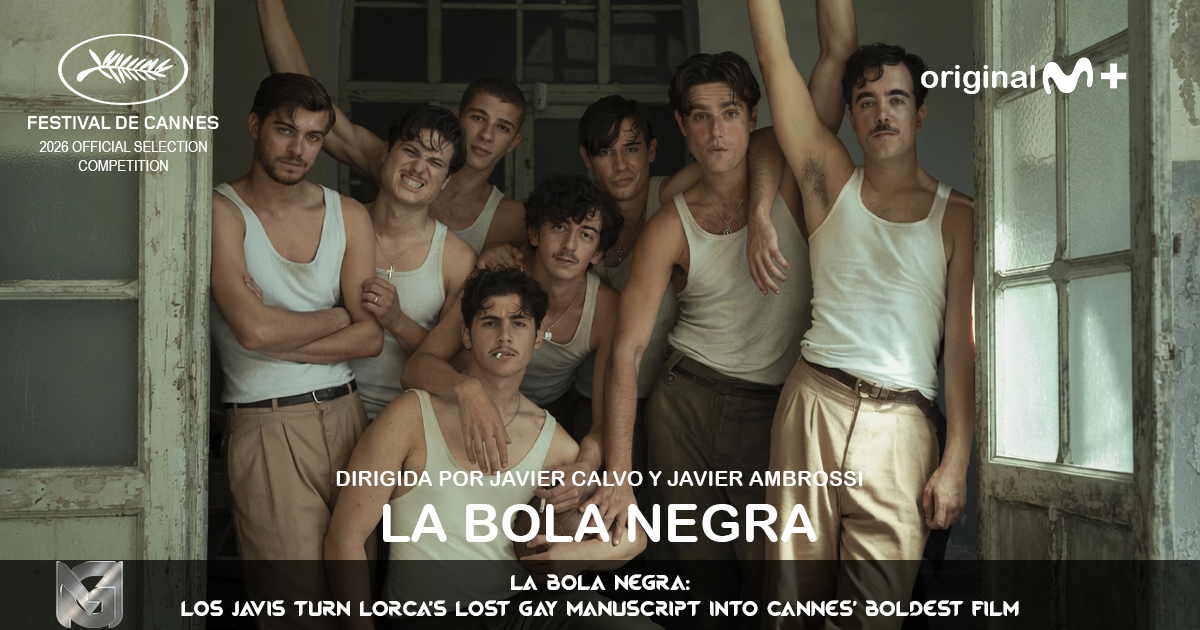
La Bola Negra is the film a whole generation of queer Spain has been waiting for, and it arrives with a Cannes trophy already in its hands. Directed by Javier Ambrossi and Javier Calvo, the Madrid duo known everywhere as Los Javis, it takes a manuscript that Federico García Lorca never finished and turns it into a sweeping, three-part meditation on gay desire, silence and inheritance stretched across almost a century of Spanish history. It is ambitious, it is unapologetically queer, and it may be the most talked-about Spanish release of the year.
Presented in competition at the 79th Cannes Film Festival in May 2026, where it shared the award for Best Director, this is easily the most daring mainstream Spanish film of the year and one of the most openly queer works ever to compete on the Croisette.
A lost Lorca work brought back to life
Lorca began writing a piece called La bola negra in the 1930s and left only four pages behind before Francoist forces murdered him in August 1936. Those fragments are the earliest known work in which the poet handed his own homosexuality to an openly gay protagonist, which is why they have haunted scholars for decades as a tantalising what-if. Los Javis, writing alongside the playwright Alberto Conejero, treat the pages as a seed rather than a finished script. They weave in Conejero’s acclaimed stage play La piedra oscura, which imagines the last night of Lorca’s lover Rafael Rodríguez Rapún, and build a whole architecture of fiction around what the poet left unsaid.
What ‘the black ball’ really means
The title is not decorative. In the Granada of Lorca’s day, gentlemen’s clubs admitted new members by dropping balls into a box: a white ball meant yes, a black ball meant no. A single black ball was enough to reject a candidate, and it quietly became a weapon against any man suspected of being homosexual. La Bola Negra takes that small, cruel gesture of exclusion and turns it into the emblem of a century of shame, blacklisting and erasure, a rejection that echoes from a private club in the 1930s all the way to the present.
Three eras, one thread of desire
Rather than a straight biopic of the poet, La Bola Negra braids together three timelines set in 1932, 1937 and 2017. Each one follows a young gay man, and the film lets their stories rhyme across the decades, so that a glance, a touch or a fragile piece of paper in one era finds its echo in the next. It is a structure about memory as much as romance, about what gets buried in a family and a country and what refuses to stay buried.
From a Granada casino to present-day Madrid
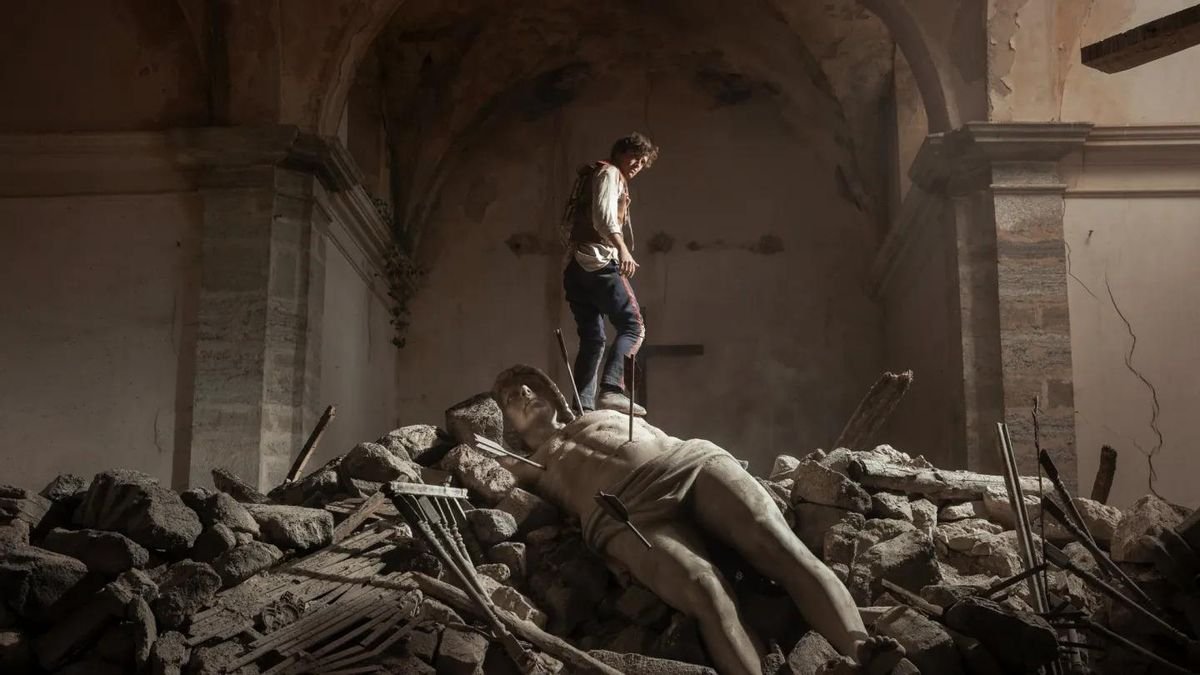
In 1932, a young man is blackballed by the elders of a Granada social club simply for who he is. In 1937, at the height of the Civil War, a soldier and a captured Republican prisoner fall into a charged, impossible closeness, and a manuscript changes hands in the shadow of an execution. In 2017, a present-day writer inherits a family secret that leads him back to Lorca’s lost pages. Rafael Rodríguez Rapún, Lorca’s real secretary and lover, who died in combat in 1937, runs through the wartime strand and is played by Miguel Bernardeau, giving the invented drama a firm anchor in real history.
A cast that reads like an event
Los Javis surround their newcomers with heavyweight names. The singer Guitarricadelafuente and the young Milo Quifes both make their acting debuts among the three leads, sharing the screen with Carlos González. Orbiting around them are Penélope Cruz and Lola Dueñas, with Glenn Close appearing in a supporting role that turned heads the moment the casting was announced. Shot on 35mm film for a reported budget of fifteen million euros, La Bola Negra was built to look like the prestige epic its subject deserves, and that craft shows in every carefully composed frame.
Why this film matters now
For a gay magazine, La Bola Negra is far more than a handsome period piece. It is an act of cultural recovery. Lorca has long been claimed as a queer martyr, yet the specifically gay heart of his work was softened, sidestepped or censored for generations, first by fear and then by tasteful discretion. To see Spain’s most celebrated poet finally rendered on this scale, with his desire placed at the centre rather than whispered in the margins, feels like a debt being paid. That Los Javis, themselves an openly gay couple beloved for series like Veneno and La Mesías, were the ones trusted to do it only sharpens the sense of a torch being passed.
Cannes crowned it, the world will stream it
The film’s Cannes premiere on 21 May 2026 drew a standing ovation reported at well over fifteen minutes, and critics largely followed the room. La Bola Negra holds strong scores on the major review aggregators, praised for its ambition and its production values even where the modern strand divides opinion. Sharing the festival’s directing prize put Los Javis, long adored at home, firmly on the international map and confirmed the film as one of the queer cinema events of the year.
Where and when to watch
La Bola Negra reaches Spanish cinemas on 25 September 2026 through Elastica Films, before landing on Movistar Plus+. International audiences will find it through different doors. Netflix holds the rights for the United States and Canada, giving the film a rare theatrical run from October 2026 ahead of streaming, while France gets its own cinema release in December 2026. Wherever you catch it, this is not a title to let slip past.
More than a costume drama, La Bola Negra drags into the light a story the twentieth century tried to bury with a single black ball. That Los Javis got to make it on this scale, and that Cannes rewarded them for it, says something genuinely hopeful about how far queer Spanish cinema has travelled since Lorca laid down his pen.
For comments or projects, please contact me.