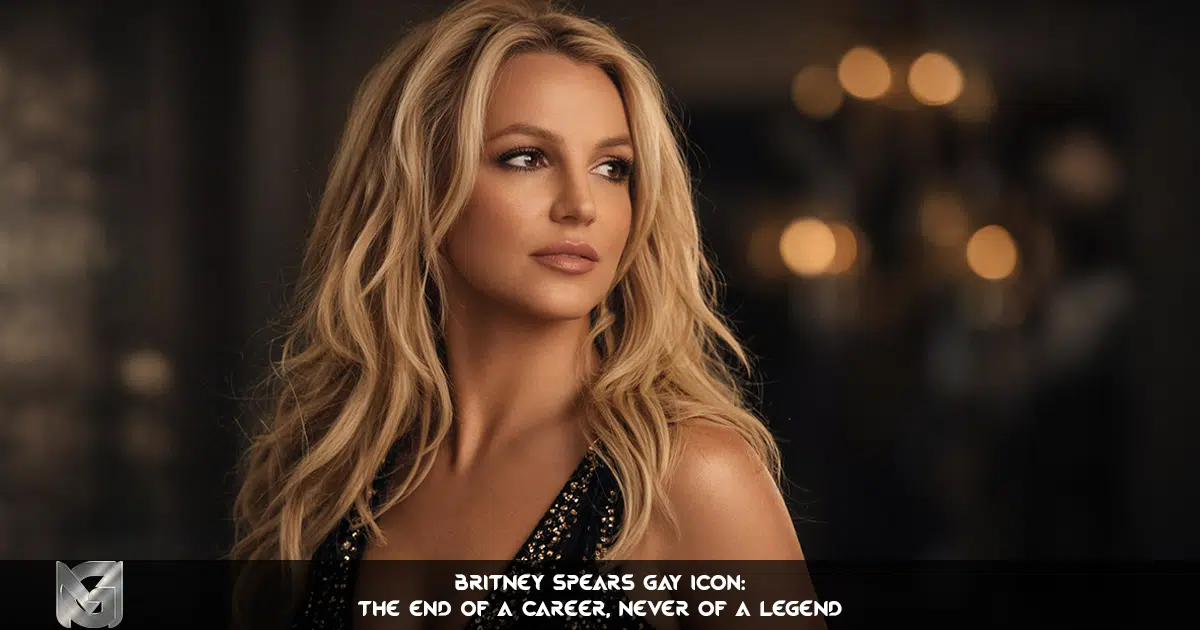
Britney Spears gay icon for more than twenty years, the princess of pop announced in August 2026 that she was ending her music career. At 44, the woman who made whole generations dance in the clubs says she no longer wants an industry that, in her words, “humiliated” and “dishonoured” her. For the LGBTQ+ community, which carried her through her darkest years, the news has a bittersweet taste. Here is a look back at an extraordinary relationship, and at what this announcement really changes.
An announcement that closes a chapter
Earlier this month, Britney Spears posted an unambiguous message: she is done with music. In a text shared on her socials, the singer explains that she wants to “get closer to God” and turn the page on an industry that, she says, crushed her. It is not a total surprise. Since 2024 she has repeated that she will not return to the stage, and in January 2026 she was already vowing never to perform in the United States again.
The announcement stirred a wave of emotion among her fans, many of whom praised a decision they see above all as healthy for her. On social media, plenty pointed out that, after so many years under control, she more than anyone has earned the right to choose when to stop. Others, more nostalgic, refuse to believe in a final full stop and watch for the slightest hint of a comeback.
The end of a long battle
The decision comes after thirteen years of legal guardianship, the infamous conservatorship, an arrangement that controlled her life, her money and even her body before ending in 2021. Earlier in 2026, the singer also sold her music catalogue to Primary Wave for a sum estimated at around 200 million dollars. In other words, she is settling her accounts with the industry, financially and symbolically. It is hard not to read it as an act of freedom.
Two mystery projects that stir doubt
Plot twist: just days after slamming the door, Britney sowed confusion by mentioning “two projects” planned for late 2026, in an Instagram video that was quickly deleted. Music? A book? Something else entirely? Nobody knows. For her fans, that vagueness is almost a signature: with her, nothing is ever fully written in advance, and that is part of why they love her.
Why Britney Spears is a gay icon
You do not become a Britney Spears gay icon by chance. Since “…Baby One More Time” in 1998, her catalogue has been a pillar of gay clubs and bars, dancefloor fuel that has never left the decks. “Toxic”, “Gimme More”, “Womanizer”: so many anthems sung in unison, endlessly remixed and replayed night after night around the world.
From dancefloors to drag stages
It is impossible to count the drag queens who have embodied her on stage, wig, lip-sync and pinpoint choreography included. The Britney Spears gay icon is also a performative, theatrical and joyful kind of pop, exactly what drag culture loves to celebrate. The star never stopped at words: she has performed in gay clubs, addressed genuine love letters to her LGBTQ+ fans and, in her memoir “The Woman in Me”, published in 2023, shared her “unconditional love” for the community.
#FreeBritney, a largely queer fight
When the singer fought to escape her guardianship, it was largely LGBTQ+ voices that made the #FreeBritney movement explode. The director of the documentary “Framing Britney Spears” acknowledged it plainly: many of the loudest activists were queer. There is a deep reason for that. In her struggles, her very public breakdown and her rebirth, part of the community recognised its own story of resilience. That is what makes the Britney Spears gay icon a figure as intimate as it is universal.
Hits that became genuine anthems
It is hard to sum up what these songs mean to gay nightlife. “Toxic” and its now-cult violin hook, “Everytime” reworked as a piano ballad, “I’m a Slave 4 U” and its unapologetic sensuality: each track tells of an era, a night out, a memory. In many clubs, the moment a Britney medley drops is still when the dancefloor fills up all at once. Her hits have soundtracked coming-outs, first nights at the club, evenings of celebration as much as of comfort.
It is this shared soundtrack, passed from one generation to the next, that explains why her name still stirs so much emotion today. Where other stars fall out of fashion, she has become a landmark, almost a rite of passage. People do not replay Britney out of mere nostalgia: they play her because she is part of the scenery, just like the glitter and the neon lights of the Yumbo.
Britney Spears gay icon: what her exit changes
So, should we mourn? Not really. The Britney Spears gay icon does not vanish because she puts down the mic. An icon does not retire: it enters the heritage. Her songs will keep making parties come alive, her videos will remain visual references, and her story already belongs, fully, to queer culture.
A legacy that stays alive
The real message of this announcement may lie elsewhere. By finally choosing what she wants for herself, Britney sends the signal the community has always defended: the right to control one’s own life and body. That is also why the Britney Spears gay icon remains, today more than ever, a figure of freedom before being a simple pop star.
The Britney Spears gay icon is therefore taking her musical bow, but she leaves behind far more than hits. She leaves a bond, woven over more than two decades, between a superstar and a community that never let her go. Retirement, for an artist of her stature, is rarely the end of the story; it is more often the moment the myth settles in for good. Whether those famous “two projects” lead to a comeback or not, one thing is certain: in the clubs, on the drag stages and in the hearts of her fans, Britney is not done shining.
For comments or projects, please contact me.