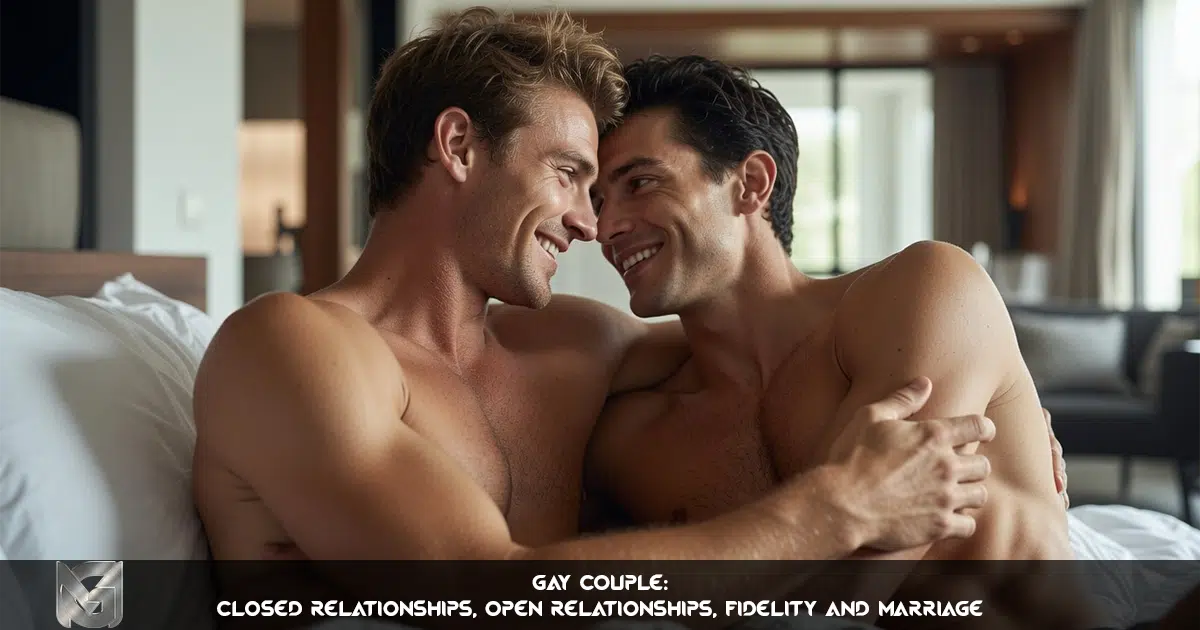
The gay couple is often described through two opposing clichés, either the romantic ideal copied from the straight model, or a supposedly permanent sexual freedom. Between those caricatures, reality is more interesting, because it forces us to talk about what many couples, straight ones included, sometimes prefer to keep blurry: the rules of desire, what fidelity means, how boundaries are negotiated, and the way marriage changes, or doesn’t change, a relationship.
In this article, we set out the essentials, we distinguish between closed and open relationships, we look at what may differ from straight couples, and we address marriage and divorce with the numbers that are available, while keeping one crucial caution in mind: comparing divorces between same-sex couples and opposite-sex couples is not always straightforward, because rights are not equally longstanding, populations are not identical, and statistics do not always measure the same thing.
Closed relationship, open relationship: two frameworks, not two levels of love
A gay couple described as “closed” is built on sexual exclusivity, and usually emotional exclusivity too, even if those two dimensions do not always overlap perfectly. In that framework, fidelity is often experienced as a safety pact, a way of saying, I am your stable place, and you are mine. Monogamy can be a deep, joyful, long-term choice without being a concession to any norm.
An “open” couple is something other than a vague permission. It is an agreement, sometimes very precise, about the possibility of sexual experiences outside the duo, with boundaries that can cover frequency, practices, repetition with the same person, sleeping over, or the level of transparency. What makes an open relationship last is not the absence of jealousy, but the ability to recognise it, name it, and treat it as emotional information rather than a moral failure.
In both cases, strength does not come from the label. It comes from coherence between what each person believes they are living and what the couple is actually living. A closed relationship can be weakened by silence and repeated breaches. An open relationship can be weakened by fuzzy rules, unwanted asymmetry, or using openness as an escape from an emotional conflict.
What can differ from straight couples: history, visibility, and explicit negotiation
Comparing a gay couple to a straight couple does not mean opposing two different species of relationships. The emotions are the same, attachment is the same, and power struggles or communication problems do not have a sexual orientation. But some social and historical parameters weigh differently.
First, visibility. A straight couple is presumed legitimate in public space, while a gay couple may still have to assess, depending on the place, the context, or the country, whether it is safe to hold hands, kiss, or simply say “my husband.” That constant micro-negotiation can strengthen complicity, but it can also exhaust, and create imbalances if one partner experiences affirmation more calmly than the other.
Second, learning. Many straight couples grow up surrounded by relationship scripts, in family life, films, advertising, and institutions. The gay couple, for a long time, had to invent its reference points, sometimes leaning on community, sometimes improvising, sometimes copying straight models, sometimes rejecting them. That history creates a paradoxical effect: some gay couples consciously reproduce the traditional couple model, while others develop a more explicit negotiation culture, because there is no single “instruction manual.”
Finally, sexuality. It would be wrong to say gay couples are “naturally” more open. What is more accurate is that, in some contexts, gay communities have a more visible tradition of sexual sociability, first through community venues, then through apps. That can make conversations about desire more direct, but it can also create an implicit pressure, as if openness were a sign of modernity, or as if monogamy were naïve. A gay couple does not have to prove its freedom or its respectability. It has to build compatibility.
Fidelity: the same question, but sometimes a different definition
In a gay couple, fidelity is often where the difference between social norm and intimate agreement becomes most visible. In many straight couples, fidelity is treated as an implicit standard, sometimes barely discussed, until the moment it is broken. In many gay couples, fidelity is more often defined, discussed, and redefined, because the framework is not always presumed.
That does not mean gay couples communicate better across the board, nor that straight couples communicate worse. It means that the absence of presumption can push people to clarify. And clarification is often what protects.
Fidelity can be sexual, emotional, or both. It can also be understood as loyalty, meaning a way of not putting the relationship at risk, even when exploring elsewhere. In that logic, some open couples experience themselves as faithful, because the agreement is respected, and because the emotional priority remains the duo.
The sensitive point is betrayal. Betrayal is not always the sexual act. It can be the lie, the hidden repetition, the humiliation, or the fact of shifting emotional intimacy to someone else without talking about it. This is where the straight/gay comparison becomes useful, because it reminds us of an obvious truth: what breaks a couple is not a universal rule, it is the breach of the contract, whatever that contract is.
Marriage: recognition, protection, and new expectations
Marriage carries a particular meaning for a gay couple, because it was not a “natural” right but a hard-won one. For many, getting married is not only a romantic gesture, it is a gesture of social recognition, sometimes a political gesture, and very often a gesture of legal protection, especially around inheritance, parenthood, health decisions, housing, and security in case of separation.
But marriage also brings expectations. It can reinforce the idea that there is a correct way to be a couple, and it can put back on the table questions some couples had avoided, such as money management, long-term planning, or the place of family. For a gay couple, marriage can be soothing, but it can also be a mirror, because it exposes the relationship to stronger social norms, including inside the community.
One simple point matters: marriage does not guarantee stability. It provides a legal framework and rights. Stability depends on the quality of the bond, communication, and the ability to move through change.
Divorce: what the numbers say, and why comparison is tricky
When we try to compare divorce between same-sex couples and opposite-sex couples, we quickly hit a methodological wall. Same-sex marriage is recent in many countries, which means cohorts have not had the same time to “age,” and observed marriage durations are not comparable over several decades. In addition, some countries mix marriage and civil partnerships, or change legislation, which affects statistical series.
That said, there are useful official data, notably in the UK, where the Office for National Statistics publishes figures separating divorces of opposite-sex couples and divorces of same-sex couples.
In England and Wales, the ONS reports that in 2022 there were 80,057 divorces in total. Within that total, 78,759 were opposite-sex divorces, while 1,298 were same-sex divorces. The ONS also notes that same-sex divorces decreased in 2022 compared with 2021, which is notable because they had increased steadily since the introduction of same-sex marriage in 2014. These figures do not, on their own, prove that gay couples divorce more or less than straight couples, because they describe annual volumes, not a “lifetime probability,” and because the married same-sex population is much smaller.
The ONS does provide an interesting element on marriage duration at divorce. For same-sex divorces in 2022, the median duration of marriage at divorce was 7.5 years for male same-sex couples and 6.3 years for female same-sex couples. For opposite-sex couples, the median duration was 12.9 years. This difference does not automatically mean the gay couple is more fragile. It also reflects the fact that these marriages are newer, and that observed divorces cannot, by definition, involve 20- or 30-year unions as frequently as in opposite-sex couples.
Another ONS detail is that, in 2022, 69.0% of same-sex divorces under the new legislation involved female couples. Again, this number does not tell us “why,” and it would be risky to turn it into a psychological explanation. It mainly signals that, even within same-sex couples, statistical dynamics can differ by gender, which is a good reason to avoid sweeping generalisations.
If we want a more intuitive comparison, we can say this: in countries where statistics are detailed, opposite-sex divorces remain overwhelmingly dominant in volume, because opposite-sex marriages are far more numerous. Same-sex divorces exist and are measured, but interpreting them requires taking into account population size, the recency of the right to marry, and the fact that some couples converted a civil partnership into a marriage, which can complicate how duration is recorded.
What these comparisons really tell us about the gay couple
Divorce numbers, even when robust, do not tell the full story of a gay couple. They tell us something about a society’s ability to recognise and register unions, and about how couples use the law when a relationship ends. They also tell us that marriage equality did not create perfect couples, it created equal rights, including the right to separate.
Where the comparison with straight couples becomes genuinely interesting is that it highlights a shared truth: commitment is not a magic formula, and fidelity is not a slogan. Couples that last, gay or straight, are often those that make their rules explicit, accept that desire evolves, and know how to ask for help before resentment becomes an identity.
In gay culture, there is sometimes a particular tension between two aspirations. On one side, the desire for normality, meaning the right to a stable couple, marriage, family, and peace. On the other, the desire not to be locked into a norm that excluded us for so long, and therefore the wish to keep a space for sexual or relational freedom. That tension is not a flaw. It is a conversation. And it may be one of the strengths of the contemporary gay couple: it more often forces us to talk about what we want, rather than live on assumptions.
Conclusion
The gay couple is neither a copy of the straight couple nor a counter-model. It is a space where the same human needs play out, safety, desire, recognition, tenderness, but with a different social history, one that long demanded invention, caution, and sometimes resistance.
Closed relationship or open relationship, strict fidelity or negotiated fidelity, marriage or not, the central question remains the same: are both partners living the same contract, and do they have the freedom and the words to rewrite it when life changes. Divorce numbers, for their part, remind us of something simple and healthy: equality is not only the right to love, it is also the right to make mistakes, to start again, and to choose a relationship shape that truly fits who we are.
For comments or projects, please contact me.