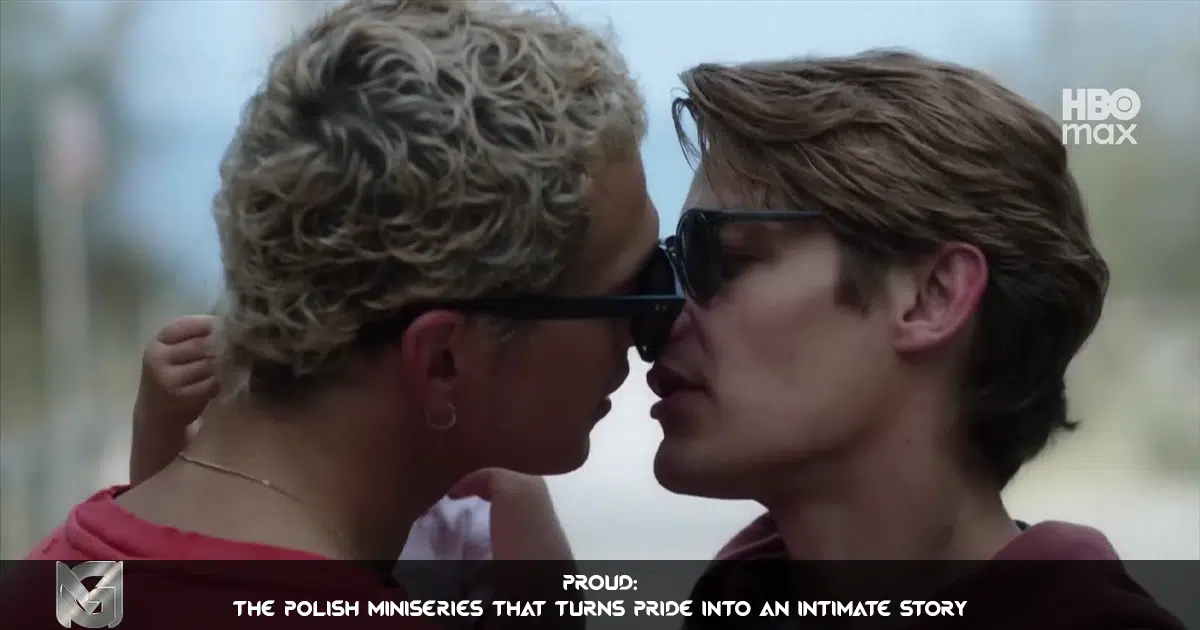
Proud HBO is not a “message show” in the most predictable sense, it’s better than that. It’s a tight, human, sometimes harsh story that uses intimacy to speak about politics. Set in a Poland where LGBTQ+ issues remain a cultural battleground, the miniseries follows Filip, a young gay man who starts out relatively carefree, until a family tragedy forces his life onto a different track. That is where the series becomes compelling: it doesn’t merely display hostility, it observes what hostility does to bodies, bonds, choices, and to the way you “hold on” when life demands that you grow up.
In a landscape of queer fiction often split between romantic comedy and militant drama, Proud finds a third path, the everyday, responsibility, and dignity. A Pride that is less slogan and more endurance, and that is precisely what Proud HBO manages to capture.
A simple story, never simplistic
The premise is clear: Filip lives his life with impulses, contradictions, and that kind of lightness that sometimes looks like a survival strategy. Then a family shock hits. The series places him in front of a reality that cannot be negotiated: you have to act, protect, decide, and sometimes collide with institutions that do not see you as a full citizen. That is also where Proud HBO takes on a universal dimension.
Without giving away the plot mechanics, Proud explores family in the broadest sense:
- Biological family, with its loyalties, silences, and sometimes its violence.
- Chosen family, the one you build when you don’t have the luxury of being welcomed as you are.
- And “administrative” family, the one the state recognizes, validates, or refuses.
That very concrete tension gives the series its particular strength. It is about love, yes, but about a love that must be proven through forms, appointments, glances, and decisions that shape the future. On that ground, Proud HBO avoids shortcuts.
A Pride that isn’t a backdrop, but a stake
The title Proud sets expectations, but the series avoids postcard Pride. Here, pride is not only a flag, a march, a playlist. It is an inner posture, sometimes fragile, sometimes furious, often quiet.
In this context, Pride becomes a question: how do you stay proud when you’re asked to apologize for existing? How do you avoid dissolving into fear or self-censorship? How do you love without shrinking yourself? That is the thread running through Proud HBO.
What stands out is that the series does not chase spectacular heroism. It shows fatigue, small renunciations, and small victories. And it is precisely that realism that hits.
Filip: a character who grows before our eyes
Filip is not written as a symbol. He is written as a person. He can be annoying, impulsive, clumsy. He can also be deeply brave, without posing.
The series achieves something rare: it films maturation. Not a magical transformation, but an evolution made of imperfect decisions. Filip learns to carry a responsibility that exceeds him, while remaining himself, with his shadows. That is one of the strengths of Proud HBO.
That is where Proud gains credibility. Many queer fictions fall into the trap of the “exemplary” character or the “victim” character. Here, we get someone alive, wrestling with reality.
Poland in the background: a climate that weighs on every scene
You don’t need a geopolitics lecture to feel the pressure. The series establishes a climate: a country where LGBTQ+ issues are instrumentalized, where social and religious norms can become weapons, and where public space is not neutral.
This context is not just scenery. It shapes:
- How characters speak to each other.
- How they hide or show themselves.
- How institutions treat what falls outside the norm.
And above all, it shapes the emotional rhythm: you understand that every gesture can cost. Saying “I am” is not a confession, it is sometimes a risk, and Proud HBO makes that palpable.
Adoption, parenthood, and legitimacy: the political heart of the story
Without reducing the series to a single theme, it is hard to ignore the question of parenthood and legitimacy. Proud stages a reality many know: love is not always enough, you must be recognized.
When a society ranks families, it ranks lives as well. It decides who is “fit,” who is “stable,” who is “normal.” And in that sorting, LGBTQ+ people are often asked to prove more. It is a mechanism Proud HBO exposes without didacticism.
The series is smart enough to show the violence of that logic without turning it into a speech. It makes you feel it, scene after scene, through details: a sentence, a hesitation, a judging look.
A direction built on restraint
Proud is often described as “delicate,” and the word is not a euphemism. The direction favors restraint, observation, and what remains unsaid. It does not try to “shock” in order to exist.
That restraint serves the story:
- It leaves room for the viewer.
- It avoids melodrama.
- It makes emotions feel more believable.
This is far from a clinical aesthetic. It is human material, sometimes dark, sometimes bright, always close to the characters, and Proud HBO gains accuracy from it.
Why this series can speak to Gay Mag readers
For a French-speaking LGBTQ+ audience, Proud has several editorial strengths.
1) A European fiction, grounded, without exoticism
Queer stories are often discussed through an Anglo-American lens. Here, we are in Europe, with codes, tensions, and realities that resonate differently. It matters, because it reminds us that rights are never guaranteed, even “close to home.” That is also what makes Proud HBO particularly relevant.
2) Representation that avoids clichés
The series does not reduce gay life to nightlife, sex, or suffering. It shows a gay character in a story that goes beyond his sexuality, while acknowledging that sexuality changes how the world treats him.
3) An adult Pride
Pride here is not a festive parenthesis. It is a word with a price. This approach can reach a wide audience, including those who sometimes feel distant from “Instagrammable” Pride representations. On that point, Proud HBO scores.
What Proud says without saying it: pride as a survival strategy
One idea runs through the series: pride is not only a feeling, it is a strategy. A way not to let a hostile gaze define you.
In some contexts, being proud means:
- Refusing the shame others want to impose.
- Refusing to apologize.
- Refusing to shrink yourself.
And sometimes it also means accepting fear, while moving forward anyway. That nuance is something Proud HBO can hold.
What to expect: pace, emotion, and impact
If you’re looking for a feel-good Pride series, Proud is probably not your Friday-night pick. But if you like short, tense, emotional stories that leave a mark, it’s an excellent discovery.
The miniseries format serves the narrative: no filler, no pointless subplots. Each episode pushes Filip a little further into a space where he must decide who he wants to be.
Conclusion: a series worth watching slowly
Proud doesn’t try to win by volume. It wins by precision. It reminds us that Pride is not an automatic given, that it can be an intimate struggle, and that family is sometimes chosen as much as it is endured.
For Gay Mag, this is exactly the kind of series to recommend with an angle: not “the queer series of the moment,” but “the series that shows what pride costs, and why it remains necessary.” And if you had to keep one simple label in mind, Proud HBO sums up the experience well.
For comments or projects, please contact me.