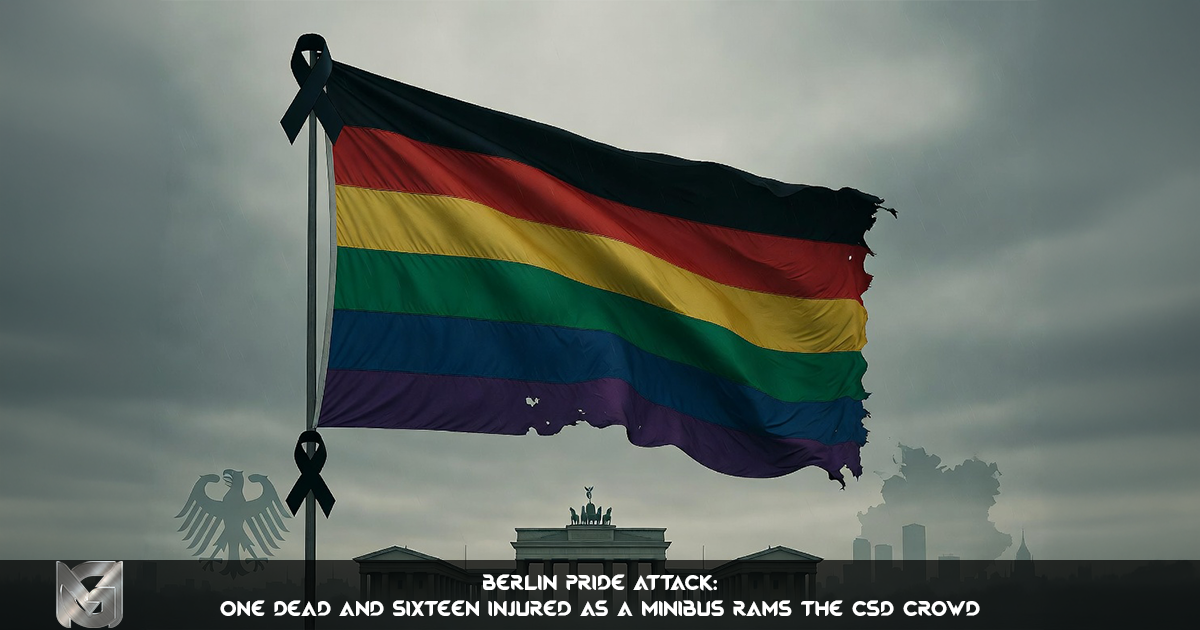
The Berlin Pride attack has left Europe’s LGBTQ+ community in shock and mourning. On the evening of Saturday 25 July 2026, a white minibus was driven into a crowd in Berlin’s Tiergarten park, in the southern part near Lennestrasse and Potsdamer Platz, as Christopher Street Day (CSD), the German capital’s Pride, was drawing to a close near the Brandenburg Gate. One woman was killed and sixteen people were injured, three of them in a life-threatening condition. By the day after, the driver was still at large and the subject of a public manhunt, and a day of joy and freedom had ended in grief.
What happened at Berlin’s CSD
A day of celebration cut short
Berlin’s CSD is one of the largest Pride gatherings in Europe. On 25 July 2026 it brought hundreds of thousands of people onto the streets, marching along the Strasse des 17. Juni toward the Brandenburg Gate, where a closing rally and concerts had been running through the day. Singer Sarah Connor had performed at the closing rally, a rainbow flag over her shoulders. For most of the day the mood was everything Pride is meant to be: loud, colourful, defiant and free, a public celebration of the right simply to exist in the open.
The moment of the attack
The Berlin Pride attack unfolded at around 10 p.m. A white minibus drove into people in the southern Tiergarten, at the Ahornsteig near Lennestrasse, striking several before coming to a halt against a tree. At least one person then left the vehicle and fled on foot into the darkness of the park. At about 10.15 p.m. the organizers stopped the closing rally and told the crowd, from the stage and on Instagram, to leave calmly and go home.
The human toll
The Berlin Pride attack killed one woman, who died at the scene. Sixteen other people were injured: according to the Berlin fire service, three were in a life-threatening condition, eight seriously hurt and five slightly, while around thirty more were treated for shock. Emergency teams reached the park within minutes and the injured were taken to hospitals across the city. By the following day the woman who lost her life had not been publicly identified, and Berlin was waiting for news of those still in intensive care.
The investigation
What the police have said
In the hours after the Berlin Pride attack, Berlin police launched a large-scale manhunt and, on the Sunday morning, issued a public appeal with a photograph of the man they are looking for, warning that he could be armed and dangerous. A police spokesperson said the suspect was known to officers and was attributed to ‘the Islamist scene in Berlin’. German media, including the public broadcaster ZDF, the Berlin daily Der Tagesspiegel and taz, reported that he is a 21-year-old man who had been released from detention earlier in 2026. By the day after the attack he had not been arrested, investigators had not formally established that he was the person behind the wheel, and the white minibus was described as a private vehicle rather than a rental.
A line of inquiry to treat with caution
Everything we know about the Berlin Pride attack in these first hours remains provisional. No charge has been filed, no one has been arrested, and Germany’s federal public prosecutor, who would lead any formal terrorism case, had not taken over the investigation, which means the attack has not been officially classified as terrorism. There has been no claim of responsibility, and both the exact toll and the suspect’s role are still being established. Some details reported in the press, including the possibility of a second occupant in the vehicle, remain unconfirmed. We will update this article as verified information comes in, and we would rather be accurate than fast.
Shock and solidarity
Officials react
News of the Berlin Pride attack drew swift reactions from Germany’s leaders. Berlin’s mayor, Kai Wegner, called it ‘an attack on our free and open society’. Chancellor Friedrich Merz described it as an ‘abominable act’ and said that, with Interior Minister Alexander Dobrindt, he would make sure it was fully investigated. More than two thousand police officers were deployed across the city, and a vigil was called at the Brandenburg Gate on the Sunday afternoon so that Berliners could gather, grieve and stand together. Messages of support arrived through the night from across Germany and the wider European LGBTQ+ community.
The CSD Berlin organizers
The CSD Berlin board, forced to cut short an event that takes a full year to prepare, guided a calm evacuation after the main parade had already filled the city on the Saturday, and then called off the remaining Pride programme planned for the Sunday. Their priority through the night was the simplest one there is: to keep people safe and help them get home. In the hours that followed the Berlin Pride attack, Pride organizations across Germany and the rest of Europe stood with them, promising that the movement would not be intimidated into silence.
Why this hurts the whole community
An attack on a safe space
The Berlin Pride attack struck at something bigger than one evening. Pride is far more than a party: for millions of LGBTQ+ people it is the one day of the year when a public square feels genuinely theirs, a place to be visible without fear. An assault on that space is felt well beyond Berlin, in every town and city that holds its own march. That is why the grief is shared from Gran Canaria to Scandinavia, and why so many people who have never set foot in the Tiergarten feel this loss as their own.
A backdrop of rising threats
This attack did not happen in a vacuum. Across Europe, Pride events have faced growing hostility in recent years, from the deadly 2022 shooting near a gay bar during Oslo Pride to a steady stream of threats that have pushed organizers to invest heavily in security. None of this diminishes the courage of the people who keep turning out. If anything, it explains why they do.
Standing together
In the days after this tragedy there will be vigils, official statements and hard questions about how to protect large Pride events without turning them into fortresses. Those conversations matter and they need to happen. But the first response, the one that belongs to all of us, is simpler than any policy: to hold the memory of the woman who died, to wish a full recovery to everyone who was hurt, and to refuse to let fear take from us the visibility that earlier generations fought so hard to win.
Our thoughts
The Berlin Pride attack will be remembered, but so will the response to it. Our thoughts are with the woman who lost her life, with her family and friends, with everyone who was injured, and with the whole Berlin community. The strength of Pride has always been that it answers hatred with presence and sorrow with solidarity. Berlin will march again, and so will the rest of us.
For comments or projects, please contact me.