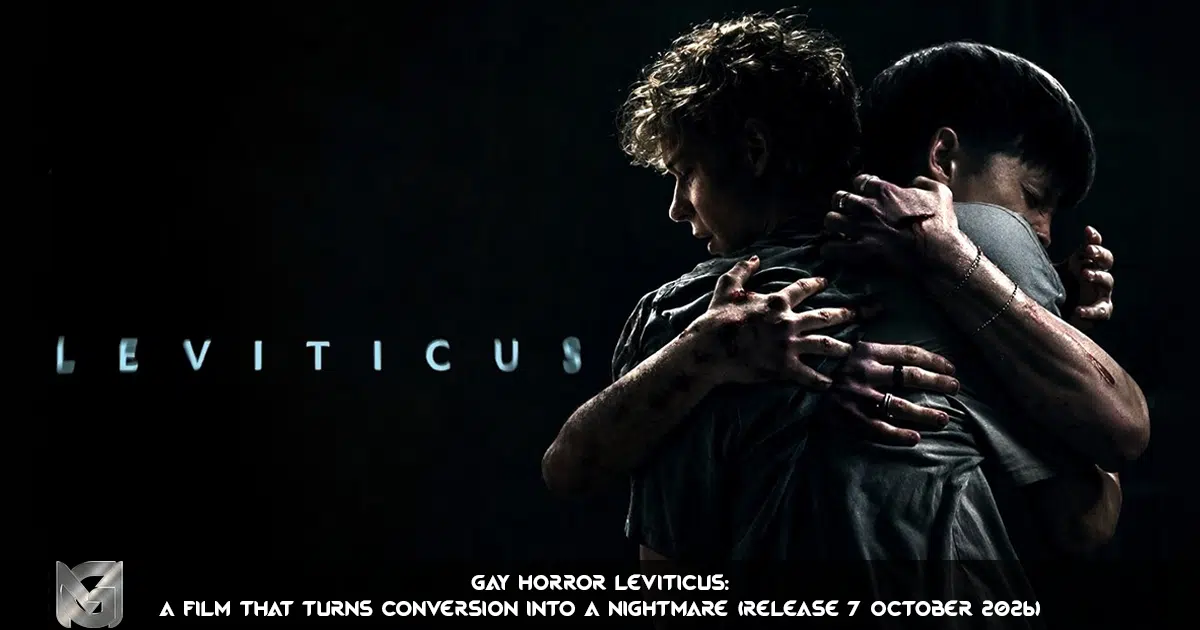
Gay horror Leviticus is shaping up to be one of the titles to watch in autumn 2026, because it doesn’t just play with genre codes, it uses them to tell a very real kind of violence: imposed shame, social rejection, and religious control mechanisms that, in some environments, still fuel conversion therapy.
Written and directed by Adrian Chiarella, Leviticus (sometimes referenced in French as Lévitique) is presented as a horror film with romantic elements, built around a teenage love story. Its French release date is listed as 7 October 2026. The cast cited in the available sources includes Joe Bird, Stacy Clausen, Mia Wasikowska, and Jeremy Blewitt.
What intrigues beyond the pitch is the promise of a film that names homophobia and conversion as violence, without retreating into comfortable ambiguity. And it does so through a particularly effective horror device: an entity that pursues, stalks, and takes the form of the person you desire most.
Leviticus in brief: what we know (and what we don’t yet)
Before going further, one important note: we do not yet have a full press kit. The information below relies on public reference pages and one review (Allociné, Cinoche, and an article from La Presse). Several elements therefore remain to be confirmed, including production details, supporting characters, and the scope of international distribution.
Quick facts
- Written and directed by: Adrian Chiarella
- Genre: horror, with a romantic dimension
- France release date: 7 October 2026
- Cast cited: Joe Bird, Stacy Clausen, Mia Wasikowska, Jeremy Blewitt
A pitch that blends desire and threat
The setup is as simple as it is unsettling: two teenagers fall in love, and a violent force begins to hunt them. Except this force doesn’t take a classic monstrous shape, it takes the face of the person you desire most.
Where many horror films treat desire as moral punishment, Leviticus seems to flip the logic. Desire isn’t the fault, it’s the point of truth. The violence comes from elsewhere: a system that wants to break that desire, deny it, and reprogram it.
A teenage romance, then outing as the turning point
According to the reported elements, the story follows Naim (played by Joe Bird) as he begins a relationship with Ryan (played by Stacy Clausen). The film is set within a devout community where religious norms weigh heavily on bodies and language.
When the intimate becomes public
The key moment is the outing. Not the chosen outing that liberates, but the imposed outing that exposes. In this kind of story, horror often comes from loss of control, and here it is double: loss of control over your own narrative, and loss of control over your safety.
The ceremony, and the entity set in motion
Still according to the available sources, a preacher leads a ceremony that triggers a supernatural pursuit. That trigger matters, because it explicitly links spiritual violence and physical violence.
The film doesn’t simply say “religion is scary”, it says “certain uses of religion can become weapons.” And it materialises that weapon as an entity.
The entity, or desire turned against you
The strongest idea in the concept is this entity that takes the appearance of the person you desire most. It’s a device that opens several readings.
1) Fear of the self, staged
In conversion narratives, a common mechanism is to frame desire as a threat, a contamination, a possession. By giving danger the face of desire, the film makes that lie visible.
2) Shame as a social monster
Shame isn’t spontaneous, it’s learned. It’s transmitted through looks, sermons, humiliations, silences. An entity that never stops pursuing is also shame that sticks to the skin, returns at night, and seeps into gestures.
3) The trap of impossible love
If the entity looks like the loved one, every attempt to escape becomes emotional torture. How do you run when what chases you has the face of what you want to protect? The film seems to build its horror on that contradiction.
Leviticus and conversion: horror as political language
According to La Presse, Leviticus uses horror to address conversion therapy and the psychological and social violence of homophobia. That matters, because it places the film in a lineage of genre cinema that refuses to separate thrills from reality.
Naming conversion, without detours
For a long time, part of cinema either sidestepped the topic or treated it as an “individual” drama. But conversion isn’t an intimate issue, it is structured violence: organised, sometimes institutionalised.
Horror can say what words sometimes struggle to make heard: conversion is a hunt. A pursuit. A system.
Horror not as punishment, but as denunciation
The difference is the angle. If the film delivers on its promise, it won’t punish its characters for desire, it will punish the system that tries to punish them.
A comparison with It Follows, but a different emotional ground
The comparison with It Follows appears in critical commentary, largely because of the pursuit mechanic: an entity that advances, never lets go, and turns everyday space into a trap.
What the comparison clarifies
- A “concept” horror, easy to explain, hard to escape.
- Tension built on duration, waiting, paranoia.
- An economy of effects where the idea scares more than gore.
What Leviticus may shift
Where It Follows played with sexuality and transmission as anxiety, Leviticus seems to shift the centre of gravity toward social violence: outing, religious pressure, and conversion.
In other words, the pursuit wouldn’t just be a horror device, it would be a direct metaphor for persecution.
Cast: faces that carry the tension
The available information cites Joe Bird and Stacy Clausen as Naim and Ryan, with Mia Wasikowska and Jeremy Blewitt also mentioned.
Why casting matters for this kind of film
In intimate horror, emotional credibility is half the movie. If the audience believes the love, they believe the fear. If they believe the desire, they understand the violence of what tries to extinguish it.
Choosing performers who can play nuance, tenderness, panic, and resistance will be decisive.
What Gay Mag will be watching between now and release
At this stage, Leviticus draws attention because it ticks several rare boxes at once: a strong concept, an explicitly gay theme, and a clear genre ambition.
What could make it an important film
- Horror that refuses to look away from homophobia.
- A metaphor that is readable without being simplistic.
- A romance that isn’t a pretext, but the engine.
Why this film can speak to our moment
We’re living through a period where rollbacks of rights, moral panics, and “healing” rhetoric are resurfacing, sometimes disguised, sometimes openly claimed. In that context, a film like Leviticus can work as a mirror, not a neutral mirror, but one that points a finger.
Horror as a space for truth
Horror cinema is often more honest than social drama because it accepts excess. And excess is sometimes the only way to represent a violence that, in real life, is already excessive.
A love story, therefore a stake
If the film lands, it will be because it reminds us of something simple: loving isn’t a crime. And everything that tries to claim the opposite deserves to be named as violence.
Quick FAQ for readers
When does Leviticus release in France?
The French release date listed is 7 October 2026.
Is the film explicitly gay?
Based on the available information, yes: the plot follows a relationship between two teenage boys, and the cited review links the film to homophobia and conversion therapy.
Is it a “gory” horror film?
Nothing currently indicates a gore-forward approach. The available elements suggest a pursuit-and-atmosphere horror.
Why is It Follows mentioned?
Because there is a similar “pursuing entity” mechanic with tension built over time. But the thematic ground appears different.
Conclusion: a film to follow, and to debate
Leviticus has the potential to be more than a horror film: a gay story that uses genre as a tool of denunciation, turning conversion into a visible nightmare.
For Gay Mag, the key will be to see how the film holds a delicate balance: frightening without betraying, symbolic without being vague, political without becoming a pamphlet. If the directing matches the idea, Leviticus could join that short list of films where horror doesn’t punish gay people, but finally shows what is chasing them.
For comments or projects, please contact me.