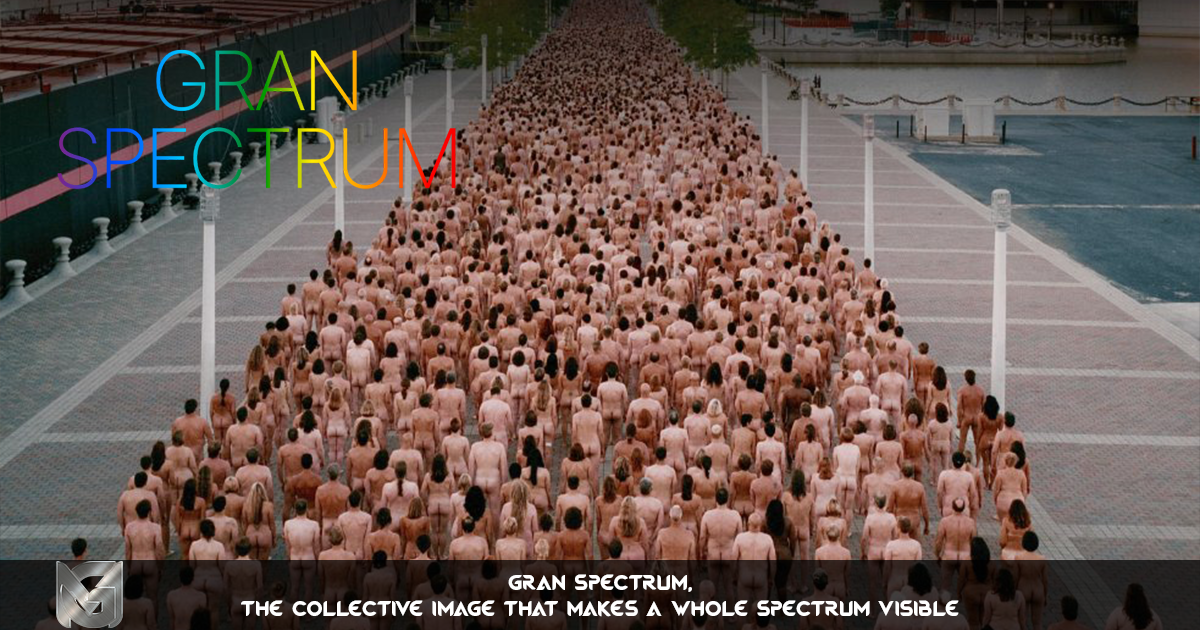
Gran Spectrum isn’t “just” another art event on the summer calendar. It’s a collective action designed to exist in public space, with bodies, colors, an island, and one simple, almost radical idea: make visible what already exists, but is rarely seen together.
Scheduled for 26 July 2026 in Gran Canaria (Canary Islands), this participatory installation is led by photographer and visual artist Spencer Tunick, known for large-scale human compositions. Here, the ambition is clear: create a symbol-image where the colors of LGBTQIA+ flags become material, structure, and message.
A participatory work, therefore a political gesture
When a work relies on participation, it doesn’t merely represent a community, it makes it exist, concretely, in a given place, at a given time.
From presence to visibility
The project frames participation as a progression: presence, then visibility, then statement. In an international context where LGBTQIA+ rights remain at the center of debate, and very real rollbacks, the image produced is not decorative. It asserts.
What matters is not only the final photograph, it’s the fact that people gather, stand exposed together, and transform public space into shared space.
An image that speaks of diversity without a pasted-on speech
The strength of this approach is that it avoids the slogan. Colors and bodies do the work. Diversity isn’t “explained”, it’s shown, composed, and owned.
And that’s precisely what Gay Mag appreciates in this kind of gesture: a strong aesthetic that stays readable, and a message that lands without being underlined.
Spencer Tunick, the body as a collective language
For more than three decades, Spencer Tunick has built images where the individual dissolves into a common form. His work has often been reduced, wrongly, to provocation around nudity. But his point is elsewhere.
Taking the nude out of sexualization
Tunick argues for a reading of the nude that is neither intimate nor pornographic. In his installations, the body becomes material: texture, volume, a human topography.
This shared arrangement shifts the gaze: you don’t “consume” a body, you observe a composition. Individual vulnerability turns into collective strength.
A global practice, from cities to landscapes
The project site notes that the artist has carried out actions in more than a hundred cities, from New York to Barcelona, from London to Sydney, sometimes with thousands of participants.
What repeats is the same fertile tension: intimacy and public space, modesty and freedom, social norm and belonging.
Gran Spectrum, a first built around LGBTQIA+ colors
The announced differentiator is major: for the first time, Tunick explicitly integrates the colors of LGBTQIA+ flags into a large-scale human composition. Gran Spectrum therefore embraces an immediate, legible, universal symbolism.
Color + bodies + public space
Here, color is not decoration. It structures the image. It connects multiple identities within the same frame, without dissolving them.
The expected result is a photograph that functions as visual “proof”: we are here, together, visible, and we occupy space. That’s also what makes Gran Spectrum so compelling: the image doesn’t only document, it affirms.
Who can take part?
The project announces participation open to the LGBTQIA+ community, allies, and more broadly the general public. The idea is inclusive, without rigid community gatekeeping, while keeping a clear axis: LGBTQIA+ visibility.
Final practical details (exact time, instructions, organization) are said to be shared with registered participants ahead of the installation.
Why Gran Canaria matters in this story
The choice of territory is not neutral. Gran Canaria, and the Canary Islands more broadly, are presented as a European space where LGBTQIA+ visibility and integration have consolidated over recent decades.
An island as a stage, not a simple backdrop
The project insists on an interesting point: the place becomes part of the message. Gran Canaria doesn’t merely serve as scenery, it becomes a symbolic actor.
In other words, the resulting image will also say something about the island: its capacity to welcome, its contemporary identity, and its international positioning. In that sense, Gran Spectrum acts as a cultural showcase as much as an artistic gesture.
A cultural and tourism signal
Without slipping into empty marketing, the stakes are clear: associate a destination with an international artistic action that speaks about inclusion and fundamental rights.
This kind of event produces narrative, and narrative today is cultural currency.
What “participating” means, in practical terms
Taking part in a work like this is not only “being in a photo”. It’s accepting an organization, a collective trust, and a form of exposure.
Trust as an invisible material
Large participatory installations rely on an implicit contract: I show up, I follow instructions, I become part of an ensemble, and I trust the artistic team.
That’s also what makes the experience powerful: you don’t live art as a spectator, you help make it. And in Gran Spectrum, that making is precisely the core of the message.
A limited-edition photograph
The site states that participants will receive a limited-edition photograph taken by Spencer Tunick on the day, offered as part of Culture & Business Pride 2026.
It’s an important detail: the work is not only “consumed” on site. It leaves a trace, an object, a memory. For many, Gran Spectrum will also be a tangible souvenir of a shared moment.
Culture & Business Pride 2026, the wider framework
Gran Spectrum sits within Culture & Business Pride 2026, presented as an international platform linking culture, creativity, and the defense of LGBTQIA+ rights.
When art becomes a bridge
The project claims a bridge-building logic: between communities, institutions, and committed companies.
It’s an interesting approach because it recognizes that LGBTQIA+ visibility also plays out through alliances, funding, institutional spaces, and the ability to produce large-scale events. In that sense, Gran Spectrum is presented as the platform’s most ambitious artistic project to date.
Institutional support, clearly stated
The site mentions support from the Presidency of the Cabildo of Gran Canaria, Gran Canaria – La Isla de mi Vida, and Turismo de Islas Canarias, among other partners.
For Gay Mag, that’s worth noting: when institutions associate themselves with a work explicitly linked to LGBTQIA+ rights, they take a stance, at least symbolically.
Why this speaks to Gay Mag (and our readers)
Gran Spectrum ticks several boxes that resonate strongly with our editorial line.
1) Visibility that doesn’t collapse into a slogan
Here, visibility is produced by a collective image, not by a press release. It’s more durable, more shareable, more memorable.
2) An event that connects art, bodies, rights
The body is not a pretext, it’s the subject. And in a period when some would like to make LGBTQIA+ bodies invisible, controlled, or normalized, the choice is direct.
3) A European anchor, with a global message
Gran Canaria is a European stage, but the debate around LGBTQIA+ rights is global. The work speaks to everyone because it speaks about presence, and because Gran Spectrum turns that presence into an image.
Key practical information
- Announced date: 26 July 2026
- Location: Gran Canaria, Canary Islands
- Artist: Spencer Tunick
- Format: participatory installation (registration required)
- Framework: Culture & Business Pride 2026
Conclusion
Gran Spectrum is not a simple “giant photo.” It’s a way of saying, through image, that diversity already exists, that it deserves to be seen, and that it can occupy public space without apologizing.
For those who take part, the experience promises to be both intimate and collective, vulnerable and powerful. For those who will see the final image, it may become a visual marker of summer 2026: proof of presence, a whole spectrum, finally visible.
For comments or projects, please contact me.