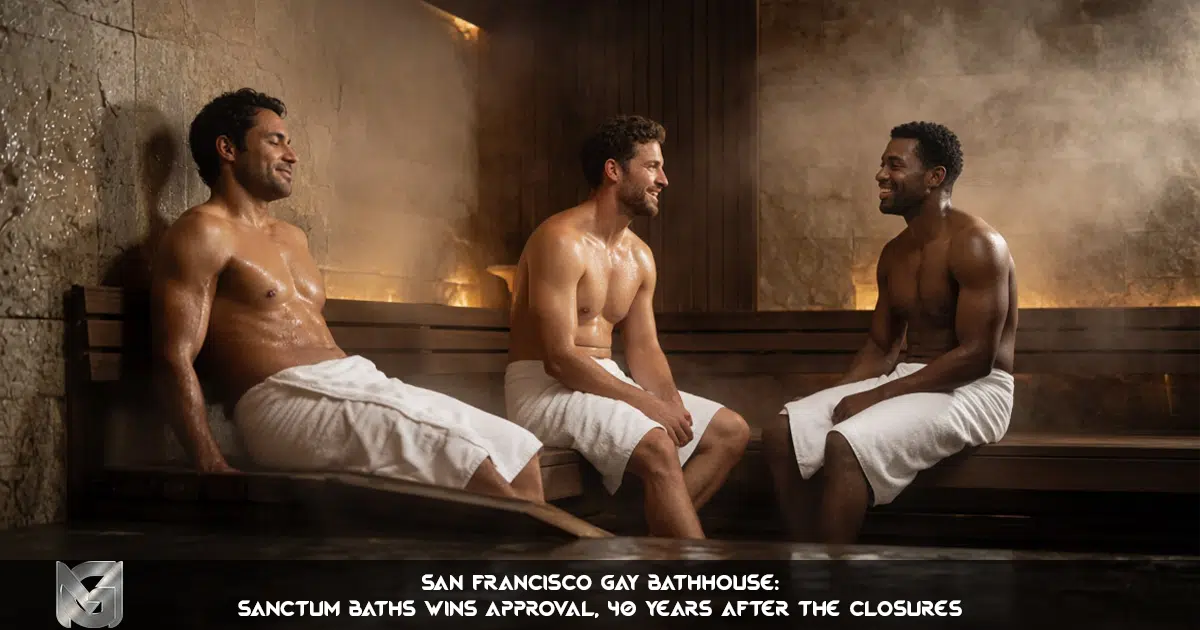
San Francisco gay bathhouse culture is about to open a new chapter. On 5 November 2026, the city’s Planning Commission voted 7-0 to approve Sanctum Baths, a bathhouse planned at 40 12th Street, just off Market Street in the SoMa district. For a city that shut its baths in 1984, at the height of the AIDS crisis, the vote carries a weight that goes far beyond a building permit. It is the first new gay bathhouse authorised in San Francisco in decades, and the result of years of work to remove rules written in a time of fear. Here is what was approved, who is behind the project, and why this small two-storey building matters so much.
The new San Francisco gay bathhouse: what was approved on 5 November
The project, filed under case number 2025-004186CUA, needed two things: a conditional use permit and a variance on the city’s window rules. According to the commission agenda, it converts an existing two-storey, non-residential building of 7,516 gross square feet into what the planning code calls an “Adult Sex Venue Use”. Planning staff recommended approval, and all seven commissioners agreed.
The window question was the trickiest part. San Francisco requires storefronts to keep clear, active windows, which is hard to square with a venue built for privacy. Zoning administrator Corey Teague said he would grant a variance, and the staff report noted that the redesign “retains an active storefront” while protecting patrons, thanks to obscured but translucent glazing. Commission President Amy Campbell was enthusiastic about the site: “I can’t think of a better and more appropriate location.”
Why SoMa suits a San Francisco gay bathhouse
The choice of the neighbourhood is no accident. The neighbourhood was the heart of gay nightlife in the 1970s and early 1980s, when its bathhouses were part of a weekend out as much as the bars. Today the SF Eagle, The Powerhouse and the Lone Star Saloon are all a few blocks away, so Sanctum Baths will land in a part of town that never stopped being queer.
Who is behind the project
The man driving Sanctum Baths is Kevin Born, a general contractor described by the Bay Area Reporter as “a straight ally”. The building on 12th Street was the headquarters of his firm, Ashbury General Contracting & Engineering, and he is also a co-owner of The Midway, a nightclub in the Dogpatch district.
Born first announced the project during Pride Month 2025 under the name The Maze. He later dropped it because it did not match his idea of an upscale venue, and chose Sanctum Baths with the help of a marketing consultant. He wants the place to be “unapologetically queer” and closer to a luxury spa than to the dark, rough image many people have of the old baths. His permit application describes a “professionally operated health, wellness and community bathhouse” for the LGBTQ+ community, with commitments on occupancy, noise, security and relations with neighbours.
When will Sanctum Baths open?
Not tomorrow. Born still has to hire an architect, obtain building permits and carry out the works. He told SFist he expects the permits to take six to seven months, and he is aiming for an opening in autumn 2027. No bookings, prices or floor plans have been published so far, so anything you read about saunas, steam rooms or private cabins at this stage is speculation.
A short history of the San Francisco gay bathhouse
To understand why this vote made headlines, you have to go back four decades.
The golden age of the baths
In the 1970s, the San Francisco gay bathhouse was a pillar of the city’s queer life. The baths were places for sex, of course, but also for meeting people, making friends and finding community at a time when few public spaces welcomed gay men. Each venue had its own crowd: SFist recalls that the Ritch Street baths drew a preppier clientele, while the Club Baths at 8th and Howard were a favourite of the leather scene.
1984: the year the doors closed
Then came AIDS. As the epidemic tore through the community, the baths became the centre of a bitter debate. In early October 1984, Public Health Director Mervyn Silverman ordered 14 bathhouses, sex clubs and bookstores to close as a public nuisance. Most of them quickly reopened, and the city took the fight to court. In late November 1984, a judge’s ruling stopped short of banning bathhouses outright, but it outlawed private rooms with locking doors and required staff to monitor patrons. Without private rooms, the business model collapsed, and the classic baths disappeared.
The decision divided the gay community. Some saw closure as a necessary emergency measure; others argued the baths could have been used to spread information, offer testing and promote safer sex. Activist Cleve Jones later said he was ambivalent, but wished the baths had stayed open to educate and test their customers.
The long in-between
For almost forty years, San Francisco lived without a true San Francisco gay bathhouse. Sex clubs without locked rooms, such as Blow Buddies and Eros, were tolerated, and the 1984 restrictions were written into the health department’s “minimum standards” in 1997. Eros moved in 2022 to the former Bulldog Baths in the Tenderloin, and according to the Bay Area Reporter it is the only such venue still operating.
Clearing the roadblocks, one by one
The return of the San Francisco gay bathhouse is largely the work of Supervisor Rafael Mandelman, who represents District 8, including the Castro. In February 2020, he introduced legislation asking the Department of Public Health to update its AIDS-era rules, and the department later rescinded them. That turned out to be only the first obstacle.
- 2022: a zoning ordinance allowed adult sex venues again in the Tenderloin, SoMa and the Castro.
- November 2024: supervisors repealed Article 26 of the Police Code, a 1973 law that banned locked rooms and required a daily register of patrons.
- Still to come: an update to the planning code on windows is expected before supervisors.
Mandelman summed up the method in November 2024: “So each time we find a new roadblock, we try to clear it away.” He is due to leave office in early January, and he admitted he would have been very disappointed if no bathhouse had opened after all that legislative work.
From health threat to health partner
The most striking change is in the official tone. In 1984, the San Francisco gay bathhouse was treated as a danger to public health. In 2026, San Francisco planning staff wrote that adult sex venues, when safely operated, help the city in its efforts against HIV and other sexually transmitted infections. Prevention has changed too: condoms and testing are now joined by PrEP, which did not exist when the doors closed. If you want to know where the pill stands on this side of the Atlantic, read our complete guide to PrEP in Europe.
A well-run venue can be a place to hand out condoms, promote testing and talk about health without judgment. That is the bet behind every modern San Francisco gay bathhouse project: forty years after the closures, the baths are no longer seen as part of the problem, but as one possible part of the answer.
Visiting a San Francisco gay bathhouse in 2027
For now, Sanctum Baths is a permit, a building and a promise. If the timetable holds, the first San Francisco gay bathhouse of the new era should open in autumn 2027, and it will be worth a visit for anyone interested in queer history, as much as for the steam. The symbol is already there: in the city that gave the world Harvey Milk, the baths are coming back by the front door, voted through by a public commission, seven votes to none.
In the meantime, Europe has no shortage of options. Our guide to the best gay saunas in Europe in 2026 covers the venues worth the trip, from Berlin to Madrid. And we will follow Sanctum Baths until its opening night.
For comments or projects, please contact me.