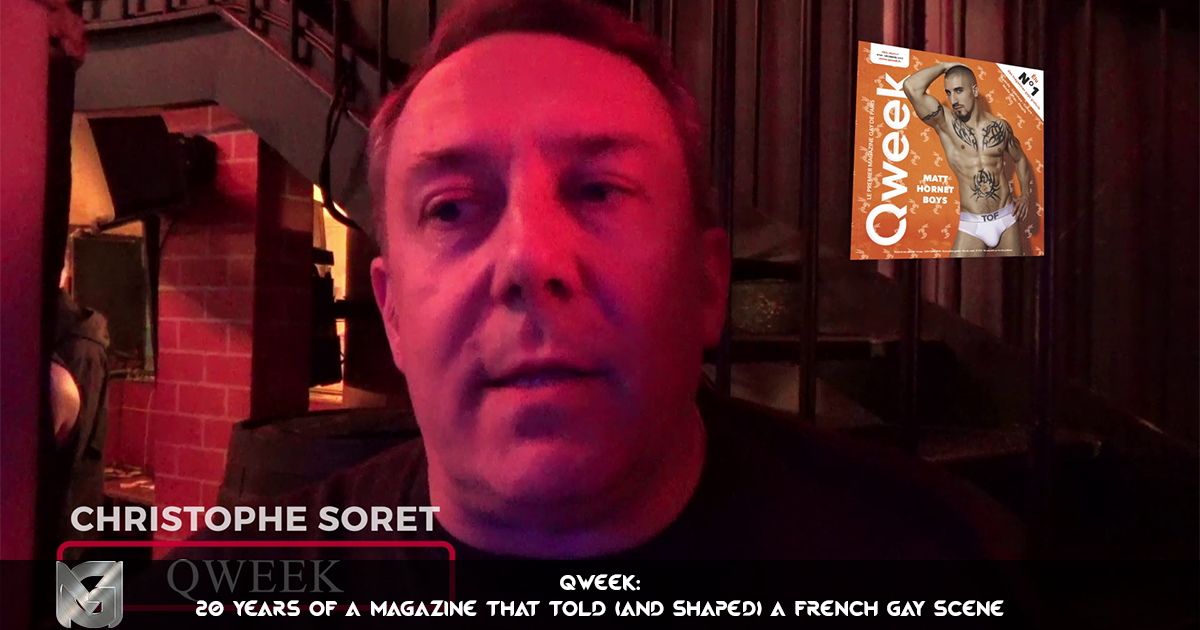
Qweek. There are titles you first flick through to figure out what you’re doing this weekend, then you end up keeping them, almost despite yourself, as intimate archives. In December 2017, to mark the magazine’s 20th anniversary, we interviewed Christophe Soret, a central figure in this editorial adventure. The point wasn’t to do a simple birthday piece, but to understand what this free title has meant, for Paris, for the regions, and for everyone who needed a media voice that spoke “about us”, without filters and without condescension.
Because 20 years isn’t only longevity. It’s proof of resilience. In a landscape where LGBTQ+ press has often been fragile, dependent on ads, venues, trends, and political winds, lasting two decades means capturing something essential: real life, the life lived in bars, associations, saunas, festivals, exhibitions, encounters, anger and pride.
Qweek, what exactly was it?
Qweek established itself as a free gay magazine, distributed and designed to be picked up “in passing”, like you’d grab a flyer, but with an editorial ambition far broader than a simple nightlife programme. Issue after issue, readers found the mix that became its signature: listings, interviews, culture, fashion, people, hookups, and a map of LGBTQ+ venues.
That editorial cocktail, sometimes dismissed as lightweight from the outside, played a very concrete role: giving people reference points. Saying where to go, who to listen to, what to see, what to read. And, above all, creating a sense of belonging. For many, Qweek was a first “paper” contact with a community, a doorway less intimidating than organised activism, and more tangible than a newsfeed.
A magazine rooted in real places, not a floating discourse
What made the title strong was its closeness to places and people. Not only big names, but also everyday actors: bar owners, party organisers, artists, activists, DJs, volunteers. That “on-the-ground” dimension is essential to understand why it mattered.
In our December 2017 conversation, Christophe Soret insisted on a simple idea: talk about the people who make the community move. A line that, without being a manifesto, feels like a method. Go out, listen, tell stories, and give visibility.
Christophe Soret: a name that comes up a lot, and it’s no accident
Christophe Soret is associated with several LGBTQ+ press titles and projects. Public sources present him as an editorial figure linked to Qweek, and also to Garçon Magazine. His role is often described as editorial, in direct contact with topics and teams.
What stands out, beyond job titles, is a posture: a media professional who understands the mechanics of communication, but who also grasped that, in gay press, credibility is earned at the bar as much as at a press conference.
A vision: making the community readable, accessible, and visible
Where some media speak to an already “initiated” audience (activist codes, references, jargon), Qweek long played a translating role: making information accessible, encouraging people to reach out to others, and showing that the community is not limited to Paris, to a single aesthetic, or to one way of living sexuality.
That’s also what makes the 20th anniversary of Qweek worth revisiting: it tells a constant need for local, close-to-life media, able to connect culture, going out, sexuality, and social issues.
20 years: why this anniversary matters
Magazine anniversaries are often an excuse for nostalgia. Here, the stakes are different. Twenty years is a marker: continuity in LGBTQ+ visibility in France, despite cycles.
We’ve seen titles disappear, newsstands close, ad budgets shift to digital, social networks capture attention. And yet, a free magazine that circulates through the city, that you can pick up, that you read on the metro or before going out, keeps a particular power: it materialises the existence of a scene.
A French context that hasn’t always been kind
LGBTQ+ press doesn’t evolve in a political vacuum. Debates around rights, backlash, periods of tension, violence, all of that shapes how media position themselves. A retrospective piece on Qweek can’t ignore that reality.
Even when a magazine talks about parties, culture or “plans”, it takes part in a form of soft resistance: it normalises, it makes visible, it says “we are here”.
What the magazine brought: a cultural and social compass
Let’s say it clearly: community media don’t only inform. They connect.
The magazine long acted as a compass:
- A geographic compass, with venue and address references.
- A cultural compass, with artists, exhibitions, and outings.
- A social compass, by making paths, commitments, and ways of being visible.
Listings as a tool of emancipation
We often underestimate the importance of listings. Yet knowing where to go is also knowing you have the right to go there. For an isolated reader, LGBTQ+ listings can be a first step towards meeting people, building confidence, and leaving an internal closet.
And that’s where Qweek was useful: no need to “earn” entry. You pick up the magazine, you read, you choose.
Our December 2017 interview: what we remember today
In December 2017, the conversation with Christophe Soret, as Qweek turned 20, had a particular flavour: a balance sheet without triumphalism. It didn’t feel like a corporate celebration, but rather an awareness of long-term work, often invisible.
What we remember most is the importance given to concrete community actors. Not only those who speak on behalf of others, but those who do, organise, welcome, create, care, and animate.
A press that doesn’t apologise for being popular
Qweek never needed to imitate mainstream press to exist. Its DNA also lies in owning a share of lightness, because lightness is political when it has long been denied. Talking about desire, bodies, parties, pop culture, isn’t “less noble”. It’s a way of saying our lives don’t boil down to struggle, even if struggle remains.
Today: legacy and questions
The legacy is having shown that a free medium can be a serious medium, in the sense that it is useful. But the question remains: how do you preserve that usefulness in the age of algorithms?
Social networks give the illusion of closeness, but they fragment. A magazine, on the other hand, brings together on a few pages worlds that don’t always speak to each other: culture, sexuality, prevention, activism, nightlife, regions.
What Gay Mag wants to keep from this story
If we’re telling these 20 years, it’s not to build a museum. It’s to restate an obvious truth: the community needs media that look at it precisely, without caricature, and with a real sense of the ground.
And that’s exactly what we want to keep defending:
- Accessible writing, but not simplistic.
- Topics close to people, not postures.
- Visibility that isn’t negotiated.
Conclusion: 20 years, and a lesson in presence
Qweek is the story of a magazine that accompanied generations of readers, sometimes without them realising it. You picked it up to go out, you read it to recognise yourself, you kept it to remember.
Those 20 years, celebrated in 2017, remind us that LGBTQ+ press isn’t a luxury. It’s a tool. A link. A living archive.
And if we had to sum up the essence of our December 2017 interview with Christophe Soret, it might be this: a community medium is worth not only what it says, but the people it brings into the light, week after week, issue after issue.
For comments or projects, please contact me.