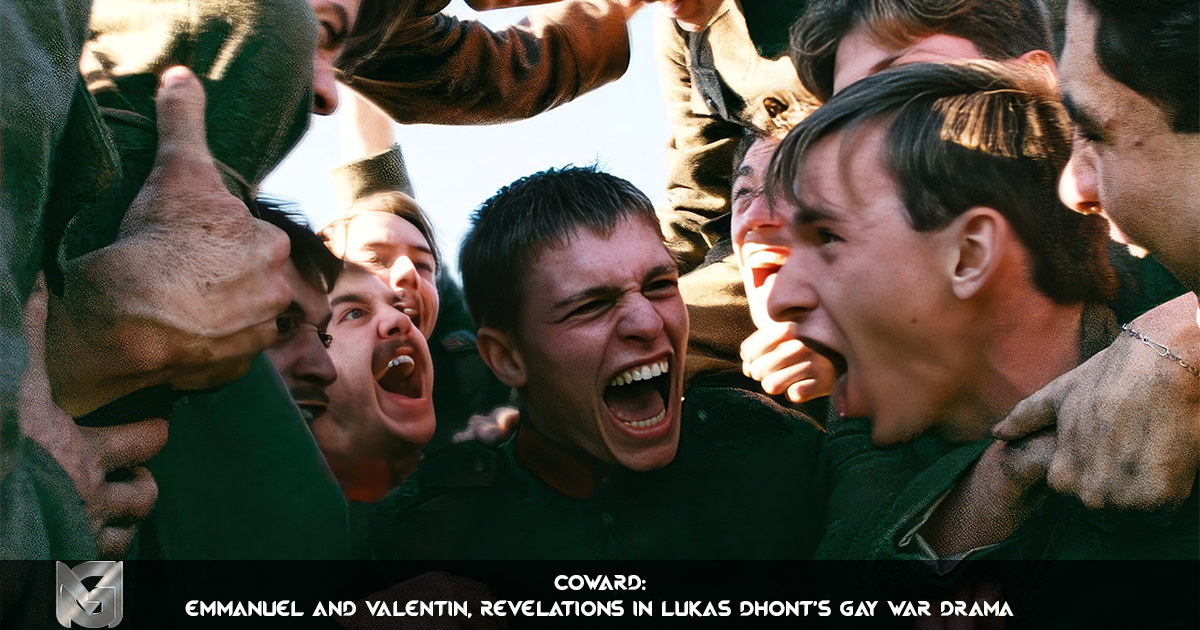
Coward: the title lands like an accusation, and like a question. At Cannes 2026, Emmanuel Macchia and Valentin Campagne received the Best Actor prize ex aequo for Lukas Dhont’s film, a gay war drama that chooses the truth of bodies over the shine of heroic posturing.
In this piece, we look at what Coward is said to be about, its characters, how the film fits into Dhont’s trajectory, and what is publicly known, at this stage, about the paths of Emmanuel Macchia and Valentin Campagne.
Cannes 2026: a Best Actor prize that makes a statement
The Best Actor prize awarded ex aequo to Emmanuel Macchia and Valentin Campagne made immediate waves, because it crowns a duo rather than a single isolated “hero”. That choice matches the DNA of Coward, which seems to treat survival as a matter of connection, glances, trust, sometimes betrayal, and very often fear.
Cannes loves discoveries, but it loves even more the kind of discovery that says something about the moment. Here, the message is clear: a war film can be a film of feelings, and a gay romance can be handled with the same dramatic seriousness as any great love story.
Coward: the film’s pitch
Coward is presented as a gay romantic drama set against World War I, in the Belgian trenches. The story follows two young soldiers, caught between the obsession to “hold the line”, the pressure of the group, and the inevitability of an attachment that becomes, at once, shelter and danger.
The title, Coward, points to the central question: what do we call cowardice when fear is everywhere, when the instinct to survive clashes with the ideal of virility, and when loving can condemn you?
The characters: two arcs that answer each other
Even if public summaries remain partial, Coward is built around a two-hander, which also explains the logic of a shared acting prize.
Pierre: proving yourself, performing, surviving
In some descriptions, one of the characters is presented as a young Belgian soldier determined to “prove himself” on the battlefield. It’s a classic engine of war storytelling, but Lukas Dhont typically uses it to crack the myth open, not to celebrate it.
Pierre embodies the performance of bravery. Bravery as costume, as posture, as a response to shame. And this is precisely where the film becomes deeply gay in its gaze: it isn’t only about sexuality, it’s about what masculinity demands, and what it destroys.
The other soldier: intimacy as a zone of resistance
Opposite Pierre, the other character, played by the other laureate, seems to act as both mirror and counterpoint. Where one tries to be “up to the task”, the other reveals what that height costs.
Their relationship, as described in several English-language reviews, unfolds like a romance under pressure. Not a decorative love story, but a bond that has to carve out space in an environment where everything becomes surveillance: superiors, comrades, rumours, and even your own body.
Why this duo hits (and why it deserves a prize)
A shared acting prize often rewards chemistry, a two-voice score. In a trench film, chemistry isn’t only in love scenes, it’s in silences, breath, exhaustion, fear, mud, waiting.
And in a gay love story, there’s an extra difficulty: playing desire without over-signalling it, playing emotion without turning it into performance, playing threat without reducing it to a suspense mechanism. That’s exactly the terrain where a duo can become unforgettable.
Lukas Dhont: why Coward fits his filmography
Lukas Dhont isn’t a filmmaker who uses intimacy as décor. He films intimacy as a battlefield. His previous films were noted for their sensitivity, but also for their ability to look at social violence without voyeurism.
With Coward, he shifts his gaze toward war without leaving his core subject: how a society manufactures norms, and how bodies try to survive inside them.
A war film, but not a “military” film
What emerges from early critical reception is the sense of a war film that refuses easy heroism. The trenches aren’t a playground, they’re a crushing machine.
In that frame, the gay romance isn’t an “add-on”. It becomes a way of telling war differently: at human height, at skin height, at fear height.
Emmanuel Macchia: who is he, and why Cannes catapults him
In terms of public information, Emmanuel Macchia is presented as a Belgian actor, and Coward is often described as his first major cinema role, or at least a striking breakthrough.
What’s striking is how quickly Cannes can turn a face into a promise. A Best Actor prize at this level isn’t only a trophy, it’s a global calling card.
A true “breakthrough” performance
The word is sometimes overused, but here it seems fair: if Coward is indeed a leading role, Macchia had to carry a rare emotional and physical intensity. In a war film, the body is a text. It tells hunger, cold, tension, panic. And in a Dhont film, the body also tells what cannot be said.
What comes next?
At this stage, his publicly visible filmography still appears relatively short. But Cannes often triggers a domino effect: agents, international casting, writers who start building roles for a specific energy.
Valentin Campagne: a career already taking shape
Valentin Campagne is presented as a French actor, with credits that include recent projects before Coward. Some public databases list him on films dated 2025, suggesting a path already in motion, even if mainstream recognition is exploding now.
An actor of nuance
In a duo, one can be the sharp edge, the other the depth. Without reducing their work to a formula, the shared prize suggests Campagne brings density and presence, a way of making inner life visible in a context where everything pushes you to armour up.
Cannes as an accelerator
For an actor, Cannes can be a before-and-after. The question becomes: how do you choose what’s next? How do you avoid being boxed into “the gay war film actor” label, and turn this moment into a springboard toward varied, complex, unexpected roles?
Why Coward speaks directly to Gay Mag readers
1) Because the film refuses caricature
Gay cinema has long been trapped between two pitfalls: punitive tragedy (love equals death) and sugar-coated comedy (love equals cute). Coward seems to aim for a third way: love as a real force, but not a magical one, in a world that forgives nothing.
2) Because it interrogates masculinity, not only orientation
The power of a gay love story in wartime is that it strips the making of virility down to the bone. War is the ultimate factory of “be a man”. And that’s precisely where desire becomes subversive, not because it is “scandalous”, but because it reminds us soldiers remain human beings.
3) Because Dhont’s direction is built for empathy
If early reception is any guide, Dhont is less interested in shocking than in making us feel. And for a publication like Gay Mag, that matters: you can talk about the film without sensationalism, staying with emotion, the politics of bodies, and the dignity of the characters.
What to remember
- Emmanuel Macchia and Valentin Campagne win Best Actor ex aequo at Cannes 2026 for Coward.
- Coward is positioned as a gay romantic drama set during World War I, centred on a duo of soldiers.
- The film fits Lukas Dhont’s ongoing themes: intimacy, norms, social violence, and tenderness as a breaking point.
- For Gay Mag, it’s prime material: cinema, representation, and a sharp reflection on masculinity.
For comments or projects, please contact me.