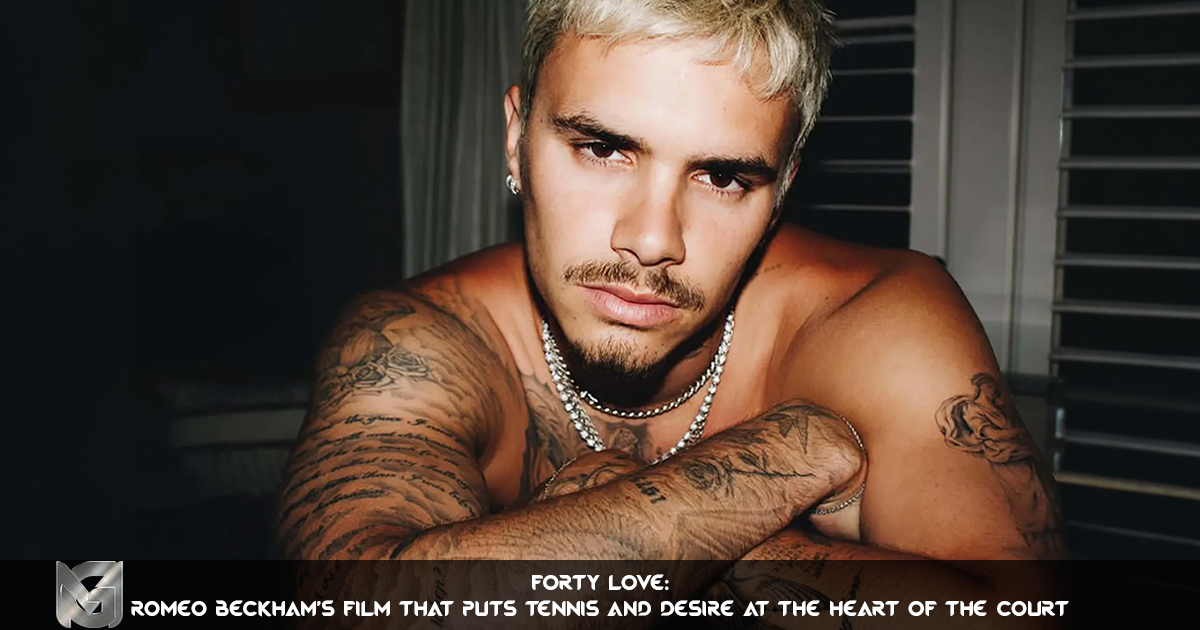
Forty Love is not just another celebrity announcement, it’s a cultural signal. At 22, Romeo Beckham lands his first leading role in a LGBTQ+ romance set in the world of tennis, a backdrop where performance, image, and social pressure constantly echo one another. And that is exactly what makes the project interesting for Gay Mag: behind the glamour of the Beckham name, there is the promise of a story about desire, identity, and rivalry, with an aesthetic that aims to be sensual and coming-of-age.
The film is titled Forty Love (a nod to the tennis score), and it is presented as a romantic fable in which love becomes the most destabilizing opponent, more dangerous even than competition. A simple pitch, but an effective one, speaking both to queer cinema fans and to anyone who knows the quiet violence of ultra-competitive environments.
What we know about Forty Love (without fantasizing)
At this stage, we need to be clear: Forty Love is an announced film, with a communicated release date, a spotted cast, and a plot described across several sources. But we do not yet have a film to dissect shot by shot, nor reviews to compare. So we stick to what is available, and we read between the lines without inventing.
An LGBTQ+ romance against a tennis backdrop
The story follows Sascha Gallo, a young player aiming for an important tournament in Paris. In the middle of the competition, he meets a rival who upends everything, on the court and off it. Romeo Beckham plays that rival, the one who disrupts the hero’s balance and pushes the story into a more intimate space.
The narrative promise is clear: tennis as a metaphor for control, and love as a force that escapes it. It is a classic romance engine, but high-level sport gives it a particular tension: you are playing for your career, your image, sometimes your masculinity, and often your right to vulnerability.
A creative team from fashion photography and French cinema
The film is directed by Pierre-Ange Carlotti, presented as a fashion photographer moving into directing. That detail matters: when a gaze comes from still imagery, you can expect special attention to bodies, textures, light, and the staging of desire.
On screen, Romeo Beckham shares the bill with French actor Paul Kircher, identified as the performer of Sascha Gallo. Around them, several sources also list prestigious names from French cinema, placing Forty Love in a more ambitious register than a simple “event movie.”
Why casting Romeo Beckham intrigues (and could work)
Romeo Beckham arrives in cinema with a paradoxical baggage: he is both extremely well-known and still “untested” as an actor. For a first film, that is a risk, but also leverage.
From sport to cinema: a coherent trajectory
Romeo Beckham has long been associated with sport. As a teenager, he trained in a football environment (with a stint in Arsenal’s orbit), and he also played tennis, with training mentioned alongside Andy Murray. He later played football at Brentford before announcing his retirement from professional sport.
He then turned to modelling, with collaborations cited with Yves Saint Laurent and Balenciaga. In other words: discipline, image, performance, media exposure. These are precisely the themes Forty Love seems to want to put under tension.
A “first queer lead role”: symbol, marketing, or a real gesture?
The fact that his first film is an LGBTQ+ romance is, obviously, a communication element. But that is not necessarily cynical. In 2026, queer cinema is no longer a niche, it is a narrative territory where you can do romantic, sensual, popular storytelling without asking permission.
For Gay Mag, the interesting question is not “is it queer enough?” but rather: what does the film say about male desire in an environment where everything is coded? Tennis, like many sports, is a space of control, tradition, and public scrutiny. Placing a romance there promises friction.
Forty Love and the mechanics of desire: what tennis makes it possible to tell
Tennis is a singular sport on screen: it is both spectacular and intimate. You are alone, facing the other, under everyone’s eyes. Every gesture is visible, every crack too.
Rivalry, attraction, and power play
The “rival-to-lover” romance works because it strips the ego bare. In a sports story, rivalry is not background, it is structure: rankings, points, pressure, constant comparison. If the other becomes an object of desire, everything gets complicated.
In Forty Love, the opponent is not only an obstacle, he becomes a force of attraction. And that is where the film can be smart: showing that desire is not a bonus, but an event that reconfigures performance.
Identity, visibility, and fear of losing
In competitive environments, love can be seen as weakness. And when love is queer, it can also be seen as a social, media, or family risk. Even as societies evolve, the fear of “losing your place” remains a powerful dramatic engine.
We do not yet know how far Forty Love will go on these questions. But simply making them plausible in a mainstream film is already a stake.
Release date and expectations: what we can reasonably anticipate
Forty Love is announced for release in France on 25 November 2026. Between now and then, we can expect a ramp-up: first images, a trailer, interviews, and of course a media narrative around Romeo Beckham.
The trap to avoid: reducing the film to “a Beckham playing gay”
Queer cinema has already suffered enough from that reflex: turning a story into mere provocation or curiosity. If Forty Love wants to exist, it will have to convince on two courts:
- Emotional credibility: the romance must be embodied, not merely hinted at.
- Sporting credibility: tennis must look like tennis, not an advertising choreography.
What Gay Mag will be watching
When the film comes out, the key questions will be simple:
- Is desire filmed accurately, without voyeurism or prudishness?
- Is the romance written as a real story, not as a “topic”?
- Does Romeo Beckham hold the screen beyond his name?
Who is Romeo Beckham beyond the name?
Let’s not pretend: the Beckham name opens doors. But it also exposes you to permanent suspicion. Romeo Beckham is not the first “nepo baby” to try cinema, and he will not be the last.
What could work in his favour is a form of coherence: he comes from a world where you learn early to be watched, judged, commented on. And Forty Love seems to be about exactly that: being observed, being expected to perform, and discovering that intimacy can derail everything.
The film also fits into a family history where the screen is not unfamiliar: Victoria Beckham has already had a presence in cinema, David Beckham has made on-screen appearances, and the family’s media ecosystem has always navigated between pop culture and storytelling.
Conclusion: Forty Love, a film to take seriously (even if we’re waiting to see)
Forty Love ticks a lot of boxes: an elegant sports setting, an announced LGBTQ+ romance, a Franco-international cast, and a highly mediatised first leading role for Romeo Beckham. The risk is hollow buzz. The promise is a film that treats love like a match you cannot control.
While we wait for release, the most honest thing to say is this: if Forty Love delivers on its promises, it could become one of those films where queer romance is not a “topic,” but a popular, sensual, emotionally credible story, with sport as a mirror of our contradictions.
For comments or projects, please contact me.