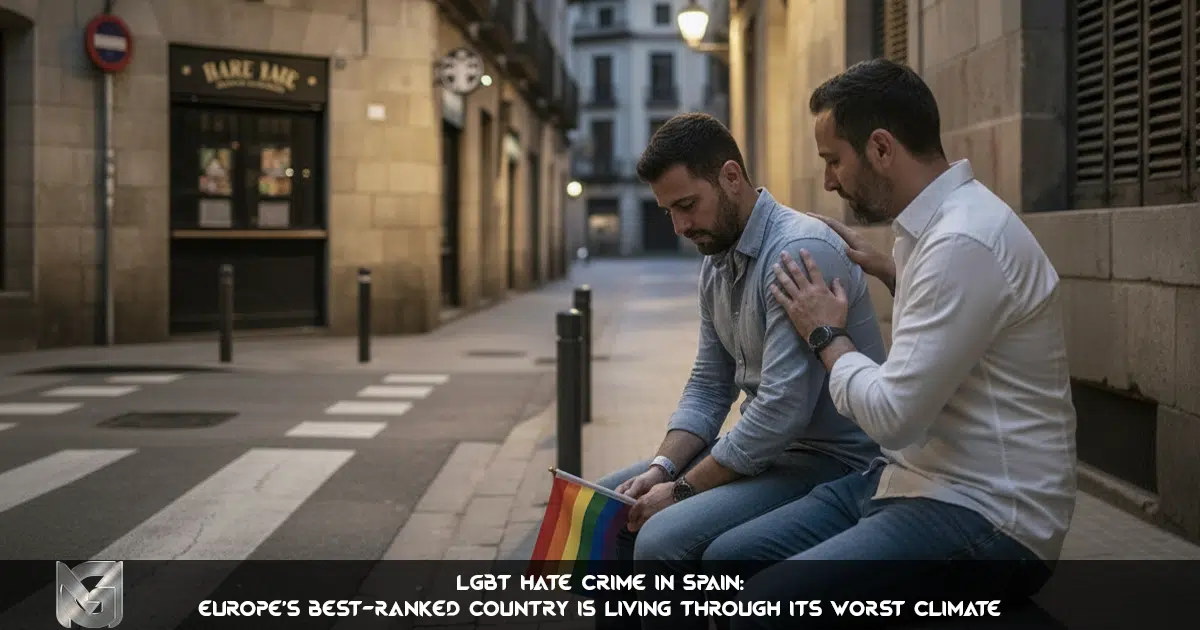
LGBT hate crime in Spain produced two contradictory headlines within a few weeks of each other. In May 2026, ILGA-Europe put Spain at the top of its Rainbow Map, first in Europe for its LGBTI laws and policies. In April, the country’s main LGBTI federation had published a report showing that 54% of LGBTI people had experienced a hate incident in the past year — the highest figure ever recorded since the survey began. Both statements are accurate. That is exactly the problem.
LGBT hate crime in Spain: a paradox the federation names itself
The report is called Estado del Odio 2026 (State of Hate 2026). It is the fourth annual edition published by FELGTBI+, Spain’s state federation of lesbian, gay, trans, bisexual and intersex people, and it draws on a survey carried out by the polling institute 40dB in February 2026.
FELGTBI+ does not hedge. It describes a “social paradox”: legislative progress on equality coexisting with the persistence — and worrying increase — of hate. Its conclusion fits in one line: the measures implemented so far are not enough.
LGBT hate crime in Spain is not, then, a blind spot for the authorities. It is documented, quantified, and echoed by the Ministry of Inclusion’s own observatory. What is missing is not the diagnosis.
What the report actually measures
54%, the highest level ever recorded
54% of LGBTI people report having been the victim of a hate incident in the past twelve months, online or offline. Counting offline incidents only, the figure is 44%.
Scaled to the population, FELGTBI+ estimates that between 2.07 and 2.26 million people experienced a hate incident in Spain over a single year.
One honest caveat about that calculation. FELGTBI+ puts the adult LGBTI population at 11–12% of Spaniards, while the CIS survey of March 2026, cited by the Ministry of Inclusion, uses 10%. The estimates differ by method. Neither is “the” definitive number.
The breakdown: what LGBT hate crime in Spain covers
Over the past twelve months:
- 22% suffered an assault
- 36% suffered harassment
- 29% suffered discrimination
In detail, 10% were victims of physical assault and 9% of sexual assault. Broken down further: 4% suffered a serious physical assault, 6% a minor physical assault, 4% a sexual assault involving violence and 6% a sexual assault involving intimidation. 17% faced insults and degrading treatment, and 7% were discriminated against at work.
These forms of violence do not add up so much as pile up. 24% experienced both harassment and discrimination, 19% both harassment and physical assault, and 11% suffered all three. Nearly half of victims say it happened more than three times in five years.
The nuance most coverage flattened
You will have read that assaults “tripled in two years”, from 7% to 22%. That is arithmetically true and still misleading.
The report is explicit: the rise happened in 2025, and the figure has remained practically stable in the 2026 measurement, at around 22%. The same is true of harassment, which levelled off after its 2025 jump. Discrimination has stayed relatively constant at around 29%, with a slight upward trend.
In other words, this is not an explosion this year. It is a plateau at a historic high. That is not good news in disguise — it may be worse. A spike subsides. A plateau settles in.
LGBT hate crime in Spain is no longer climbing, then: it is holding at its record. The distinction is not cosmetic, and it changes what should be concluded from the data.
Where LGBT hate crime in Spain happens
The street first, the workplace second
The main setting remains the street: 32% of recorded cases. Then workplaces (13%), tied with leisure venues (13%), followed by the family home (11%).
That ranking deserves a pause. A third of LGBT hate crime in Spain happens in public space — but nearly a quarter happens where people are supposed to be safe: at work and at home.
Social media as an amplifier
18% of LGBTI people have received insults on digital platforms, 13% have experienced isolation or rejection, and 11% report workplace discrimination linked to online interactions. The OBERAXE observatory notes that more than 40% of the community say they have suffered hate episodes on platforms such as Instagram or X.
Who is targeted by LGBT hate crime in Spain
LGBT hate crime in Spain does not strike at random. The victim profile is stable year on year. For harassment and discrimination: trans people and lesbian women, joined this year by asexual people. For assaults: trans people, gay men and non-binary people.
Intersectionality makes everything worse. Having a disability, belonging to a racialised, religious or ethnic minority, or being a migrant increases the risk — but so does being young or having a low income.
One finding cuts against intuition: rural municipalities do not generate more hate incidents. Medium-sized towns produce the most. That said, LGBTphobia remains one of the drivers of “sexile”: among the reasons people leave their home town, violence or discrimination there consistently exceeds 70%.
So why is Spain ranked No.1?
Because the Rainbow Map measures something else entirely.
ILGA-Europe’s 2026 ranking puts Spain first at 89%, ahead of Malta (88%), Iceland (86%), Denmark and Belgium (85%). It is the first time Spain has held the top spot. It earned it by actually implementing its 2023 LGBTI and trans laws: equality action plans, an independent authority for equal treatment, and full depathologisation of trans people in the healthcare system.
The Rainbow Map assesses laws and public policy. The FELGTBI+ report measures lived experience — that is, LGBT hate crime in Spain as it is practised, not as it is punished. Two different instruments pointed at two different realities. There is no contradiction between the numbers — there is a gap. And the gap is the story.
One piece of good news
Victims of LGBT hate crime in Spain are staying silent less often. The reporting rate has doubled in three years. Assaults are the most reported incidents (47%), ahead of discrimination (43%) and harassment (41%). FELGTBI+ credits the support and advice services run by LGBTI organisations.
The experience of reporting, however, remains mostly negative. The most common response victims describe is having the incident minimised. 22% say they were made to feel bad, and 20% say they were asked things they did not want to answer. The main reasons for not reporting: judging the incident unimportant, believing it would achieve nothing, or lacking evidence.
LGBT hate crime in Spain: the invisible cost to health
The report links hate experiences to higher levels of depression, anxiety, stress, loneliness, anger and fear. OBERAXE goes further: one in three LGBTIQ+ people has had suicidal thoughts or attempts, twice the rate of the general population.
If any of this describes your own situation, talking to a professional or an LGBTI organisation is not a weakness. It is precisely what they are there for.
What is being asked
FELGTBI+ has called on the government to do more and to adopt a national pact against hate speech. The Council of Ministers adopted an institutional declaration for LGBTI Pride Day on 23 June 2026.
But as the federation itself points out, a declaration is not a measure.
What it means for the rest of us
Spain remains one of Europe’s most protective countries on paper, and that is not nothing: those laws exist, they are being applied, and they were fought for. But an exemplary legal framework has never doubled as a social climate.
LGBT hate crime in Spain makes the continent’s clearest case for that, precisely because Spain is the best equipped country legally. That may be the most useful lesson in this report for the rest of Europe. Rights are won in courts and parliaments; safety is won in the street, at the office and in families. Neither fight substitutes for the other.
Sources
FELGTBI+, Estado del Odio 2026 (April 2026, 40dB survey, February 2026): https://felgtbi.org/wp-content/uploads/2026/04
For comments or projects, please contact me.