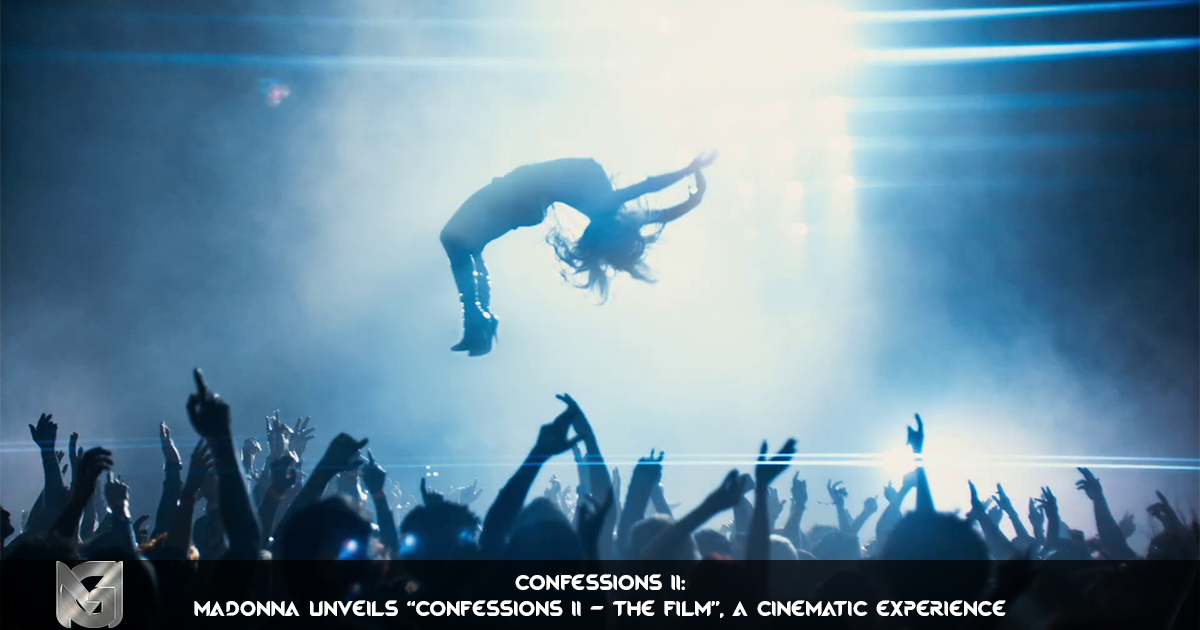
Confessions II. Two words that hit like a disco ball switching on, and that perfectly capture Madonna’s intent, returning to the heart of the dancefloor, but with the ambition of a true cinematic gesture. With “Confessions II – The Film”, the pop icon offers a visual experience designed as a narrative companion to her next album. Presented as a chaptered film, the project sits in line with her long-running obsession, turning music into story, the club into theatre, and the night into language.
For Gay Mag, it’s an obvious subject, because Madonna isn’t only a superstar, she’s a cultural figure who has accompanied, and sometimes anticipated, conversations about desire, freedom, transgression, and community. Here, she returns to territory she knows by heart, the dancefloor, treating it as a place of origin and return, a space where we find each other, reinvent ourselves, and breathe.
What we know (and what it already suggests)
The film is presented as a cinematic experience available on YouTube, following a premiere at the Tribeca Festival. Direction is credited to David Toro and Solomon Chase (TORSO). The announced device is clear, six chapters, each built around a track, as if every song opens a different door into the same night.
Without over-reading it, that format already says a lot about Madonna’s approach. Rather than lining up standalone videos, she’s proposing continuity, a trajectory, a build. It’s not just about “illustrating” songs, it’s an attempt to create a world, with its codes, silhouettes, and tensions.
A chaptered narrative, not a simple compilation
The chapter structure is interesting because it pushes the project closer to a concept film than a playlist of clips. In an era of fragmented attention, Madonna is betting on the opposite, immersion. For queer audiences, used to stories assembled through fragments, signs, and references, this kind of form can resonate. You read between images, catch symbols, follow echoes.
The cited tracks, a promise of moods
The songs mentioned in the presentation include “I Feel So Free”, “Good for the Soul”, “One Step Away”, “Bring Your Love” (with Sabrina Carpenter), “Danceteria”, and “Read my Lips”. Even from the titles alone, you can sense a palette, freedom, energy, sensuality, and Madonna’s taste for slogans that become mantras.
Why it matters for Gay Mag
Madonna has always had a particular relationship with LGBTQ+ communities, built on proximity, references, collaborations, and a rare ability to turn underground codes into pop language. For many, she was a gateway, into club culture, into queer aesthetics, into a way of owning desire without apologising.
With Confessions II, she seems to return to a core matrix, the dancefloor as a place of truth. And that’s precisely a Gay Mag angle, because the dancefloor isn’t just a backdrop, it’s a social space. You go to dance, yes, but also to exist, to recognise each other, sometimes to protect yourself, often to free yourself.
The dancefloor as a political space (without heavy speeches)
The point is that Madonna doesn’t need a frontal manifesto to remind us what the night has meant, and still means, for minorities. A film that “always returns to the dancefloor” says something simple and powerful, you return to where you learned to be yourself.
A YouTube release, a distribution choice that shifts the game
The fact that the film is offered on YouTube is also a signal. It’s a massive, accessible, international platform. For an event-style project, it’s a way to bypass barriers. No need to wait for TV, no need for a traditional cinema circuit. The audience is already there.
For a media brand like Gay Mag, it’s also editorial territory, because YouTube has become a space for first-run culture, not only a home for short content. When an artist of this calibre launches a work conceived as a film on the platform, she helps redefine what YouTube can host.
What the film can express, beyond the images
Confessions II : Without inventing what we haven’t seen, we can still describe what Madonna typically puts at stake in her visual work.
The body as language
With Madonna, the body is never neutral. It’s sign, provocation, prayer, performance. In an experience centred on dance, movement can become narrative. For queer audiences, that reading is familiar, dance as a way to say what you can’t always say elsewhere.
Party as ritual
Party, in Madonna’s universe, isn’t only pleasure, it’s ritual. You transform. You move through states. A chaptered film can follow that logic, entry, rise, surrender, return to reality.
Pop as total art
Madonna has always pursued total art, music, image, fashion, choreography, story. “Confessions II – The Film” fits that tradition, and that’s what makes it worth covering, even for readers who don’t track every release. There is a proposition, an ambition.
What we can say about the “Confessions II” album (without speculating)
The album is announced for an early July release. The title itself, Confessions II, obviously calls back to “Confessions on a Dance Floor”, an album that marked an era and remains, for many, a club-pop classic.
The point here isn’t to force comparisons, but to note what the name implies, a promise of dance, pulse, light, and strong expectations. The film arrives as a teaser, but also as a statement of intent. This won’t be just another release.
Conclusion
Confessions II isn’t just a title, it’s a signal. Madonna returns to dance, but with cinematic ambition and a release designed for a global audience. For Gay Mag, it’s a chance to talk about pop, club culture, and what the night still means, without caricature, without easy nostalgia, just with this simple truth, some songs aren’t only listened to, they’re lived.
For comments or projects, please contact me.