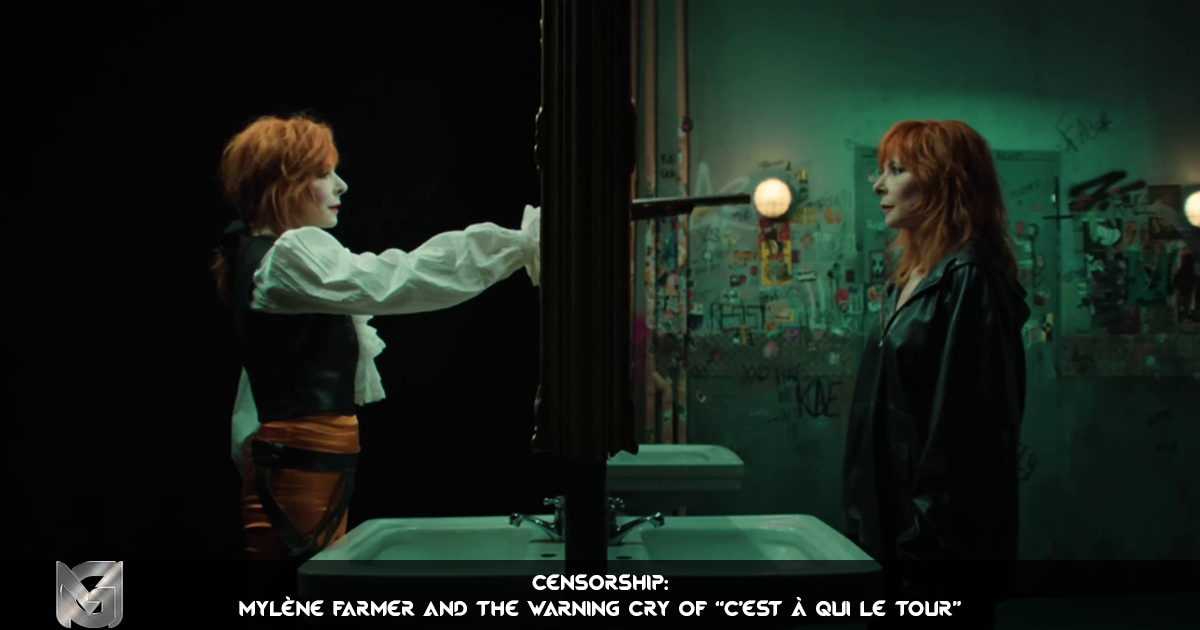
Censorship. The word lands like a verdict, and that is precisely what Mylène Farmer seems to stage in “C’est à qui le tour”. Not a simple provocation, not a “dark” set dressing for style’s sake, but an alert: a cold mechanism, a dystopia that feels uncomfortably close to our own time. Read shot by shot, the video tells less the story of the end of the world than the end of a vital space, the space where we can still desire, create, love, be seen, and disturb.
In this reading, violence is not only physical, it is symbolic, social, cultural. It targets the “ordinary person” as much as the artist. It targets the body as much as speech. And above all, it targets what has always been central in Farmer’s work: ambivalence, freedom, darkness, sensuality, unease. In other words, everything a puritanical, media-driven, algorithmic society tries to render harmless.
A dystopian video, but a very contemporary dystopia
You could watch “C’est à qui le tour” as a futuristic story. Its power, however, comes from the fact that it does not speak of a distant future, it speaks of a present that is hardening. The dystopia here is not fantasy. It is a form.
The video plants a simple, brutally effective idea: civilisation does not always collapse in one spectacular crash. It can dissolve through small amputations, successive restrictions, the normalisation of the gaze, fear of shocking, an obsession with “protecting”, until the living becomes suspect.
The end of civilisation as erosion
What this kind of staging tells is a slow ending, an ending by exhaustion.
- When we can no longer show love, we learn to hide it.
- When we can no longer show desire, we learn to deny it.
- When we can no longer show ambiguity, we learn to simplify ourselves.
And when art is no longer allowed to be dangerous, it becomes decorative. That is where the warning is political, but also intimate.
The tunnel, or censorship as violence that makes people fall
From the first images, the tunnel symbolism is relentless. A tunnel is a passage, an in-between, a place you move through because you have no choice. In this reading, the tunnel becomes a sorting corridor, a place where you endure.
We understand that people are shot there, and they fall. That fall is not only death in a literal sense, it is the visual translation of an idea: censorship is not a neutral rule. It hurts. It eliminates. It silences. It makes people fall.
A shared pain, audience and artist
This matters, because it avoids the cliché of the “martyred artist” cut off from the rest of the world. Here, the wound reaches everyone.
- The audience, because it loses images, stories, freedoms.
- The artist, because they lose a territory of expression.
Censorship is not an abstract debate. It has concrete consequences, it changes how we live, how we show ourselves, how we tell our stories.
A step-by-step mechanism
The tunnel also tells the story of a process. You do not flip overnight. You accept a first restriction. Then another. Then another. Until you catch yourself finding “normal” what would once have been unthinkable.
That is often how a society of moral surveillance is built, not through one single grand ban, but through a series of small concessions.
The nightclub, when desire becomes “content to moderate”
The nightclub scene is central, because it twists a place historically associated with queer freedom. Night, celebration, sweat, glances, bodies, ambiguity. In Mylène Farmer’s universe, these spaces have often been laboratories of transgression, places where you can be otherwise.
Here, on the contrary, the club becomes a space where it would be forbidden to see people in their loves or their sexuality. This is not only a sexual ban, it is a ban on visibility.
Modern puritanism, cleaner, but more intrusive
What strikes is that contemporary censorship does not always present itself as brutal repression. It presents itself as morality, “protection”, hygiene.
But the result is the same: a world where you learn to censor yourself.
- You cut what sticks out.
- You blur what unsettles.
- You delete what disturbs.
And above all, you turn intimacy into a potential offence.
Social media and mainstream media, normalisation through the gaze
The reading that links this scene to social media and puritanical media holds, because our era has invented a censorship that does not always need a state.
It can come from:
- algorithms,
- opaque moderation policies,
- moralising campaigns,
- media panics,
- the fear of being “cancelled”.
Desire becomes a reputational risk. Complexity becomes a risk of misunderstanding. And art becomes a risk of sanction.
Two Mylènes, XXL and Libertine, doubling as a historical wound
The next scene, with two Mylènes, may be the most moving in this interpretation. Because it does not speak only of the artist today, it speaks of the artist across time.
One Mylène points to the “XXL” generation, the other to the “Libertine” generation. These are not nostalgic winks. They are embodiments.
What the artist might no longer be able to create today
To say that the “Libertine” Mylène represents what the artist might no longer be able to create today is to point to a very current phenomenon: the moral rewriting of the past.
We no longer simply say: “it is not our era anymore”. We imply: “it should never have existed”.
And that is where censorship becomes a wound, because it does not only limit the present, it retroactively stains what freed generations.
An intimate wound, and a collective wound
When that Mylène is shown as injured, it is not only the artist who suffers. It is also the audience.
Because for many, Mylène Farmer has been a door.
- A door to desire without apology.
- A door to ambivalence.
- A door to a queer-friendly aesthetic.
- A door to the freedom to fantasise without asking permission.
If that door closes, it is not just a discography that freezes. It is an imagination that shrinks.
Mylène Farmer, witness, target, and resistance
Mylène Farmer is not a “well-behaved” artist. Even when she becomes rare, she remains a figure that unsettles, because she reminds us that pop can be a space of unease.
In “C’est à qui le tour”, she appears as:
- witness, because she watches the shift,
- target, because her work is precisely what some would like to neutralise,
- resistance, because she refuses to make her art harmless.
A body of work built on ambivalence
What is targeted in this reading is not one particular “scandal”. It is ambivalence itself.
Yet ambivalence is vital.
- It allows us to exist outside boxes.
- It allows us to desire without justification.
- It allows us to tell the world without simplifying it.
That is also why Farmer speaks so strongly to part of the LGBTQ+ community, because ambivalence is a daily experience, social, intimate, political.
Censorship is not “you can’t say anything anymore”, it is “you can’t live anything anymore”
Public debate about censorship is often trapped. It collapses into slogans. The video, read this way, shifts the question.
It does not only say: “we can’t speak”. It says: “we can’t live fully”.
When art becomes acceptable, it becomes useless
An art that never shocks, never unsettles, never makes you uncomfortable, ends up serving little purpose. It becomes a comfort product.
Mylène Farmer, on the contrary, has always worked discomfort as a form of truth.
And that may be the clearest message of “C’est à qui le tour”, if we accept this reading: a society that forbids unease also forbids thought.
The final question, “who’s next?”
The title works like a threat and like a question.
Today, a body is censored. Tomorrow, a word. The day after, a memory.
And ultimately, the question is not only: “who will be the next target?”
It is also: “who will accept falling without saying anything?”
What Gay Mag takes from it, a queer, cultural, and political warning
For a media outlet like Gay Mag, this reading resonates in a particular way. Because LGBTQ+ history is also a history of visibility wrested, then contested, then sometimes taken back.
The forbidden nightclub, sexuality made invisible, the injured artist, these are images that speak to us.
And if Mylène Farmer chooses this staging, it is not only to create an event. It is to remind us that freedom is never guaranteed.
Censorship, when it disguises itself as morality, can seem “reasonable”. But its effects are always the same: it shrinks the world.
And in that shrunken world, Farmer’s question remains hanging, insistent, almost unbearable.
Censorship: who’s next?
For comments or projects, please contact me.