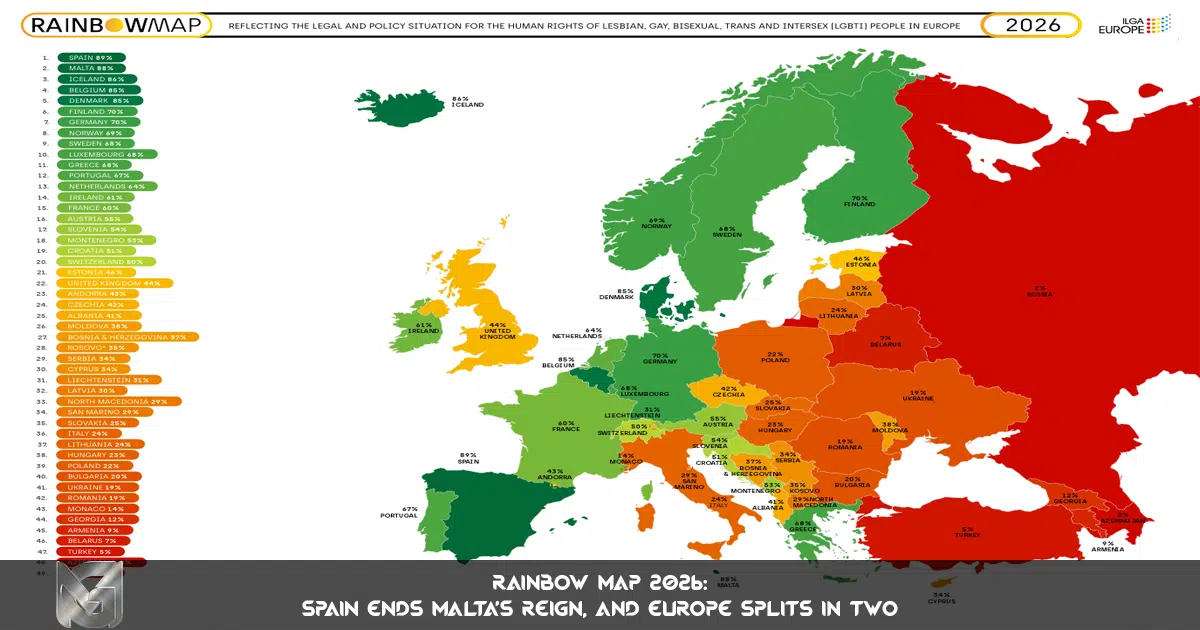
Rainbow Map 2026 is out, and for the first time in a decade the name at the top is not Malta. ILGA-Europe, the European umbrella organisation for LGBTI rights, published its 18th annual ranking on 12 May 2026, and Spain now leads the 49 countries assessed with a score of 89%. Behind that headline sits a more uncomfortable picture: a continent where a handful of countries keep moving forward while others write discrimination into their constitutions. Here is the full ranking, who climbed, who slipped, and what it tells you about travelling and living as an LGBTQ+ person in Europe today.
How the ranking works
For the Rainbow Map 2026, as every year, ILGA-Europe scores each country from 0% (gross violations of human rights) to 100% (full equality), based on laws and public policies in force. The criteria are grouped into seven areas: equality and non-discrimination, family, hate crime and hate speech, legal gender recognition, intersex bodily integrity, civil society space, and asylum.
It is important to understand what the map does not measure. It does not count Pride parades, gay bars or how friendly a hotel feels. It measures the law. A country can have a lively scene and a weak score, or the reverse. Last year we explained the method in detail in our analysis of the 2025 edition, and the grid has not fundamentally changed since.
The Rainbow Map 2026 top 10
The head of the table is tight. Only one point separates first and second place, and the next three countries sit within four points of the leader.
- Spain, 89%
- Malta, 88%
- Iceland, 86%
- Belgium, 85%
- Denmark, 85%
- Finland, 70%
- Germany, 70%
- Norway, 69%
- Sweden, 68%
- Luxembourg, 68%
Look at the gap between fifth and sixth place: fifteen points. The Rainbow Map 2026 confirms that five countries form a leading group of their own, well ahead of the rest of Western Europe.
Spain, from fifth to first
In 2025, Spain was fifth with 78%. One year later it takes the lead with 89%. ILGA-Europe credits a combination of measures: a fully functioning depathologisation of trans identities in healthcare, new legal protections, new national LGBTI and trans strategies, and a new independent authority for equal treatment and non-discrimination. The organisation also highlights the determined fightback against far-right attempts to dismantle the country’s trans protections.
We have already looked at what this first place means for travellers and expats in our article on Spain as Europe’s No.1. But a legal ranking is not a safety guarantee. ILGA-Europe itself warns about rising assaults against LGBTI people in Spain, a paradox we covered in our piece on LGBT hate crime in Spain.
Malta, second without going backwards
Malta drops from 89% to 88%. According to ILGA-Europe, its loss of first place is not linked to any rollback. It reflects stagnation, a lack of new reforms, in an index where countries clustered at the top can swap places over very small differences. For a country that pioneered the ban on conversion practices and the protection of intersex children, second place is still a remarkable result.
The biggest risers of the Rainbow Map 2026
Several countries made real progress, and the reasons are concrete.
Czechia, up six places
Czechia is one of the big winners of the Rainbow Map 2026, climbing from 30th to 24th, and from 33% to 42%. The main reason: legal gender markers can now be changed without sterilisation, surgery or hormonal treatment. Czechia had been the last country in the European Union to impose that requirement. Latvia made the same change and moves from 26% to 30%.
San Marino, the largest jump
The small republic makes the biggest leap of the year, from 42nd to 34th, and from 15% to 29%. Its criminal code now protects people against hate crime and hate speech based on gender identity.
Denmark, Iceland and Sweden
At the top of the table, progress continues too. Denmark goes from 80% to 85%, Iceland from 84% to 86%, and Sweden gains three places to reach ninth position.
Who is slipping
Not every country is moving in the right direction, and some declines are the result of deliberate political choices.
Slovakia and the “two sexes” amendment
Slovakia falls to 35th place with 25%. Constitutional amendments recognising only two sexes have made legal gender recognition impossible. It is a textbook case of a rollback written into the highest law of the land.
The United Kingdom keeps sliding
In the Rainbow Map 2026, the UK sits 22nd with 44%, compared with 46% a year ago. The country, which led the ranking about a decade ago, lost a point on the automatic recognition of co-parents after a High Court ruling concerning trans men.
Belarus, Georgia and Turkey
Belarus falls from 10% to 7% after its president signed an anti-LGBTI propaganda law modelled on Russia’s. In Georgia (12%), legal and administrative measures increasingly restrict access to funding for civil society organisations. In Turkey (5%), obscenity provisions are used against LGBTI defenders.
The bottom of the Rainbow Map 2026
At the other end of the scale, the last places have barely changed. Monaco (14%), Georgia (12%), Armenia (9%), Belarus (7%) and Turkey (5%) come just before the two countries tied at the bottom: Azerbaijan and Russia, both at 2%. In Russia, LGBTI organisations were designated as “extremist” for the first time.
Among the founding members of the European Union, Italy stands out for the wrong reasons: 36th with 24%, and ILGA-Europe notes that the national government actively blocks protections adopted by regions and cities. France, 15th with 60%, loses one point compared with 2025.
Hungary, the story that moved after the map
Hungary is 38th in the Rainbow Map 2026 with 23%, exactly the same score as last year. But its situation has changed a lot since. On 21 April 2026, the Court of Justice of the European Union ruled that the 2021 anti-LGBTI propaganda law breached EU law and the values of the Union, a first of this kind. Then, on 14 September 2026, the new government of Peter Magyar submitted a bill to Parliament removing the restrictions on the portrayal of sexual and gender diversity, including the provision used in 2025 to try to ban Budapest Pride.
Human Rights Watch welcomes the reform but notes that much remains to be done: same-sex marriage is still banned, and legal gender recognition has been closed since 2020. The Rainbow Map 2027 will tell whether Hungary finally starts to climb.
What to take away
The Rainbow Map 2026 tells two stories at once. On one side, countries like Spain, Czechia and San Marino show that political will translates quickly into real protections. On the other, a growing group uses constitutions, propaganda laws and funding rules to push LGBTI people out of public life. For travellers, the ranking is a useful compass rather than a guide: it tells you where the law protects you, not where the welcome is warmest. For everyone else, it is a reminder that rights won can also be lost.
For comments or projects, please contact me.